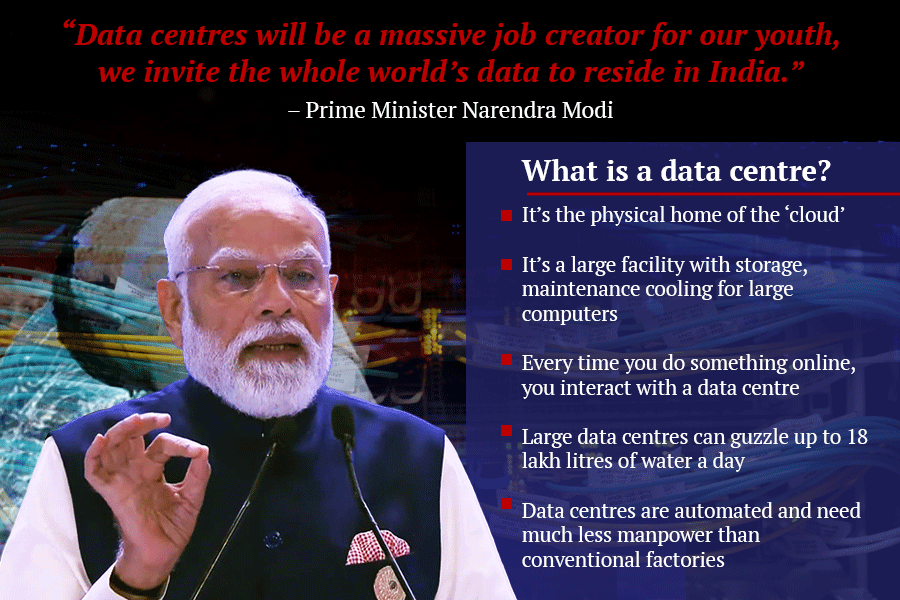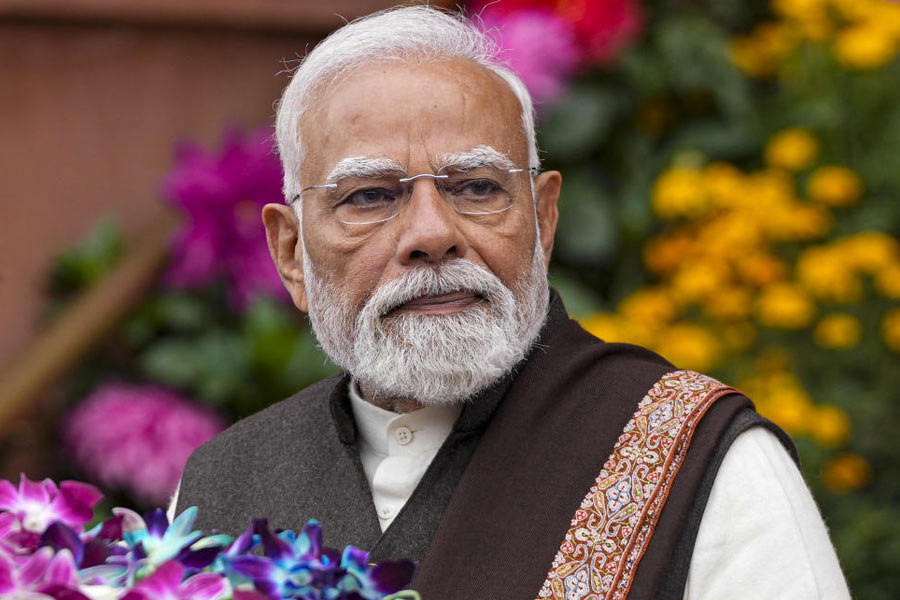
Prime Minister Narendra Modi on Thursday proposed the watermarking of AI-generated content to curb deepfakes, cautioned that humans must not become mere data points for artificial intelligence, and suggested that AI must be democratised into “a tool for inclusion and empowerment”.
“Humans must not become mere data points or raw material for AI, and therefore AI must be democratised. It must become a tool for inclusion and empowerment, particularly for the Global South,” Modi said while inaugurating the AI Impact Summit here before a galaxy of heads of state or government and tech leaders.
“We must give AI an open sky but at the same time we have to keep the command in our hands. Like GPS,” he added, underlining that GPS shows the route but leaves the final decision to the user.
Modi also presented India’s Manav (an acronym that means human) vision for AI.
He explained that the “M” stood for moral and ethical systems; the first “A” for accountable governance; “N” for national sovereignty, particularly relating to data ownership; the second “A” for accessible and inclusive; and “V” for valid and legitimate.
Modi said deepfakes and fabricated content were destabilising open societies, and that “watermarking and clear source standards are becoming necessary to ensure transparency as AI increasingly generates text, images and videos”.
“Trust must be built into technology from the start,” the Prime Minister said, recommending that digital content carry authenticity labels so that people can distinguish between real and AI-generated material.
Modi asserted that AI was a transformative power — left directionless, it could lead to disruption, but with the right direction, it could become a solution.
Modi said the core purpose of the India AI Impact Summit was to deliberate on how AI could be made human-centric rather than machine-centric, and how it could be made sensitive and responsible.
French President Emmanuel Macron, delivering his keynote address, praised India for generating a digital identity for 1.4 billion people, a payment system processing 20 billion transactions every month, and a health infrastructure that had issued 500 million digital health IDs.
Macron appealed to Modi to join the club of countries that had banned social media for children under 15 years. He said that as the current G7 chair, he would work towards ensuring the protection of children against AI and digital abuse.
“This is why in France we are embarking on a process to ban social networks for children aged under 15 years. We are committed in this journey with several European countries being present here today, (including) Greece, Spain,” he said.
Appearing to address Modi, he said: “I know, Mr Prime Minister, you will join this club. This is great news that India will join such an approach in order to protect children and teenagers. We stand ready to take all necessary actions to ensure that our young citizens are truly safe.”
Modi, in his address, too stressed the importance of child safety and said: “Just as school syllabi are curated, the AI space must also be child-safe and family-guided.”
United Nations Secretary-General Antonio Guterres said the future of AI could not be decided by a handful of countries or left to the whims of a few billionaires. He asserted that AI must be accessible to everyone.
Google CEO Sundar Pichai said that AI marked the biggest platform shift of our lifetimes.
“We are on the cusp of hyper progress and new discoveries that can help emerging economies leapfrog legacy gaps. But that outcome is neither guaranteed nor automatic,” he said.
“To build AI that is truly helpful for everyone, we must pursue it boldly, approach it responsibly and work through this defining moment together.”
Tata Group chairman N. Chandrasekaran said his company was in the process of adopting AI across the stack while also looking to produce chips for multiple industries, with the first set expected to cater to the automotive sector.
The February 16-21 AI Impact Summit is hosting 500 global AI leaders, including around 100 CEOs and founders, 150 academics and researchers, government representatives and more than 20 heads of countries.