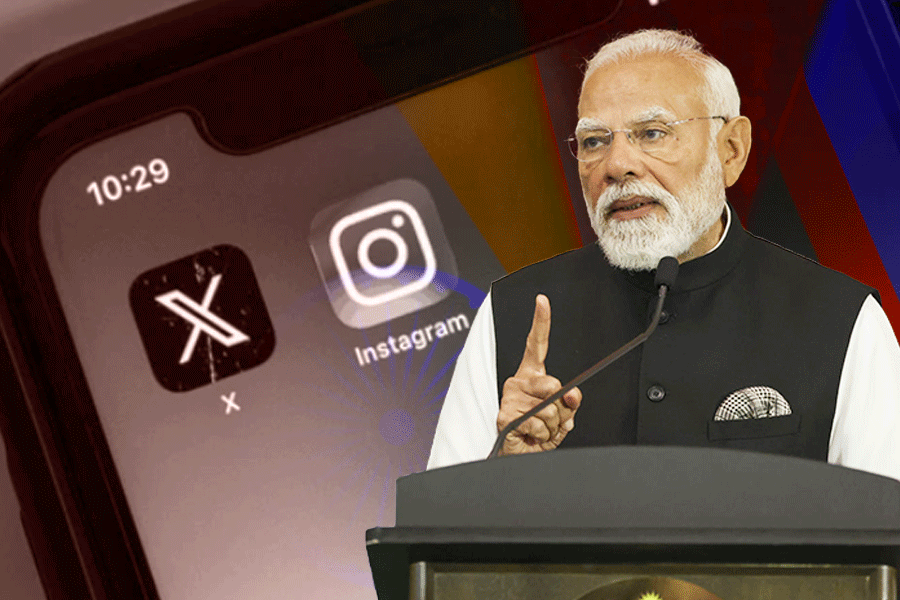
A joint order issued by Darbhanga district magistrate Chandrashekhar Singh and senior superintendent of police Satyaveer Singh on September 28 states that legal action will be initiated under relevant sections of the IPC, Cyber Act and the Information Technology (IT) Act if the administrator of any social media group violated the law.
The copies of the letter were also sent to the divisional commissioner, the inspector-general of police, the deputy inspector-general of Darbhanga range, deputy superintendents of police and the station house officers of the district. The administrators of all the groups on social networking sites were also informed about the administration's initiative.
'Of late, the police have been facing law and order situation due to circulation of fake, objectionable and factually incorrect content on WhatsApp. This, in turn, had triggered tension among religious groups. Therefore, the district police administration has now come out with a diktat to crack down on admins of these groups,' said Darbhanga additional superintendent of police Dilnawaz Ahmad.
He said social media platforms allowed a person to create a group on which members can share views, photographs or videos. 'The administration has expressed its concern about social media misuse as fake news, morphed photographs and disturbing videos with fabricated local narratives can easily be circulated, which may trigger tension and even communal flare-up in the area,' ASP Ahmad clarified.
According to the joint order issued by the DM and the SSP, any factually incorrect, rumour or misleading information on social media groups could result in an FIR against the group administrator. There are several groups on social networking sites, which are named on news groups and also groups with other names, which are propagating news and information that are not authentic. 'Such information are being forwarded without cross checks,' the order, a copy of which is with The Telegraph, said.
A police officer posted in Darbhanga revealed that considering the matter, directives have been issued to those running social media groups such as WhatsApp, Facebook and Twitter to doubly cross check before the matter was uploaded. The joint order directed the social media group administrators to be ready to bear the responsibility and ownership of the groups, the officer pointed out.
The administrator must include only those in the group who are personally known to him or her. The group administrator should contradict the news if any wrong information is pasted on the site, delete objectionable content and remove the member from the group, the order said, adding that 'In the event of inaction from the group admin, he or she will be held guilty and action will be taken against the group admin.'
In addition, such information posted on the site should also be reported to the nearest police station so that action could be taken against the member under the law, the order said. At the same time, the order admitted that social media and freedom of expression were important.
The legal actions included cases under sections 153 A, 295 (spreading hatred) and 505 1(B) of the IPC, 'which forbid making or publishing any statement, rumour or report with intent to cause, or which is likely to cause, fear and alarm to the public, or to any section of the public whereby any person may be inducted to commit an offence against the State or against the public tranquillity.'
A Patna High Court lawyer, Rajesh Ranjan Kumar Pandey, however, said in December last year, a Delhi High Court order had ruled that admins cannot be held liable for content posted by any other member of the group.
Additional director-general (headquarters) S.K. Singhal said districts were free to take decisions as per the situation. 'The district police have to act according to the situation. They can assess the situation in a better manner and take appropriate action,' he told The Telegraph.
The Vaishali district administration also vouched for such legal action. 'The move comes in the wake of communal tension, which gripped several districts of the state in the3 recent past,' said a senior IAS officer.