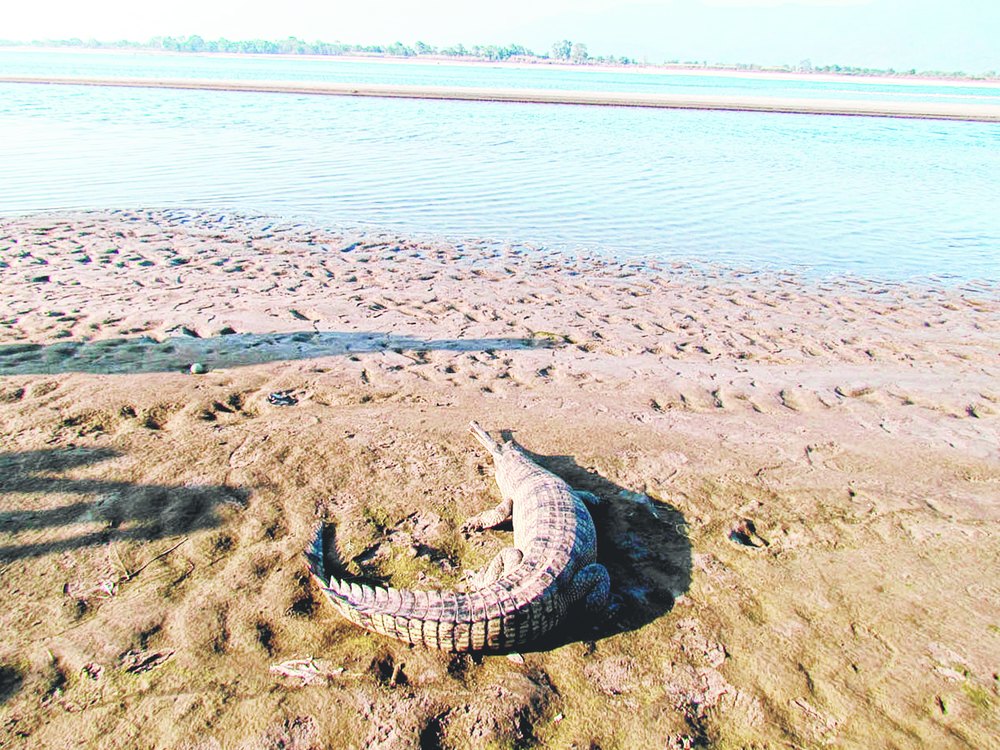

A gharial being released in the Gandak near Valmikinagar on Wednesday. Telegraph picture
Twelve captive gharials were rehabilitated in the wild this week as part of a plan to restore the critically endangered reptile in the ecosystem of the Ganga and its tributaries.
Wildlife Trust of India (WTI) released the gharials ( gavialis gangeticus) in the Gandak near Valmikinagar, around 290km northwest of Patna, on Wednesday.
The rehabilitation project is part of the state government's plan to restore this critically endangered reptile in the ecosystem of the Ganga and its tributaries. Gandak, a tributary of the Ganga, has been selected for the work because around 50km of the river passes through the Valmiki Tiger Reserve. Besides, the Gandak banks in this stretch are free of human interference, allowing the gharials to settle down in their new habitat.
In April last year, a similar rehabilitation work was undertaken by the wildlife organisation. Then six gharials were released in the Gandak. Spurred on by its success, the second round of rehabilitation work was taken up.
Another lot of 12 gharials would be released in the wild next month. So, the government would release a total of 30 gharials in the wild. The environment and forests department has sanctioned over Rs 23 lakh for the project.
The regional head of WTI, Samir Kumar Sinha, who is supervising the gharial rehabilitation project, told The Telegraph on Thursday: 'Sattelite data from the first batch of the gharials revealed that one of them moved in to the Sone, another tributary of the Ganga. The other gharials released last year are within 70-80km from the release site and appear to have settled well in their new habitat.'
The gharials already released and those to be rehabilitated are all from Patna zoo, which has over 70 of these reptiles now.
'Before rehabilitation of the captive gharials in the wild, we acclimatise them. We feed them live fishes and keep them away from public enclosures for about three months,' said the state's chief wildlife warden, Bashir Ahmed Khan.
Sharing details of the monitoring process, Samir said: 'One of the gharials in the first batch had been released with a satellite tag allowing us to access regular information on its movement. Our team also physically monitors the river every fortnight. The released gharials are identified by a special mark made on them by cutting the tail scute.'
Happy with the rehabilitation exercise till December, the International Union for Conservation of Nature vice-chair of Asia region for crocodilians, B.C. Choudhary, said: 'This current project period would end in May. The Bihar government should extend the period by at least a year so that the rehabilitated gharials can be regularly monitored for a longer duration.'
The environment and forests department is, however, non-committal so far as extending the project period was concerned. 'Let the outcome of the project implementation come to us. We would take any call on extending the project period only after studying the reports,' said chief wildlife warden Khan.