|
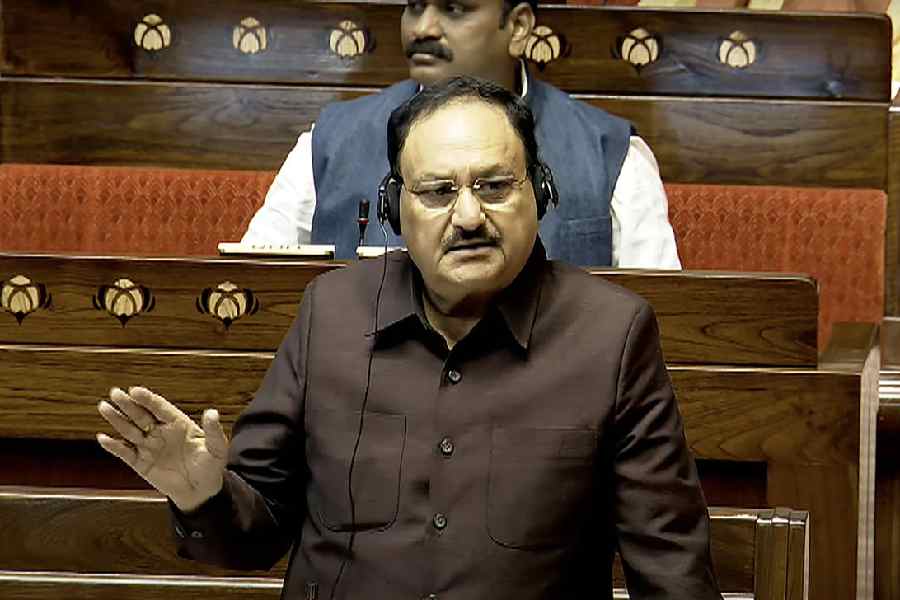
| PS Ramakrishna, faculty member of School of Environmental Sciences, Jawaharlal Nehru University, New Delhi, addresses the meet at Chandragupt Institute of Management, Patna, on Tuesday. Picture by Nagendra Kumar Singh |
Patna, May 3: Sustainable food security could be achieved by linking traditional and indigenous modern agricultural practice.
With this theme, a consultative workshop “Sustainable agriculture: traditional indigenous knowledge systems and food security” was organised by Nabard and Unesco, at Chandragupt Institute of Management, Patna (CIMP).
The participants at the workshop focused on various aspects of traditional and indigenous aspects of agriculture. Speaking on the occasion, the chief general manager of Nabard, V. Mohandas, said: “Green revolution was a great success. Along with the increase in agricultural output, it also brought few environmental hazards such as decrease in fertility of soil and increase in its salinity.”
The Nabard expert cautioned that as the second green revolution is about to start in states in eastern India, including Bihar and Bengal, the mistakes of the first should not be repeated. “In the second green revolution, emphasis should be given in the use of manures instead of using chemical fertilisers,” he said.
The Narbard chief also highlighted the utilisation of the watershed committee in agriculture. The watershed committee is a group of volunteers mainly from villages working for the protection and conservation of water.
Das said: “Nabard is working for the conservation of water in Bihar and for this, eight drought-prone and Naxalite-affected districts of south Bihar have been chosen. Here, villagers are encouraged to conserve water as these areas receive scanty rainfall as compared to the flood-prone areas of north Bihar.”
Das highlighted the issue of sustainable development among the tribes as they are mainly involved in shifting agriculture. He said as it has been generally found that tribes keep shifting from one place to another in search of agricultural land, effort should be put in to encourage them to go for cultivation of such crops that takes time to give fruits.
Director of CIMP V. Mukunda Das inaugurated the workshop. P.S. Ramakrishna, a faculty member of School of Environmental Sciences, Jawaharlal Nehru University, New Delhi, also spoke at the event.