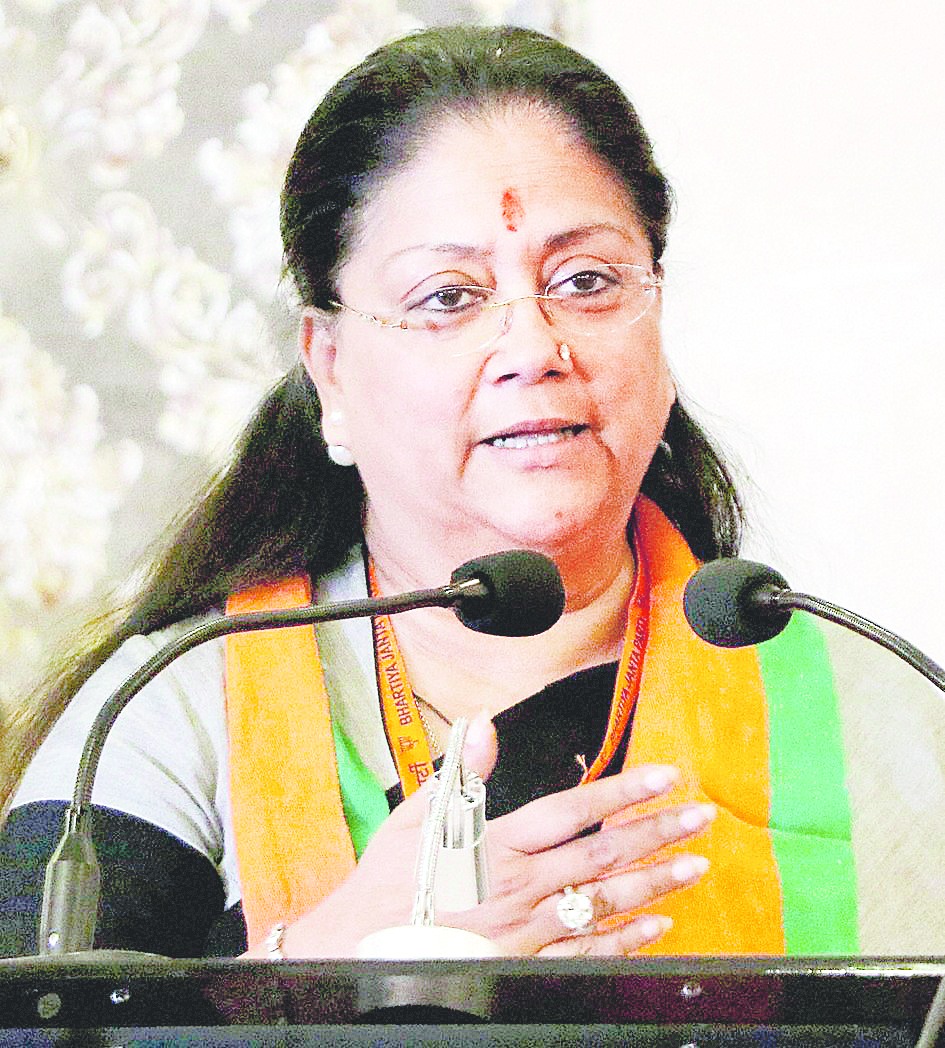

The BJP called Vasundhara Raje’s move to legislate 14 per cent reservation to the “economically deprived backward classes” among the upper castes a “trial balloon” and claimed that other states could emulate the idea if it took off in Rajasthan.
“We will see the implications in Rajasthan, how it works out,” Union minister Prakash Javadekar told the media at a BJP press briefing today. Another party source said the Rajasthan chief minister’s decision was indeed a “trial balloon”.
The Rajasthan government also passed another bill granting 5 per cent quota in education and jobs to the special backward classes, including the Gujjars who had demanded reservation for several years.
BJP sources said although Vasundhara’s step was a response to quell the threat of another Gujjar agitation in October — the last time she was the chief minister, the Gujjar uprising turned violent after the protestors clashed with the tribal Meenas — the long-term implications were not lost on the party.
The Rajasthan government’s decision came days after the RSS “sarsanghachalak” Mohanrao Bhagwat had stated in an interview to Organiser and Panchjanya that reservation for the socially backward classes (that is the other backward classes as against the Dalits and tribals, constitutionally deemed as backward on three quotients, education, economics and social) had been “politicised” and called for a re-look to see which categories required reservation and for how long.
Asked if Bhagwat’s proposals and Vasundhara’s decisions were coincidental, Javadekar said: “The issue of 50 per cent reservation (for the SCs, STs and OBCs) is non-negotiable. But other affirmative steps can follow. The difference is while the OBCs are regarded as socially backward, the economic criterion can apply to sections of the upper castes.”
Notwithstanding a long-term blueprint, the BJP had a big problem on its hands. As its Bihar adversaries unleashed a campaign, charging the RSS and the BJP of harbouring an agenda to do away with OBC and SC/ST quotas, Javadekar’s response was: “Why have Lalu Prasad and Nitish Kumar joined hands with Manish Tewari and Jitin Prasada of the Congress who have advocated change on reservation policy? Why only ask the RSS to clarify?”
Former UPA ministers Tewari and Prasada had advocated revisiting the reservation policy, the former in a newspaper article and Prasada in a news interview. Prasada, a former Uttar Pradesh MP, suggested that it was time to weed out the OBCs who had benefited from quotas.
The BJP’s deeper context for stirring a debate on expanding reservations, despite the possibility of a backlash from the non upper castes in Bihar, was ironically the fear that if it overplayed the OBC-Dalit card in the elections, its upper caste voters may be put off.
“There is a text for every context. On the day some of our leaders began flaunting the giving away of tickets to 22 Yadavs, so many EBCs etc, our feedback was the Brahmins, Bhumihars, Rajputs and Kayasthas got restive. We had to mollify them too,” a general secretary said.
The Constitution, however, does not yet recognise economics as a sole criterion to adjudicate which caste merits quotas just as it has excluded religion as a yardstick.
BJP sources claimed that if it came to that and a political consensus was evolved on earmarking a quota for sections of the upper castes, the government could consider amending the Constitution to achieve the objective.
“It is a long haul,” a BJP source admitted, adding that the validity of the Rajasthan laws were subject to judicial scrutiny because of the Supreme Court’s 50 per cent ceiling on reservations.
Tamil Nadu was the only state to buck the apex court’s limit because the Supreme Court has permitted it to extend its policy of 69 per cent reservation. Odisha, Karnataka and Maharashtra have similar quotas but these have been stayed legally.
Like Tamil Nadu, Maharashtra, Odisha and Karnataka, the Rajasthan government hoped to get its two bills included in Article 31B of the Ninth Schedule of the Constitution. The provision was meant to immunise laws contained in the Ninth Schedule from judicial scrutiny.
There was a catch: in 2007, while hearing the IR Coelho vs the State of Tamil Nadu case, the apex court ruled that laws that threatened to violate the basic structure of the Constitution would be open to judicial review. This was the ground for striking off the quotas in excess of 50 per cent in Odisha, Maharashtra and Karnataka.
GRAND ALLIANCE LIST
Following are the Grand Alliance candidates announced till September 23.
Only candidate for Rajgir is yet to be declared by the JDU