|
| Sonia Gandhi (left) at Lalu Prasad’s daughter Hema’s wedding ceremony in New Delhi on Sunday night. (PTI) |
Patna, March 12: Bitter rivals in politics can continue to share personal rapport.
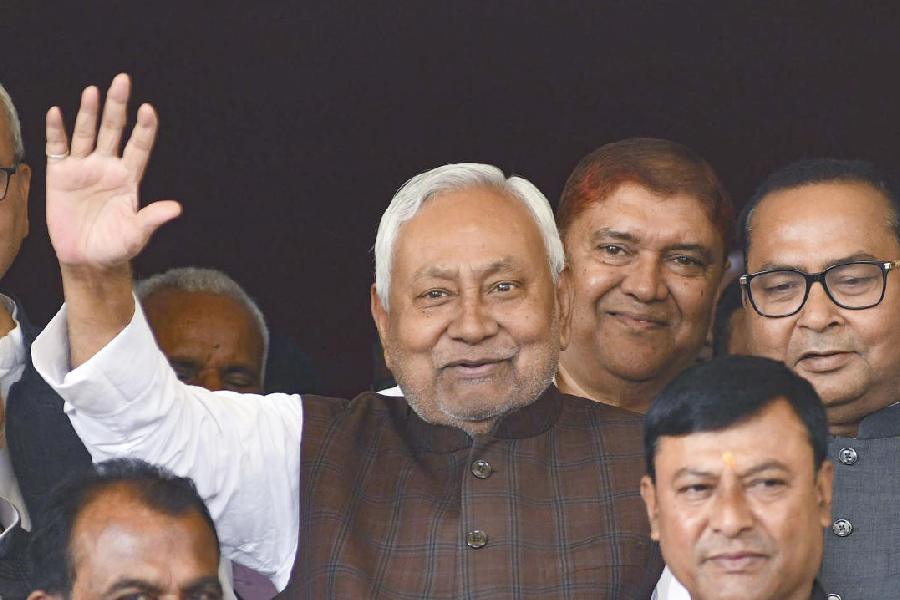
The relationship between chief minister Nitish Kumar and RJD president Lalu Prasad suggests that the two — friends since the JP movement in the seventies when they were students — have kept their personal equations afloat in spite of being locked in a fierce political tussle for over one-and-a-half decades.
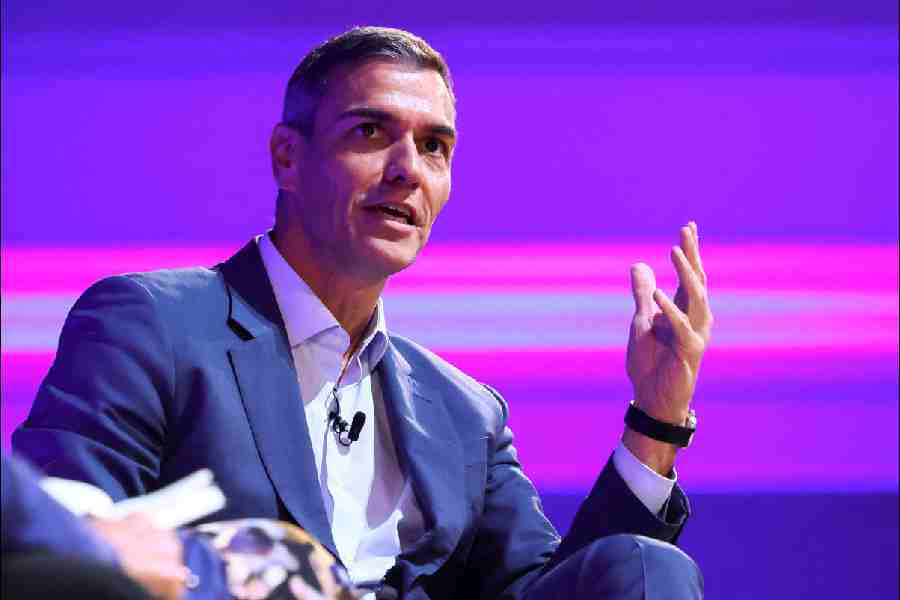
Nitish yesterday attended the wedding of Lalu Prasad’s fifth daughter, Hema, at the RJD chief’s 25 Tughlaq Marg residence in New Delhi. He stayed for over an hour at the ceremony that was graced by, among others, Prime Minister Manmohan Singh, UPA chairperson Sonia Gandhi, leader of Opposition in the Lok Sabha Sushma Swaraj, Lok Sabha Speaker Meira Kumar and Uttar Pradesh’s chief minister-designate Akhilesh Yadav.
Given the manner in which the two Bihar stalwarts have conducted themselves — while working together (from 1974 to 1994) or on opposite sides of the political spectrum (since 1994) — both leaders have been cautious to keep their personal relationship separate from their political differences.
This is not the first time that Nitish has attended a wedding hosted by Lalu Prasad. He was present at the marriage of Lalu’s first daughter, Misa, at 1 Aney Marg in Patna — Nitish’s current address then occupied by Lalu Prasad and Rabri Devi — in December 1999 when the bitterness between the Nitish-led Samata Party (now defunct) and Lalu’s RJD was at its pinnacle.
It was the time when Lalu Prasad had come out of jail after spending months in prison in connection with fodder scam cases and several leaders from the Samata Party were fighting court battles against him. Even at that time, Nitish had refrained from making personal attacks against Lalu. “Ours is a political battle. We want to replace the regime (Lalu-Rabri’s) politically. Let the law and courts take their course,” was all that Nitish would say when asked to comment on Lalu’s involvement in the scam.
On his part, Lalu visited 1 Aney Marg to attend the prayer meeting organised by Nitish following the death of wife Manju Devi in 2007, two years after the RJD was ousted from power. Lalu, his eyes moist, put his arms around Nitish to console his friend.
Again, on January 1, 2011, Lalu, who was in Bhubaneswar then, learnt about the death of Nitish’s mother Parmeshwari Devi. “It amounts to the death of my own mother. It is a personal blow to me,” the RJD chief had said, the grief showing in his voice.
The relationship often became tenuous, especially during election campaigns. But the two were quick to act to repair the damage. For instance, Rabri Devi — not so adroit in managing the state’s political culture — made a personal attack on Nitish while campaigning in Chhapra ahead of the 2009 Lok Sabha polls. Then state JD(U) president Lallan Singh, who was close to Nitish, made it an issue, and filed a petition against Rabri Devi in Patna High Court. But Lalu soon disassociated himself from Rabri’s remarks. Asked to comment on his wife’s utterances, Lalu hurriedly quipped: “Nitish hamarey chhote bhai hain. Isse jyade hum kuchch nahin bolenge (Nitish is my younger brother. I won’t speak beyond that).” Nitish too did not speak a word on what Rabri said.
Nitish’s elder brother Satish Kumar has several anecdotes on the family’s relationship with Lalu Prasad. Satish, while sharing his experiences with The Telegraph recently, said: “Lalu munh nahin chhipate hain. Jab bhi idhar se gujarte hain bhaiya bhaiya bolte ghus jate hain aur bina phankiya khaye nahin jate (Lalu never turns his face. Whenever he passes through my place, he barges into my home shouting bhaiya, bhaiya and never returns without taking phankiya, an ayurvedic concoction).”
Though sharply different in their demeanours, the two leaders have mattered more in Bihar’s annals than anyone else. A recent biography of Nitish has dealt at length on how Lalu had begun referring to Nitish as his chhota bhai (younger brother) in a well-nuanced political move to show his affection for Nitish and at the same time send the impression that Nitish was after all “smaller” to him and how Nitish too had started calling Lalu his “bara bhai (elder brother)” in the eighties.
As recently as in 2008, Lalu, then railway minister, gave money for the relief of the flood-stricken people of Kosi region to Nitish. The chief minister, addressing a joint news conference with Lalu, had said: “I am happy that bara bhai Laluji has come with relief money for the inundated people.”
Then Nitish had taken Lalu for a round of the Samvad Bhawan that the government had renovated. Lalu had smiled, chirping: “He (Nitish) has done everything for me to occupy it later.” Nitish let a smile do the talking for him.