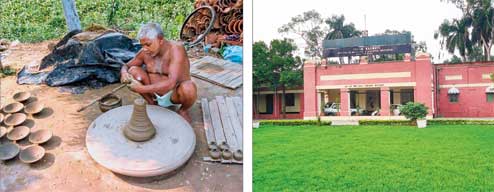

A dying age-old tradition and a more recent engineering marvel are both battling for survival in picturesque Munger region, flanked by the Ganga in the north and the Kharagpur hill range in the south.
If the kumhars (potters) at Bihar's biggest potter village in Kumhartoli no longer find their ancestors' vocation a viable source of sustenance, the Indian Railways Institute of Mechanical and Electrical Engineering (IRIMEE) is set to become history as the railway ministry has decided to pull the plug on it. Sources said the ministry has written to the Union Public Service Commission (UPSC) to stop recruitment to the 80-year-old elite institution.
For 80 years, the institute - housed on the campus of the Asia's oldest railway workshop set up in 1862 at Jamalpur - has been producing some of the world's best railway engineers, through the SCRA exam. Those attached with these two dying vocations have similar grouses in the run-up to elections.
Arun Pandit (66), busy making pots on his chak (barn stone), said: "I am the last person in my family to carry on with the earthen pot-making that has become more a source of loss than gain. My two sons are working in garages. I am making some diyas [lamps] and children's play-pots as Diwali and Chhath are round the corner."
Asked if he had fond memories of the time when Lalu Prasad had, as railway minister in the first UPA government, introduced kulhars to serve tea in trains, Arun shot back: "Happy? It was the worst phase. Lalu's railway sourced the kulhars from the market controlled by big traders. Businessmen bought our kulhars at Rs 30 a hundred and supplied them to the railways at Rs 60 a hundred. The businessmen prospered, we remained where we are. Lalu hamaray baray mein socha hoga, lekin bhari bewakoof thaa [Lalu might have thought about us, but was utterly foolish]."
Asked what he thinks about Prime Minister Narendra Modi campaigning more than any of his predecessors for the Bihar Assembly elections, Arun said: "U to desh videsh ghurte rehta hai, lamba lamba bhashan deta hai, U ka karega? [He keeps travelling around the world. Gives long speeches. What will he do?]"
Arun was equally unsparing of chief minister Nitish Kumar. "Earlier, we got earth and water for free for our trade. Over the years we are forced to buy everything to prepare earthen pots. Earlier, customers used to buy directly from us. Now, we are prohibited from setting up stalls in the market and have to sell our commodities at a price dictated by businessmen. Nitish has hardly done anything to help us in this trade that has sustained us for centuries," Arun said.
Who will he vote for then? "Vote to Nitish-e ko hi dengein [But we will vote for Nitish only]," said Arun. Note that he addressed the chief minister as Nitish-e, the way Nitish's election strategist Prashant Kishore has coined the catchphrase "Bihar mein Bahar ho, Nitish-e Kumar ho".
But why would Arun - the elderly member of an extremely backward class community spread across 300 houses on the northern outskirts of Munger - prefer Nitish? "See the roads in front of our houses? The electric bulbs in our homes, the cycles and scholarship our children have? If someone has done something, if not everything, for us it is Nitish," he replied.
His niece, Rupa Kumari (19), a BA student at a local college who assists him in pottery, too, hoped Nitish would fulfil their aspirations. "The scholarship and cycles Nitish gave us helped us pass school-level exams. I want to join the police service after graduation," she said, perhaps hoping that Nitish's decision to reserve 35 per cent seats in government departments, including police, for women would see her through.
Pintu Kumar (24), a graduate and Arun's and Rupa's neighbour, who was preparing for the railway travelling ticket examiner (TTE) and assistant station master (ASM) examinations, was greatly disappointed with Prime Minister Modi.
"I voted for him as he promised he would give us jobs. I
completed my graduation and began taking coaching for TT and ASM exams when Narendra Modi formed his government, about one and half years ago. But the railways have not announced any vacancies
for the posts in the past 14 months," Pintu said.
Generation Next here has largely abandoned their ancestors' vocation, embracing education to carry on with their lives. Nearly 200 youths in Kumhartoli, which has a population of 2,000, go to schools, colleges or are preparing for competitive examinations for government jobs, preferably in the railways, a dream shared by many in the twin cities of Munger and Jamalpur. Kumhartoli has around 30 people working as track mechanics, fitters or doing other grade III or IV jobs in the railways.
Barely 8km south of Kumhartoli is the huge railways establishment, housing 150-year-old diesel engines, smart coaches, jacks and a crane-producing workshop at Jamalpur.
Besides, there is the IRIMEE. Its 2,700-quarter colony accommodates India's top-ranking railway engineers, officers and Grade III and IV employees.
"I am a product of IRIMEE. I left IIT-Bombay in 1982 to join IRIMEE through the SCRA exam conducted by the UPSC. I don't regret leaving IIT, as my job has given me everything I aspired for," said A.K. Sinha, chief manager of the workshop, adding: "Almost all present and past students had joined IRIMEE through SCRA after leaving the IITs. IRIMEE products are, by far, better engineers - particularly in the context of Railways - than IITians or other engineering college students."
IRIMEE director A.K. Gupta said: "I, too, had left IIT-Kanpur to join
IRIMEE in 1977. It gives me great satisfaction to be heading my alma mater. The institution has produced several top level personalities including environmentalist R.K. Pachauri, VSM (in action) M.L. Khanna, Berlin Olympics champion G.P. Bhalla and scores of Railway Board chairmen and members."
All four students who joined the latest batch of IRIMEE had left the IITs to join it. "Last year, I left IIT-Kharagpur to join IRIMEE through SCRA. I aspired to join the civil services. But SCRA offers one an opportunity to join a position equivalent to a civil servant after clearing one's Plus-II exams. We get posted as Class I officers after IRIMEE," Abhilash, a fresh student, said.
The pain shared by Kumhartoli's kumhars and wannabe technocrats who are losing a traditional asset in Jamalpur is almost the same. But the political preferences of the two disgruntled communities are vastly different. Unlike Rupa of Kumhartoli, who sees hope in Nitish, Abhilash said: "We prefer Narendra Modi. He talks about Digital India, something we can connect with." The officers and engineers, of course, were not ready to talk of their political preferences for they are "bound" by the model code of conduct.
Few things Munger - which has three Assembly segments, namely Munger, Tarapur and Jamalpur - can still take pride in include the Munger School of Yoga and Nawab of Bengal Mir Quasim's fort, which the British conquered to complete their seizure of the East after the battle of Monghyr.
Munger votes on October 12