|
 |
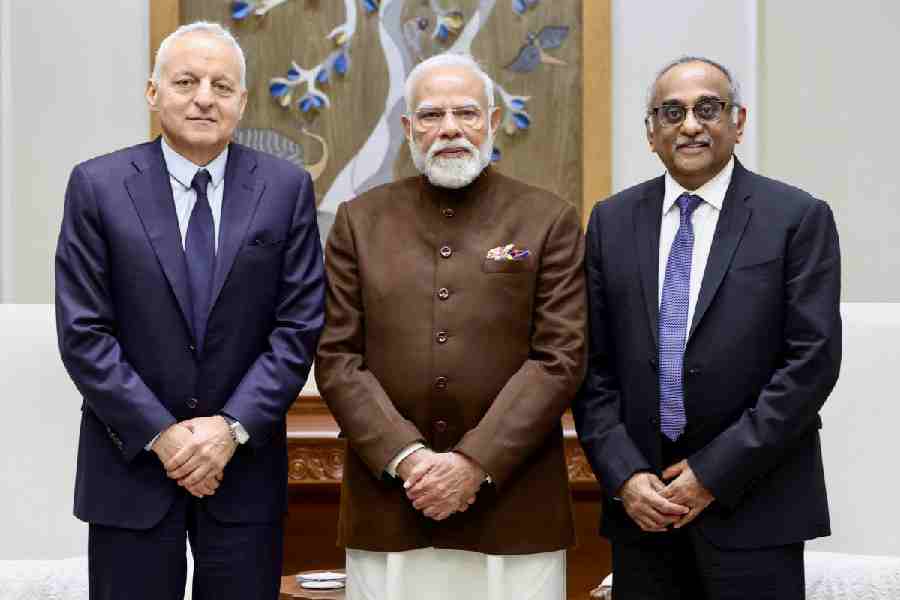
| Nitish Kumar and Manmohan Singh |
Patna, Feb. 20: Nitish Kumar today officially joined the chorus of chief ministers in opposing the National Counter-Terrorism Centre (NCTC), a pet project of Union home minister P. Chidamabaram which has become a symbol of alleged central transgression into states’ territories.
The Bihar chief minister has written to Prime Minister Manmohan Singh asking him to re-examine the creation and necessity of NCTC.
Last week, Mamata Banerjee, Naveen Patnaik and Narendra Modi — the chief ministers of Bengal, Odisha and Gujarat respectively — wrote separate letters to Singh opposing NCTC. Tamil Nadu’s Jayalalithaa too had publicly spoken out against the home minister’s decision. Naveen today wrote a second letter to Singh, clarifying he had no intention of politicising the issue but he was opposed to the “high-handed” attitude of the Centre.
Nitish, who had been busy with the global summit on “Changing Bihar” from Friday, did not speak on the issue for the first two days. On Sunday, when the event ended, he shot off the letter to Singh.
The chief minister has been consistent in his opposition to several central government decisions, which, he believes, erode the powers of the state. On Monday itself, he asked MPs of Bihar to oppose the Centre’s proposed seed bills. Nitish has time and again asked Delhi to cut down on centrally sponsored schemes, insisting that states must have a final say on what they want. His mood against the Centre was reflected at the global summit when he declared that Bihar would develop on its own steam.
In his letter to the Prime Minister dated February 19, Nitish has urged the Centre to re-examine the issue of creation of NCTC, scheduled to come into existence from March 1.
“We are aware that chief ministers of several states have written to you against the unilateral and hasty decision of MHA (ministry of home affairs) to create NCTC without consulting the state governments. Won’t you agree with the suggestion that government of India must re-examine the whole issue and ensure that the order is suitably modified to take care of the states’ genuine concerns?” reads the letter.
It says that creation of NCTC is highly flawed as it has been set up within the Intelligence Bureau (IB), an organisation without any accountability to Parliament.
“Is it not an established principle that secret intelligence agencies are never given the powers of arrest? Not even the British, during their rule over India, gave the powers of arrest and search to IB. None of the post-Independence Indian governments have done so till date. Why then such powers are sought to be given to intelligence agencies which will remain prone to misuse?” says the letter.
The missive hints at the NCTC being used against political opponents: “You are aware that eminent political leaders were branded as threats to national security and put behind bars during emergency of 1975-77.”
Though the chief minister maintains creation of a strong mechanism to counter terrorism is the need of the hour, he has also raised a question: “…would it not be better to consult the state governments and take their views which would contribute to improved design and structure of the new establishment?”
The letter raises the issue of federal structure of the country. “Don’t you think that since ‘police’ and ‘law and order’ are state subjects, any action involving arrest, search and seizure should be taken only with active involvement of the state police?” it reads, and goes on to state, “In fact, the state police have been providing valuable operational support to central agencies in such matters on case to case basis. Has there been any instance when a state government has been found wanting in taking action against the perpetrators of crime? Where is the need then to create new centres like NCTC with provisions which arbitrarily trample upon the existing constitutional safeguards to protect the highly delicate balance of power between the Centre and the state?”