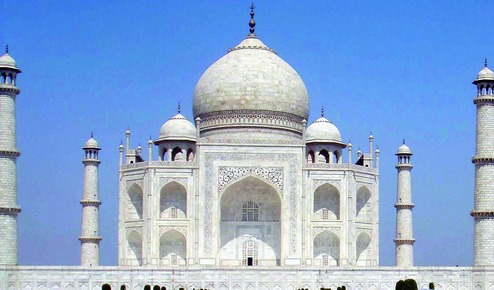

Patna: At a time when some BJP leaders have tried to project the iconic Taj Mahal as something which didn't reflect Indian culture, a book written by the former chairman of the Bihar Board of Religious Trusts, Kishore Kunal, contends that there was much more to the "monument to love" than what its critics would like people to believe.
Titled Ayodhya Revisited and published last year, the book has quoted a farman (official order) issued by the court of Mughal emperor Shah Jahan in AD 1634 which suggests that he had refused to accept the land for free for constructing the iconic structure.
Kunal, a former IPS officer, argues that the land belonged to Raja Jai Singh who had offered to gift it to Shah Jahan for free. But the Mughal emperor refused to accept the offer, citing provisions of the shariat because a tomb cannot be constructed on gifted land. The book also narrates that four other plots were given to Raja Jai Singh in lieu of the land taken for constructing the "Rauza-i-Munavvara", which later came to be known as Taj Mahal.
The book also sheds light on how a Hindu temple which had been converted into a mosque by Shah Jahan was restored.
The book quoting from an article "Imperial Mughal Farmans in Gujarat" - which forms part of Volume 9 of the "Journal of the University of Bombay" - says that a farman was issued by the court of Shah Jahan that ordered restoration of a Jain temple constructed by one Shantidas.
"This Farman is dated July 3, 1648, and the restoration had taken place on the petition of Mulla Abdul Hakim who had represented to the emperor that this building, by reason of its being the property of another person, could not be considered a mosque according to the inviolable Islamic law," says the book.
The facts assume significance as BJP MLA from Uttar Pradesh Sangeet Som had recently termed Mughals as a "blot" on India culture.
"Those who got the Taj Mahal built had tried to finish Hindu culture. It would be unfortunate if such people still get space in our history books," Som had said recently.
His statement had come almost four months after Uttar Pradesh chief minister Yogi Adityanath had termed the Taj Mahal as something which didn't reflect Indian culture.
"Foreign dignitaries visiting the country used to be gifted replicas of the Taj Mahal and other minarets which did not reflect Indian culture," the Uttar Pradesh chief minister had said at a public meeting at Darbhanga in Bihar in June this year.
Terming the controversy over such statements related to the Taj Mahal unfortunate, Kunal told The Telegraph: "Taj Mahal is part of Indian synthetic culture. It should not be linked to any religion, it is a pride of India."
He also refused to accept that Mughals were invaders. "They did come from outside India but they had made India their home," he said.
Patna University history teacher Daisy Narain echoed Kunal's views and maintained that the Mughal rulers contributed immensely to Indian culture. "Those who paint the Mughals as invaders are doing politics over such issues," she said.