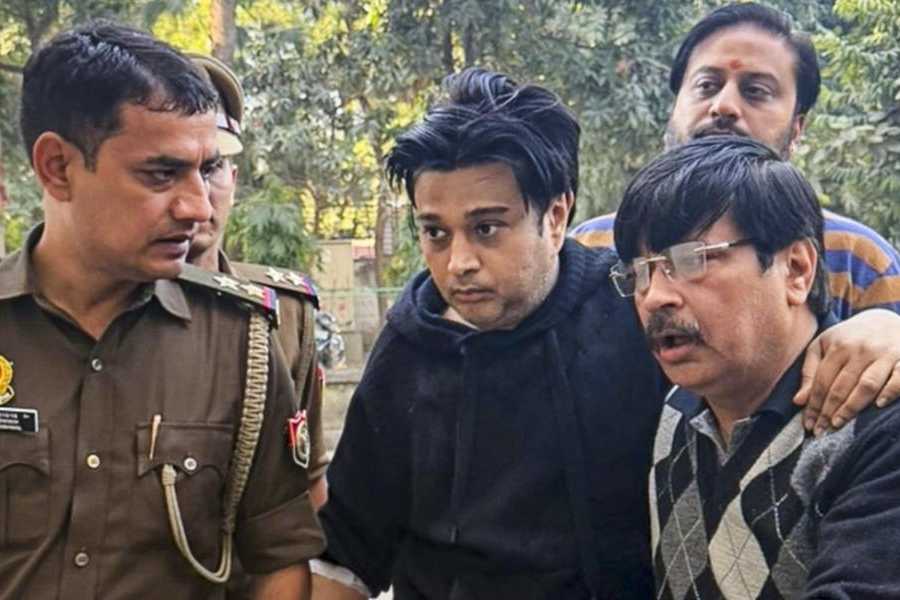
Patna, Sept. 8: Arrested terror mastermind Yasin Bhatkal had made the Indian Mujahideen (IM) operations Bihar-centric, a National Investigation Agency (NIA) team interrogating him stated.
The strategy of most of the IM operations in different parts of the country was initially chalked out from the organisation’s Delhi base. But Bhatkal virtually shifted it to the inaccessible areas of Darbhanga, Madhubani and Samastipur districts in north Bihar. The proximity of the three districts to Nepal facilitated IM operations, said a member of the NIA team.
According to police sources, the base was shifted apparently to hide the organisation both from public and police glare. A senior police officer, who was present during Bhatkal’s interrogation after his arrest from Raxaul in East Champaran, said the kingpin of the banned organisation has revealed the names of at least six members, who helped him build a strong Darbhanga module in the Mithilanchal region. According to the IM, a module is a group of people assigned a specific task and most of its members belong to a precise area or region. For example, the Azamgarh module of Uttar Pradesh was tasked to carry out attacks in the state and Delhi. There are 11 modules under the IM’s India wing.
The officer said Bhatkal spent a considerable amount of time in the Darbhanga belt between 2007 and 2010.
“In 2007 he came in contact with Mohammad Danish,” the officer said. An NIA team had arrested Danish from Laheriasarai in January this year.
Bhatkal, alias Mohammad Ahmad Zarar Siddibapa, reportedly told the interrogators that before coming to Darbhanga he had met Omar Madani, a Nepal-based Lashkar-e-Toiba (LeT) operative, in 2006.
Madani, a native of Basopatti village in Madhubani, was an active LeT member, who was closely associated with anti-India activities from Nepal.
“He had shifted base to Nepal’s Mahua area to carry out operations in India,” the officer said. Madani, who was arrested in Delhi in August 2009 for his alleged involvement in a blast case, was earlier designated to recruit operatives from the Bihar region.
The officer added that Bhatkal had met an engineer from Darbhanga, Md Fasih Mehmood, and had also visited his village.
“Mehmood in Darbhanga and Md Tariq Anjum Hasan from Nalanda were the first recruits of Bhatkal, who formed the Bihar module with the help of Asadullah Akhtar alias Haddi,” the officer told The Telegraph.
During the probe, Bhatkal reportedly said he had met one Md Rabbani (now dead), who helped him build the terror network in Darbhanga. He used to carry out his activities under the garb of a practitioner of Unani.
“He offered the education formula and promised jobs to the talented ones,” the officer said.
His method was to recruit youths both from the poor and affluent families. To drive home his point, the officer said, on one hand Bhatkal recruited an engineer like Fasih, and on the other, trapped Gayur Ahmad Jamali, the son of a poor man. Many were lured by offering admissions in engineering colleges outside Bihar, he added.
Bhatkal, who was of late operating from Nepal’s Pokhra area, also told the interrogators that he had recruited Gayur Ahmad Jamali, a resident of Madhubani to strengthen the organisation’s base. Jamali was appointed as a preacher to influence youths belonging to a particular community. Later, Bhatkal recruited Tehsin Akhtar and Md Aftab Alam.
Of the 16 alleged terror operatives arrested from Bihar by the NIA and the police teams of different states, 10 hailed from Darbhanga and Madhubani districts.
“We are planning to bring Bhatkal to Bihar to corroborate whether what he told the interrogators was true or not,” an NIA officer said. He, however, refused to disclose the date of their visit to Bihar.