|
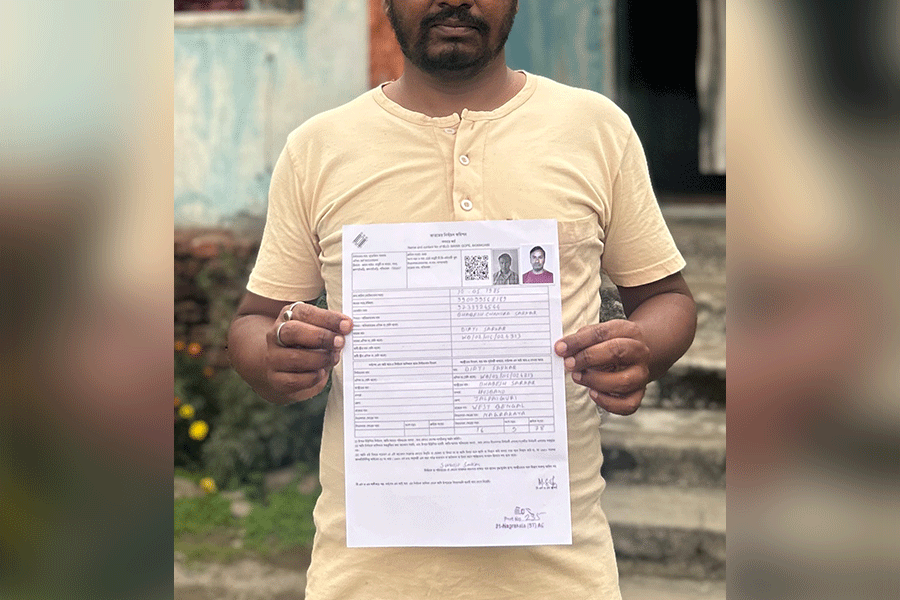
| Workers of the asbestos factory stage a dharna and (below) residents stand on a heap of asbestos waste at Bihiya in Bhojpur. Telegraph pictures |
Manti Devi is scared of serving food to her six children because whatever she cooks turns a menacing red.
The 35-year-old resident of Bihiya village in Bhojpur, 70km west of Patna, said: “I am afraid that my children will fall sick. It has all happened since the asbestos factory opened near our village.”
The factory of Ramco Industries Ltd opened on the outskirts of the village — around 50m from human habitation — in 2010. Since then, claim villagers like Manti, the environment of the area has become polluted.
All water bodies are contaminated with asbestos particles and the resident are afflicted with a variety of diseases, irrespective of their age or health records.
Belmati Devi, 40, falls sick regularly. Saroj Kumar Singh, 23, has been recently diagnosed with tuberculosis.
The fears of the villagers are not unfounded, claim medical experts.
 |
Ashok Kumar Ghosh, a Patna-based environmentalist, said: “Asbestos affects the respiratory system. When one inhales asbestos, the particles get stuck in the lungs and causes inflammation. This leads to continuous coughing. If this persists, it can lead to decaying of lung tissues and cause mesothelioma (a rare form of affecting mesothelium, the protective covering of internal organs). Prolonged exposure to asbestos can also cause tuberculosis.”
Environment experts also corroborate the claims of the villagers.
Gopal Krishna, environmental and occupational health researcher, said: “Asbestos is a carcinogenic mineral fibre. It is banned in 55 countries. India, too, has banned asbestos mining. But a full-fledged asbestos factory is running only 50m from the village while it should have been located at least 500m away.”
He added: “You can see big pieces of asbestos strewn outside the factory. The management just dumps it anywhere. They also burn the gunny sacks of asbestos at night so that there is no proof of the violations.”
Authorities and the factory management, however, claim that the villagers are at fault, not the asbestos unit.
Bihar State Pollution Control Board manager-secretary Rakesh Kumar said: “The area where the factory has been set up is allotted for industries. So, we cannot intervene. But if water has been contaminated, we will check it.”
Bihar Industrial Area Development Authority (Biada) had allotted the land to Ramco Industries. The managing director, Dipak Kumar Singh, said: “The land was first allotted to the factory. Then people came to live here. What can we do about it?”
Residents of the village, with a population of 7,000, however, claimed that they had been living there since long before the factory was set up.
The management of the factory refuted the accusations and claimed that the unit was not even operating at full capacity.
Gopi Krishna, the manager of the factory who lives on site, said: “The annual capacity of the unit is 1.2 lakh metric tonnes. We don’t produce to full capacity. Nor do we violate any norms. No asbestos is burnt at night, we dispose off the waste in a proper manner.”
The workers at the factory had a different tale to tell.
Brajesh Kumar Ojha, 29, laboratory quality tester, said: “We are not provided medical cards. There is no periodic health check-up for us either. As a result, many workers are suffering from diseases.”
Factories Act, 1948, lists asbestos manufacturing as hazardous. Diseases caused to workers in these factories have to be compensated under Workmen’s Compensation Act, 1923. The Supreme Court on January 27, 1995, passed an order that directing asbestos manufacturers to keep health records of workers for 15 years after their retirement.
Factory manager Krishna claimed that all medical procedure was followed and regular health check-up were conducted.
The workers are on strike against the unit since August 2. On August 8, nine workers were also sacked for allegedly misguiding other workers. Some of the workers went on hunger strike in protest.
The hunger strike was stopped on Friday after the intervention of senior administrative and police officials after the condition of some of the protesters worsened. Bheem Singh, Bimlesh Singh, Kamlesh Singh and Nagendra Yadav were administered saline water. The workers, continued with the strike. They said the protests would continue until they were given permanent jobs and the nine workers reinstated.