 |
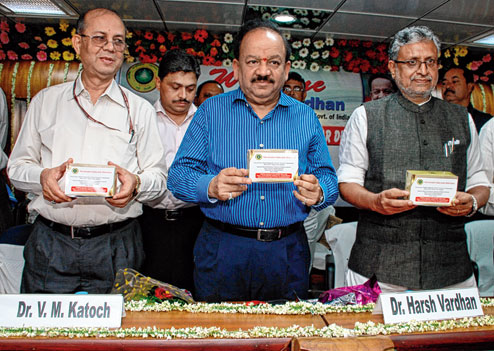
| Union health minister Harsh Vardhan at the launch of the kala-azar kit in Patna on Tuesday. Picture by Jai Prakash |
Patna, Sept. 2: Union health minister Harsh Vardhan on Tuesday said the ministry has fixed a deadline of 2015 to eradicate kala-azar from the country.
Vardhan was here to inaugurate the non-invasive kala-azar detection kit at Rajendra Memorial Research Institute of Medical Sciences (RMRIMS).
Scientists at the RMRIMS have developed a new tool kit for fast diagnosis of kala-azar from sputum and urine samples of patients instead of their blood samples. Vardhan said: “The new method would drastically reduce the time taken in giving reports confirming the disease, which would allow doctors to start early treatment.”
Vardhan said kala-azar persists in only a few countries, including India, Bangladesh, Nepal, Brazil, Ethopia and Sudan. While there are 56 kala-azar-prone districts countrywide, Bihar alone accounts for 33 such districts. The other affected states are Jharkhand, Bengal and Uttar Pradesh.
The minister announced an incentive of Rs 500 for such patient who uses the kit for diagnosis purpose and free medicines from the government. “We don’t want any loopholes in the programme and want to take it to logical conclusion,” Vardhan said, adding: “That’s why we have decided to go every home detecting kala-azar cases. In this help of female health workers would be taken and for every case of kala-azar being detected by them they will be also provided incentives for the same.”
The RMRIMS is due to patent this diagnostic kit, which, till now in its trial period, has helped diagnose 2,000 patients with 95 per cent accuracy. Termed by the World Health Organisation (WHO) a “neglected disease”, kala-azar — visceral leishmaniasis in medical jargon — puts an estimated 165.4 million people at risk in Bihar, Jharkhand, Uttar Pradesh and Bengal.
Caused by female sandflies, India accounts for 90 per cent of total cases of kala-azar worldwide, while Bihar accounts for around 80-85 per cent of cases in the country.
The RMRIMS director, Pradeep Das, said: “Earlier, suspected patients were hesitant in giving blood for diagnosis of kala-azar, as extraction from the bone marrow made the process a little difficult and a skilled personnel was needed for the same. However, the new kit is much easier to handle and doesn’t require blood samples. This method saves time (takes only 10-15 minutes) and is cost-effective (requires only Rs 50-60 while a patient earlier had to dole out Rs 100 or more).”