Crossings

YOU KNOW," said Nikolas, the friendly taxi driver taking us to our hotel in downtown Athens, "Britain hijacked our glory."
How, I ask him.
"Because everyone knows Brexit," said Nikolas with a smile and in his broken English. "But they took the term from us, from Grexit, which never happened."
You land at the Athens international airport, named after Elefthérios Venizélos, who served several terms as Prime Minister between 1910 and 1933, and straightaway get a feel of the economic crisis that has doomed Greece for the past eight years or so.
The number of flights has decreased since the crisis erupted, many carousels are empty, the shops are open but not many are inside. It lacks the buzz and glitter that other airports in Europe such as Heathrow, Charles de Gaulle, Frankfurt or Vienna have. Business travel has gone down sharply and tourists from Europe often use the smaller airports in the many isles to enter and exit if Athens is not on their itinerary.
Bereft of growth and hammered by the austerity measures, Greeks have become poorer: unemployment hovers around 25 per cent and many families are insolvent as they have failed to pay off loans.

Much of the debate in Athens centres around on whether Greece should exit the Eurozone. Many like Nikolas and our hotel receptionist think so. A return to the old currency, drachma, they believe, would help boost exports and tourism and discourage expensive imports.
I ask Nikolas how he was coping. "The number of tourists has come down, but we hope for an increase in July-August. Life has been tough, but we have learnt to live with it."

For much of our stay, this is what we got to hear: it's been tough but the Greeks have learnt to make the most of a lousy situation.
The traffic, even for a mid-week evening, is thin. Many offices have shut down, many people have moved out into the rural areas to take up farming. The occasional protests take place outside Parliament, but even the protesters seemed a tired lot.
A drive through the Athens Riviera, the pretty coastal towns that line the road by the Aegean leading up to the magnificent Temple of Poseidon, tells part of the story. This was where the rich and the powerful of Athens built their weekend homes pre-2008. Now many of these houses are abandoned, you see several unfinished projects dotting the road. "No money," tells our driver. "Overnight people became bankrupt."
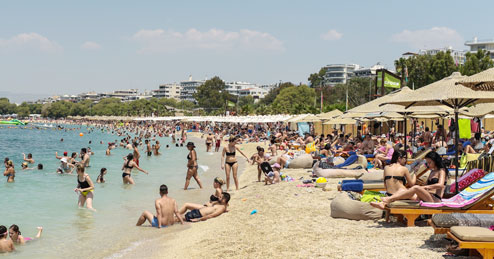
The tourist season is just beginning. The many pubs and tavernas are looking for business that would help them hold on for a whole year. Locals have stopped eating out or don't venture as often. The restaurants are solely dependent on tourist support. The portions are generous, the Greeks haven't compromised on their eating habits at least.

Tourism, we are told, at the hotels we stayed across the country - on the mainland and in the gorgeous Aegean isles - is expected to pick up this year. The Greek National Tourism Organization has announced that it expects 30 million foreign visitors for 2017, up by 7 per cent or 2 million over 2016.
Most of our tour guides in Athens and Delos, a world heritage isle off Mykonos, were out-of-work archaeologists, some with PhD degrees. Excavations have stopped since the government has no money to fund digs. Theo, a 20-something tour manager I chatted up in the breathtakingly beautiful isle of Santorini, told me that the hardest hit are youngsters. Few can afford to marry, leave alone buy a home, or have children. "Our history and beauty is what we have to offer visitors like you. And our spirit of philotimo," said Theo, using the term that is a unique characteristic of Greece.
" Philotimo" is loosely translated as "love of honour", representing the spirit of its people, the tolerance of the people of Greece, which for centuries has opened its arms to all. Theo, and many like him, believe it is this spirit that will help the country, where modern civilisation began, to get its footing back again.
Devdan Mitra