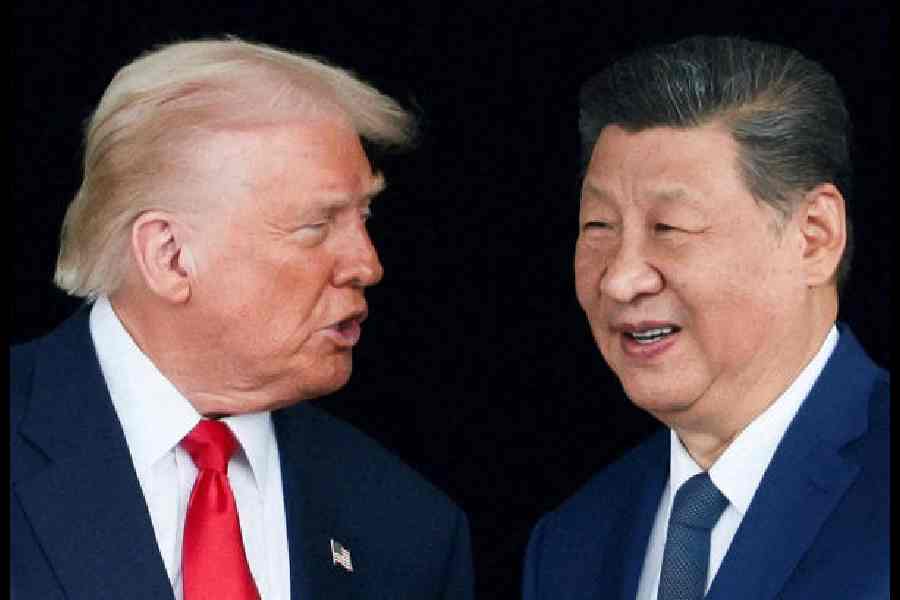
President Donald Trump’s summit with President Xi Jinping in China this April is expected to be a grandiose affair, although friction over trade, Taiwan and technology could upset the bonhomie.
Trump is scheduled to travel to China on March 31 for a three-day trip, a White House official confirmed on Friday. The Chinese government, which tends to hold off from revealing plans for major visits, has not confirmed the dates, but Trump already appears exuberant about his trip.
“I have a very good relationship with President Xi. I’m going to be going to China in April,” Trump said last week. “That’s going to be a wild one.”
He said his latest summit with Xi should "put on the biggest display you’ve ever had in the history of China". Trump also noted the ceremonial troops he saw during his last visit to Beijing in 2017, saying "I never saw so many soldiers all the same height".
For China, a grandiose reception for Trump will convey a message to the world, especially to its Asian neighbours, said Julian Gewirtz, a former senior director for China and Taiwan Affairs at the National Security Council under President Joseph R. Biden Jr.
“Xi is sending a global signal that he has successfully managed the US through a year of resistance” to Trump’s trade war, said Gewirtz, who is now a senior research scholar at Columbia University. China would want Trump’s presence to show "that even the most powerful country in the world has decided that the risks outweigh the benefits of standing up to China", Gewirtz said.
The White House has not released details about precisely when and where Trump will hold talks with Xi.
The US and China have many points of contention that could ruffle, or at worst derail, the summit. And Trump’s bargaining power over Xi ahead of their meeting may be partly clipped by the US Supreme Court’s decision that declared parts of his tariffs illegal.
Last week, the Supreme Court struck down a large part of the tariffs that Trump has imposed on many countries, including China. The White House has said that it would keep the tariffs going under new legal justifications, and Trump has already announced a new 15 per cent import tax.
Even so, the legal setback for Trump may boost Xi’s confidence that he has gained more of the initiative in his country’s rivalry with the US, said Chinese and American analysts.
“I think this will put China in a more advantageous position in the forthcoming trade talks with the US, and China can also push the US on other fronts,” Professor Wu Xinbo, the director of the Centre for American Studies at Fudan University in Shanghai.
Trump will go to China focused on securing business and investment agreements, his previous statements suggest. The Trump administration has also pressed Xi to stop restricting sales of rare earths as a lever against other countries, a step that Beijing used last year to retaliate against US export controls and tariffs.
“China had already turned the tables on the US with its effective use last year of rare earth restrictions to force the US to have reduced tariffs and limit its export controls,” said Scott Kennedy, a researcher on the Chinese economy at the Centre for Strategic and International Studies in Washington.
Xi’s main hope from the summit may be less specific: an extended period of stability in dealings with the US. Much of China’s economy is in poor shape, despite a record trade surplus. Xi has also overseen purges and investigations in the Chinese military. Late last year, these brought down Zhang Youxia, the most senior general of the People’s Liberation Army, or PLA, who was accused of corruption and disloyalty.
“At a broad level, I think Xi wants time and stability in relations,” said Evan S. Medeiros, a professor at Georgetown University who worked as director for China in the National Security Council under President Obama.
Xi "needs time to make the economy more resilient and put it in a long term pathway to growth", said Professor Medeiros. “He needs time to sort out the PLA. And he thinks time with Trump in office will help him diplomatically.”
Xi will also probably seek concessions from Trump on restrictions of Chinese purchases of technology, as well as on Chinese investments into the US, said Professor Wu, the researcher in Shanghai.
Xi’s greatest goal may be to persuade Trump to dilute US support — rhetorical, diplomatic and military — for Taiwan, the island-democracy that has for decades rejected Beijing’s claims of sovereignty.
New York Times News Service