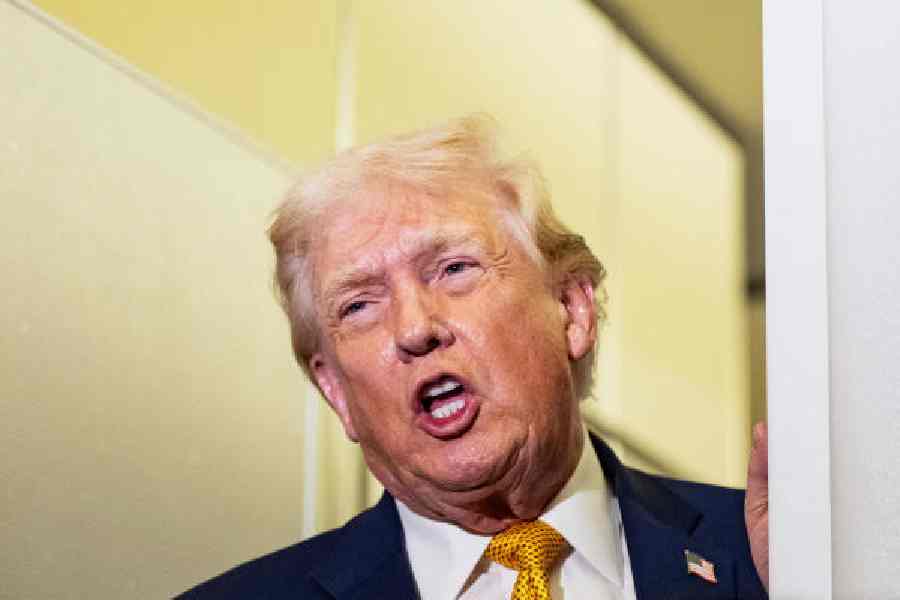
Barely 48 hours after toppling the leader of Venezuela and asserting US rights to the country’s oil, President Donald Trump threatened Colombia with a similar fate, declared that Cuba was not worth invading because “it’s ready to fall”, and once again claimed that Greenland needed to come under American control as an issue of national security.
Trump’s claims, in interviews on Sunday and then a lengthy back-and-forth with reporters aboard Air Force One as it returned from his private club in Florida, offered a glimpse of how emboldened he felt after the quick capture of Nicolás Maduro, the strongman who was seized on narco-trafficking charges.
“We’re in charge” of Venezuela, Trump claimed, as he described his plans to breathe new life into the Monroe Doctrine, the 1823 foundational statement of US claims over the Western Hemisphere.
Or, more specifically, he invoked a more recent update that he refers to, characteristically, after himself: the “Donroe doctrine”.
Trump never described his philosophy in detail, or whether it applied beyond the Saturday attack on Caracas. But he certainly suggested that he could use the forces amassed in the Caribbean for new purposes, this time aimed at Colombia and its President, Gustavo Petro.
The country, he claimed, was “run by a sick man who likes making cocaine and selling it to the United States”.
“He’s not going to be doing it for very long,” Trump told reporters on Air Force One. “He has cocaine mills and cocaine factories. He’s not going to be doing it.” Asked whether the US would conduct an operation against Colombia, the President said: “It sounds good to me.”
It may have been an empty threat, an effort to use the swift precision of the snatching of Maduro from his well-protected bedroom to bring Petro to heel. But the core of Trump’s argument was about American power, and what the Maduro operation said about his willingness to use it.
“American dominance in the Western Hemisphere will never be questioned again,” Trump told reporters as he announced the Venezuela attack from Mar-a-Lago, his private club in Florida.
Trump talks in blunt declarations, which is why his secretary of state, Marco Rubio, spent much of Sunday gently walking back his boss’ declaration — which he had repeated multiple times — that the US planned to “run” Venezuela for the foreseeable future. But a more nuanced position about the US role in the
Western Hemisphere is described on page 15 of the Trump administration’s
recent National Security Strategy, a document that appears to have been written with this moment in American territorial adventurism in mind.
A close reading could point to what Trump is thinking about beyond Venezuela — from Colombia to Mexico to Cuba and Greenland, the ice-covered territory that Trump asserted again over the weekend must come under some form of US control.
Over the weekend, Trump hinted at military action in Mexico to combat drug
cartels.
Mexican President Claudia Sheinbaum responded to Trump’s threats saying, “It is necessary to reaffirm that in Mexico the people rule, and that we are a free and sovereign country—cooperation, yes; subordination and
intervention, no.”
Trump, who keeps a pensive portrait of the fifth US President near his desk in the Oval Office, squeezed between Alexander Hamilton and Andrew Jackson, said “the Monroe Doctrine is a big deal, but we’ve superseded it by a lot, a real lot”.
He appeared to be referring to what the National Security Strategy called the “Trump Corollary” of Monroe’s famous declaration that sought to stop European powers from meddling in the Americas.
The Trump Corollary asserts a US right to “restore American pre-eminence in the Western Hemisphere” and to deny “non-Hemispheric competitors” — namely, China — “the ability to position forces or other threatening capabilities, or to own or control
strategically vital assets”.
That last phrase, about taking command of “strategically vital assets”, has echoes of Trump’s explanation for why the US is claiming rights to Venezuela’s vast oil reserves, the largest in the world. He referred to oil roughly 20 times in his remarks on Saturday, talking about the need to rebuild long-neglected facilities, control production and provide remedies for US companies, because Venezuela’s leaders “stole our oil”.
“We built that whole industry there, and they just took it over like we were nothing,” Trump said of the oil sector.
“And we had a President that decided not to do anything about it,” Trump added, appearing to refer to his predecessor, Joseph R. Biden Jr.
New York Times News Service and Reuters