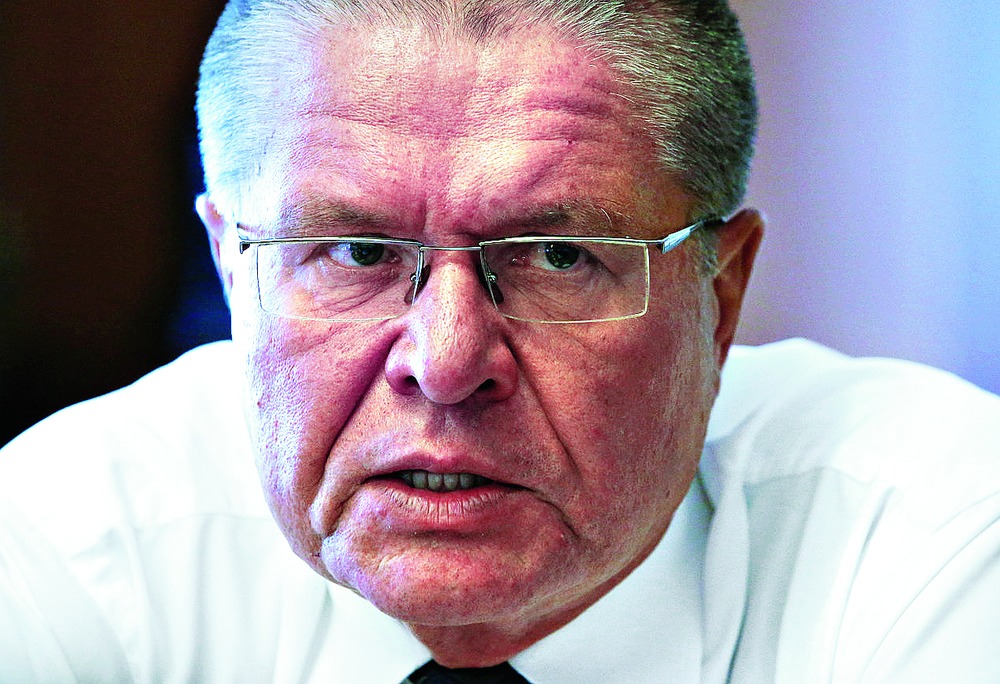

Moscow, Nov. 15 (Reuters): Russian investigators today charged economy minister Alexei Ulyukayev with extorting a $2 million bribe from Rosneft, Russia's biggest oil company, in a case that threatens to expose fault lines in President Vladimir Putin's inner circle.
Ulyukayev, a 60-year-old technocrat whose ministry has been overseeing a sale of state assets, is the highest-ranking Russian official to be detained while in office since the collapse of the Soviet Union in 1991. He faces up to 15 years in jail if found guilty.
Ulyukayev, who a Moscow court ruled should be put under house arrest for two months until January 15, faces up to 15 years in jail if found guilty. Wearing a blue suit, Ulyukayev told a Moscow court he did not accept his guilt. It was in his own interests to cooperate with the investigation as he valued his reputation, he said.
The Investigative Committee, the state agency that investigates major crimes, said Ulyukayev had extorted the bribe in exchange for approving Rosneft's $5 billion purchase of a stake in mid-sized oil producer Bashneft.
In a twist reminiscent of the Soviet era, his detention was announced in the early hours of this morning, with state TV and pro-Kremlin politicians presenting it as part of a high-profile fight against corruption.
Others said it was evidence of infighting at the highest levels of power, possibly involving Igor Sechin, the chief of Rosneft, a close Putin lieutenant who is one of Russia's most powerful men, and might herald a shake-up.
Low oil prices and western sanctions mean the government is struggling to plug holes in the state budget ahead of a 2018 presidential election, and that competition for resources inside the tightly-controlled system has become more acute.
Law enforcement sources told Russian media the minister's phones had been tapped and his electronic communications monitored. Investigators set up a sting operation in which the alleged bribe was handed over yesterday, the reports said.
Investigators said Ulyukayev had threatened to use his position to cause problems for Rosneft unless it paid him. They said they were not challenging the legality of Rosneft's purchase of the Bashneft stake or investigating it.
Putin was informed about the case when the investigation was first launched, Kremlin spokesman Dmitry Peskov told reporters. "These are serious allegations," Peskov said. "Only a court can deliver a verdict."
Previous high-profile prosecutions during Putin's rule have been a cover for settling commercial or political scores, according to people involved in those cases.
The Kremlin and law enforcement agencies deny that, saying they only target criminals.
Rosneft's acquisition of Bashneft last month was the focus of a major turf war between rival Kremlin camps, sources close to the deal and in the government have said.
Sechin lobbied hard for the green light to buy Bashneft, but the deal was fiercely opposed by economic liberals in the government, some with ties to Prime Minister Dmitry Medvedev, who believed Bashneft should go to private investors.
Ulyukayev initially opposed Rosneft buying Bashneft, one of the most lucrative state assets to be privatised in years, but eventually signed off on the deal.
A 19.5 per cent state-owned stake in Rosneft is up for privatisation next.
Rosneft is poised to buy the stake itself to sell on to investors later.
Sources said last week that Rosneft's parent holding company may help Rosneft with funds for the deal.
One state company helping another conduct a privatisation is likely to be controversial among some members of the government.
Call to boost ties
Putin and President-elect Donald J. Trump spoke by telephone for the first time yesterday, agreeing to review what both consider the poor state of relations between the two countries, according to a statement from the Kremlin.
The two agreed "on the absolutely unsatisfactory state of bilateral relations", said the statement, and they both endorsed the idea of undertaking joint efforts "to normalise relations".