The day begins before sunrise in the tea gardens of Rajganj in north Bengal, nearly 450 km from Kolkata, for political workers of the state’s ruling party.
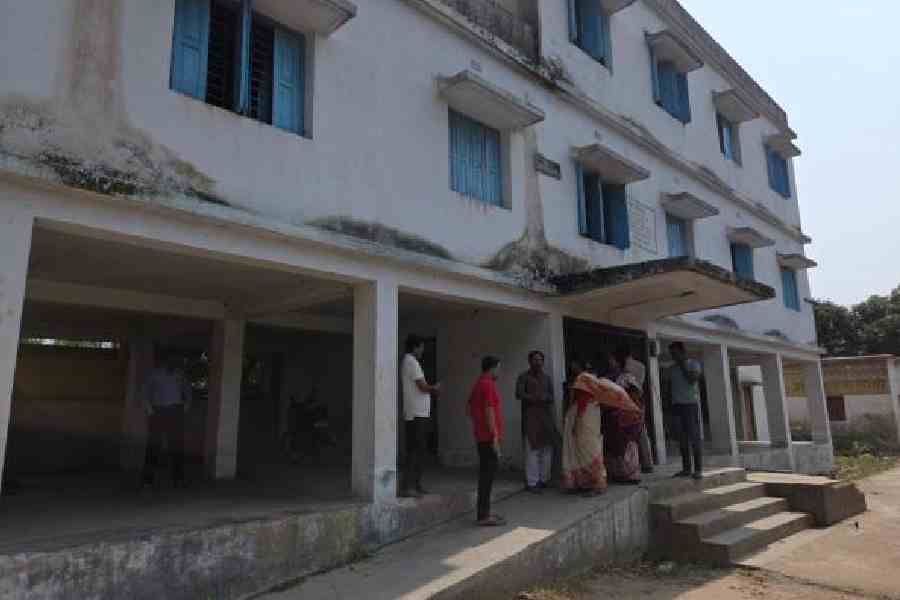
By first light, small groups of Trinamool Congress workers gather under tin roofs and banyan trees, mapping out the day’s election campaign — which lanes to cover, which homes to revisit, which voters remain unconvinced.
By mid-morning, many of them will return to the fields, plucking tea leaves for a daily wage that has barely kept pace with rising costs.
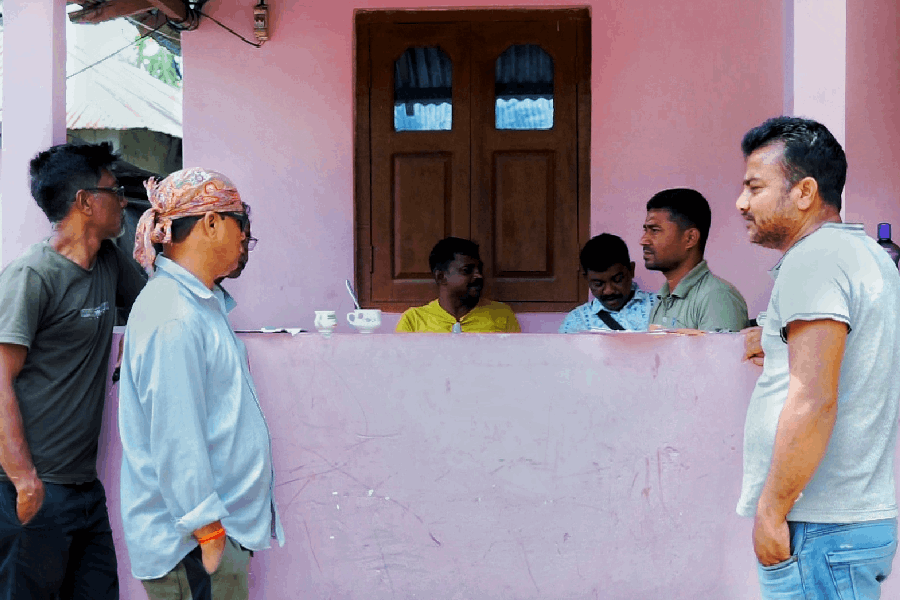
Party workers gather during the day ahead of campaigning in north Bengal. (Debayan Dutta and Ribhu Chatterjee)
Politics, here, is folded into survival.
It is this intersection of labour, loyalty and expectation that has made the party’s choice of candidate unusually fraught in the run-up to the 2026 Assembly elections.
The nomination of Swapna Barman, the Asian Games heptathlon gold medallist once celebrated across the country, has not translated into easy acceptance in her home constituency.

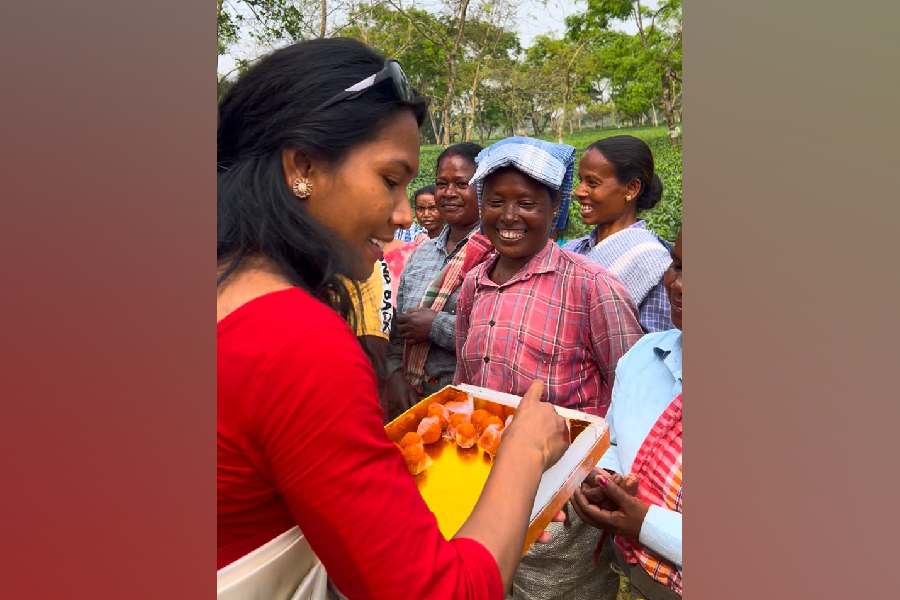
Athlete Swapna Barman (Reuters)
In Rajganj, where political capital is often built over years of proximity, her candidacy has exposed fault lines within the Trinamool’s ranks.
“People here are working for the party, not the candidate,” Pradhan Hembram, a Trinamool worker from the tea gardens, told The Telegraph Online.
Another resident, Bodu Munda, said that Barman had yet to visit their tea garden. “She hasn’t even come here to campaign,” he said.Some others said: “We don’t like Barman’s attitude. She is too arrogant and doesn’t even try to connect with the local people.”Another person quipped: “Even her neighbour won’t vote for her.”
Khageswar Roy, a three-time MLA from Rajganj and a long-time Trinamool organiser in north Bengal, had won the seat in 2021 by over 15,000 votes, a margin of more than 15 per cent. His removal from the ticket, party workers said, has unsettled a carefully built grassroots network.
Roy has publicly predicted defeat for the party in the constituency following Barman’s nomination.
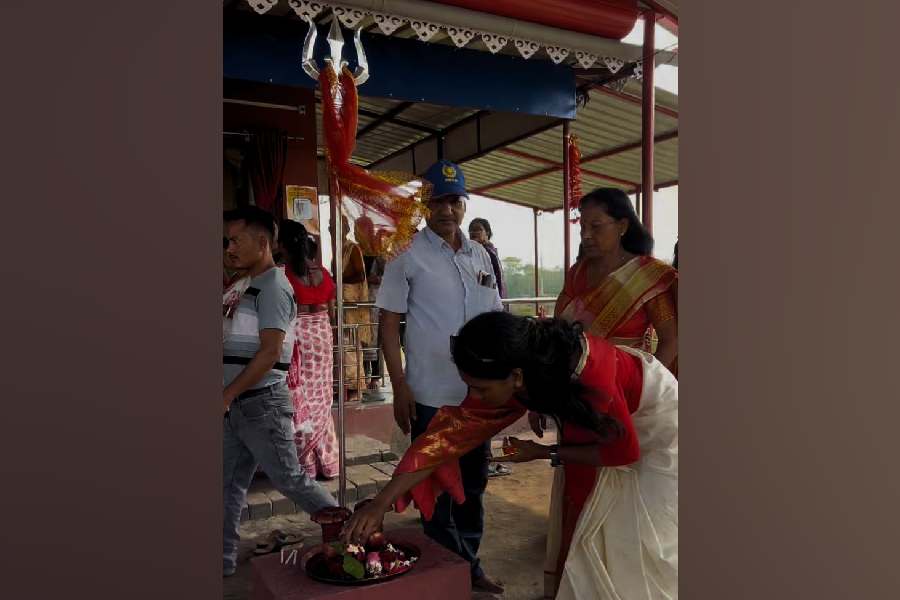
Swapna Barman offers prayers at a temple. (Debayan Dutta and Ribhu Chatterjee)
The BJP has fielded Dinesh Sarkar, also known as Haradhan Sarkar, a candidate with a visible presence on the ground and a steady following in the region.
North Bengal has, in recent years, emerged as a stronghold for the BJP’s organisational push, and party workers here speak with a confidence that was less evident in previous elections.
In Jalpaiguri district, the BJP’s vote share was 18.2 per cent in 2016 Assembly polls. In Lok Sabha 2019, the party leaped to 53.9 per cent. In the 2021 Assembly polls, the saffron party received 47.4 per cent votes, and in Lok Sabha 2024, the party secured 48.9 per cent.
In all the polls after 2016, the saffron party received more votes than the Trinamool.
The rise of the BJP has been similar in other north Bengal districts such as Coochbehar, South and North Dinajpur since 2016.
For many in Rajganj, however, the election is less about party arithmetic and more about representation. In the tea gardens, where incomes remain precarious and public services uneven, the expectation from an MLA is immediate and tangible.
Hembram said: “Barman will not do any work in our area. The gardens are not doing well. People are struggling. That’s why we need someone who will work here.”
The discontent has not translated into defection. Hembram and others insist their vote will remain with the TMC solely because of Mamata Banerjee, underscoring the Bengal chief minister’s appeal across the state’s rural belt.
But that loyalty, they suggest, is being tested. It could well be a leitmotif of the Bengal Assembly election 2026.
Barman’s campaign has sought to stay on message. “The overall development of Rajganj is our primary goal,” she said when she launched a manifesto for her constituency.
On the ground, conversations often drift beyond campaign promises. Some residents, speaking cautiously, allude to long-standing perceptions about the candidate’s distance from the community and her family’s strong-arm reputation of late. These are not formal allegations, nor easily verifiable claims, but they circulate enough to shape opinion in subtle ways, the kind that rarely make it into speeches but linger in voting decisions.
The stakes are not limited to Rajganj alone. In neighbouring Jalpaiguri Sadar, where the Trinamool scraped through in 2021 with a margin of less than 1 per cent of the vote, similar murmurs about candidate selection – here, Krishna Das – have surfaced.
Das has a support base in the area. Workers like Hembram believe that had Das been made to contest from Rajganj they would have won the seat without even campaigning. Analysts and local journalists predict that the TMC stands to lose both these seats because of poor candidate selection. Statutory warning: Add salt to taste.
North Bengal constituencies vote in the first phase of the Bengal Assembly election, on April 23.