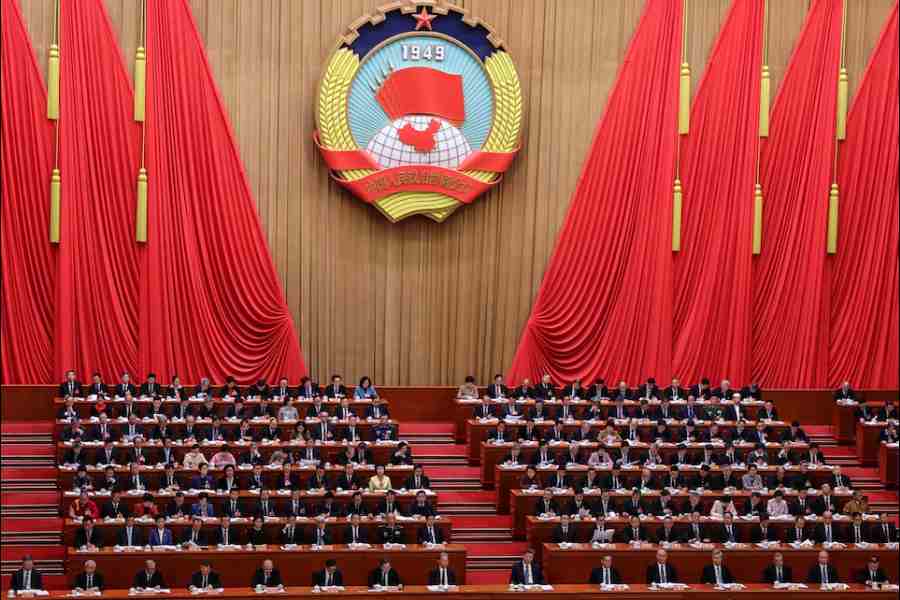
China on Thursday unveiled major development targets in its five-year plan for the 2026-2030 period as a government work report was submitted to the country's top legislature for deliberation.
Hike in defence budget
At the opening of the annual parliament meeting, Premier Li Qiang praised China's ability to withstand US President Donald Trump's tariff hikes, but said "multilateralism and free trade are under severe threat," and announced 10 per cent increases in the defence budget, as well as in research and development.
Roughly 1.9 trillion yuan (about $275 billion) will be allocated to national defence, Chinese Premier Li Qiang announced .
For context, the US defence budget for the fiscal year 2026 is heading towards $901 billion.
Beijing lowers economic growth target
Li acknowledged an "acute" imbalance between strong supply and weak demand, subdued market expectations and ongoing risks from a persistent property sector downturn and high local government debt.
These challenges have pushed Beijing to set a lower growth target of 4.5 per cent to 5 per cent for this year, down from last year's 5 per cent, which was met largely through a one‑fifth surge in its trade surplus to a record $1.2 trillion.
China's 15th five-year plan pledged investments in innovation and industrial upgrading, as well as a "notable" - but unspecified - increase in household consumption as a share of economic output.
The combination of a lower growth target and higher outlays on research and strategic industries underscores Beijing's bet that technological upgrading- not consumption - will drive its next phase of development despite growing structural pressures.
"China’s government remains laser-focused on spurring technological breakthroughs and high-tech investment," said Fred Neumann, chief Asia economist at HSBC. "In part, this is motivated by competition with the United States for control over the technologies of the future."
"Many international observers may be left disappointed, therefore, by slower progress in rebalancing the economy away from investment towards consumption."
Vows to raise household consumption
China’s economy is driven far more by state-led investment than by consumer spending, unlike most countries.
This state-controlled, debt-driven development model leads to industrial overcapacity, fuels trade tensions abroad, and creates deflationary pressures at home.
"The rebalancing challenge that China faces, and that will take years to achieve, is implicitly acknowledged by a weaker growth target for the coming year," Neumann added.
Plans to cut carbon dioxide emissions
China plans to reduce its carbon intensity, or carbon emissions per unit of gross domestic product, by 17 per cent during its current five-year plan.
The new plan also called for replacing 30 million metric tons per year of coal with renewables and pushing to reach peak coal, but did not put further limits on coal consumption.
During the five-year plan that ended last year, China reduced its carbon intensity by 12 per cent.
In 2026, it plans to cut its carbon intensity by around 3.8 per cent, according to a report from China's top state planner, the National Development and Reform Commission (NDRC).
China has said it expects that its carbon emissions will peak before 2030.
In the next five years, China will also introduce a mandatory minimum quota system for renewable energy consumption, the National Development and Reform Commission (NDRC) report said.
High-tech push as rivalry with US intensifies
The five-year plan aims to raise the value-added of "core digital economy industries" to 12.5 per cent of GDP and roll out new policies for an integrated national data market and establish a system for AI security risk prevention.
China also proposes a total of 109 major projects in six areas, ranging from steering the development of new quality productive forces to ensuring and improving public well-being, the report said.
These goals reflect President Xi Jinping's vision of developing "new productive forces" to escape the middle-income trap, counter the demographic downturn, and enhance national security by insulating China from US export controls.
China pledged support for "breakthrough" developments across a range of industries, from farm seeds and biomedicine to areas at the cutting-edge of science, such as machine-brain interfaces.
State-owned enterprises were urged to create demand for made-in-China technology like semiconductors and drones.
But the five-year plan also lists new ambitions in areas China already dominates. While accounting for 85 per cent of the electric vehicle charging stations in the world, China aims to double their number within three years.
AI push, rise in monthly pension
Beijing promised to build out "hyper-scale" computing clusters supported by cheap and abundant electricity.
In terms of stimulus, China plans a budget deficit of 4.0 per cent of GDP and has set special debt issuance quotas at 1.3 trillion yuan ($188.5 billion) for the central government and 4.4 trillion yuan for local authorities - all unchanged from last year.
China pledged to raise minimum monthly pensions by 20 yuan per person and basic medical insurance subsidies for rural, non-working people by 24 yuan - marginal, rather than structural, moves.
It said it wants to increase education spending, subsidise childcare and reform public hospitals, acknowledging the demographic downturn.