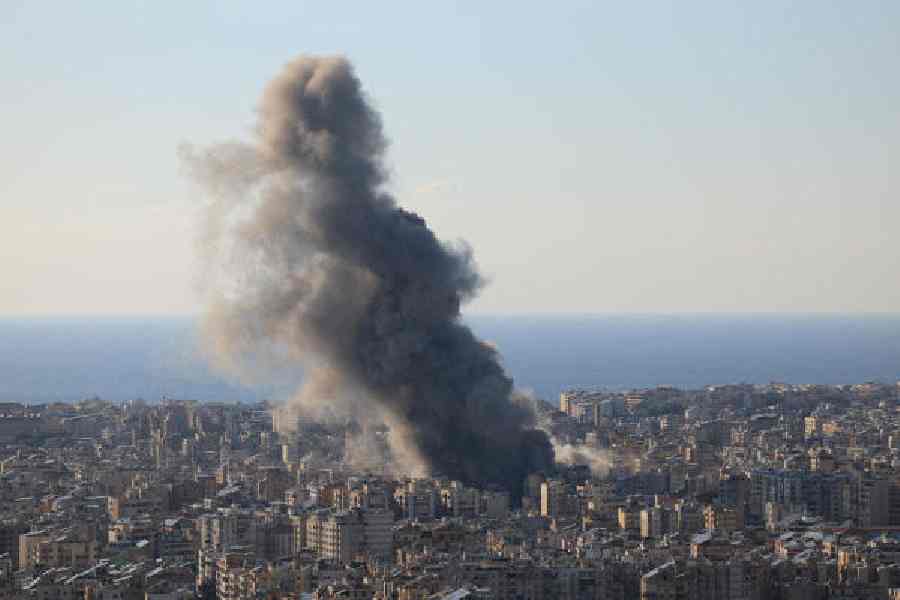
A heavy barrage of Israeli retaliatory strikes against the Iran-backed Hezbollah militia early Monday brought a fresh wave of displacement in war-weary Lebanon.
A Lebanese health ministry official said the death toll from Israeli strikes on Lebanon stood at 52, with more than 150 wounded.
In villages across the country’s southern region near the Israeli border, parents bundled sleepy children into cars and crawled through miles of traffic toward the capital, Beirut, many clutching little more than a change of clothes. In Dahiya, the densely populated Hezbollah stronghold on the southern outskirts of Beirut, residents fled with barely a suitcase between them as explosions echoed nearby.
With no proper shelters to house them, the newly uprooted spilt into parking garages, schools and mosques. By midmorning, some had drifted to Beirut’s promenade along the Mediterranean. They settled beneath palm trees, wrapping themselves in blankets and sheets and waiting — for food, for safety, for whatever would come next.
“This country is beautiful, but we need peace,” said Musa Hashem, 50, a municipal worker who had fled Dahiya. He was sitting by the roadside with his twin brother and their eight children. “We just want this war to stop,” he said.
Lebanon’s disaster management agency said it had opened more than 40 schools as makeshift shelters. More than 3,000 displaced people had so far registered — a figure aid workers and government officials warned was certain to climb.
As concerns about a wider war grew on Monday, many people — both Lebanese and Syrian — began flocking to the border with Syria, hoping to leave the country.
On Monday, many fled not only in fear but in bitter disbelief, forced from their homes barely a year after a cease-fire that was meant to still the guns. Israel and Hezbollah signed that truce in November 2024, though near-daily Israeli strikes have since rattled Lebanon. Some of those escaping on Monday spoke of homes still lying in rubble, businesses not yet recovered and their children’s schooling suspended once again by the thrum of war.
“We have been living daily with war for more than two years,” said Shadia Shahla, who works at a school in Tallouseh village in southern Lebanon, which she fled. During the 2024 war, she said she was displaced in Beirut for 66 days. “Now a new war is here, and we are tired,” she said.
Shahla was among roughly 1,500 people who arrived at a technical training school in west Beirut on Monday. Some parents said no one was attending to their children, some of whom cried after going without food all morning. Many simply fell asleep in the cars or vans that had brought them, while aid officials at the school, visibly overwhelmed, scrambled to find and allocate rooms.
France N-boost
French President Emmanuel Macron announced on Monday that France will increase its nuclear arsenal and for the first time allow the temporary deployment of its nuclear-armed aircraft to allied countries, in a new strategy aimed at strengthening Europe’s independence.
Macron announced this during a speech outlining his country’s nuclear strategy at a military base at L’ile Longue in northwestern France that hosts the country’s ballistic missile submarines. “To be free, one needs to be feared,” Macron said.
New York Times News Service and AP