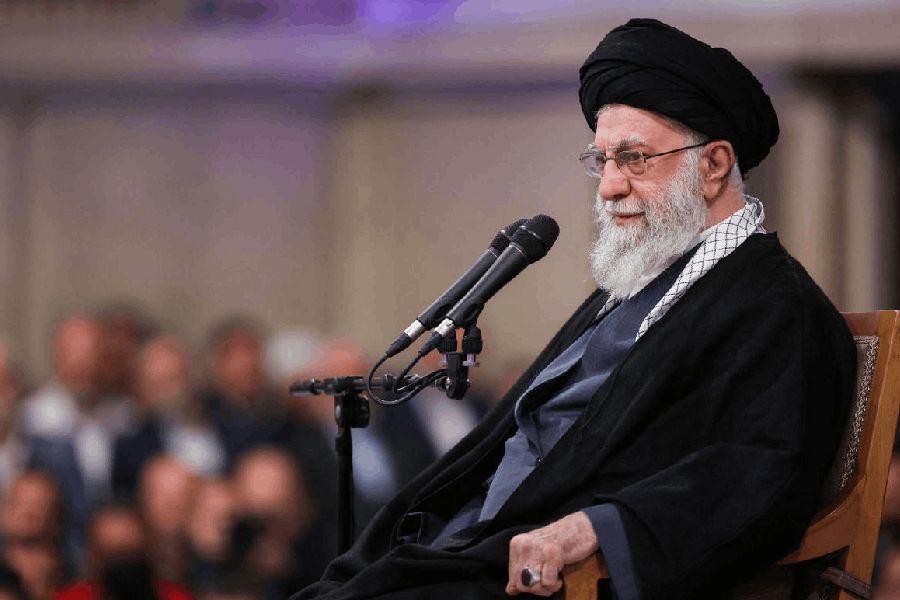
Large crowds of Iranians poured into the streets of Tehran and other cities across Iran overnight, celebrating the news that Iran’s supreme leader, Ayatollah Ali Khamenei, had been killed during a day of coordinated US and Israeli attacks.
The ayatollah’s death, after nearly 40 years of authoritarian rule, represented a historic shift for Iran’s theocratic regime. Many Iranians, inside and outside the country, rejoiced, even as the threat of more attacks by US and Israeli forces cast a pall over some celebrations.
Landlines and cellphone service were down across Iran, making it difficult to gauge public sentiment in the nation of more than 90 million people as US and Israeli forces struck targets for a second day. Early reports of the death toll in Iran suggested that more than 100 people had been killed in the first wave of strikes.
But in neighborhoods across Tehran, the capital, pockets of exuberance emerged. In video calls with The New York Times, three residents of Tehran showed the scenes unfolding in their neighborhoods: Large crowds of men and women dancing and cheering, shouting, “Woohoo, hurrah.” Drivers passing by honked their car horns. Fireworks lit up the sky and loud Persian dance music filled the streets. Many residents, from their windows and balconies, joined in a chant of “freedom, freedom.”
Sara, 53, a resident of Tehran, who like others interviewed asked that her last name not be used for fear of retaliation, said in a phone call that when she heard on the news that Khamenei had been killed, she let out a scream and jumped up and down. Her husband started pacing and they hugged, she said.
“Then we bolted outside and shouted from the top of our lungs and laughed and danced with our neighbors,” Sara said. Just a month ago, she, her husband and daughter were among protesters who took to the streets in an uprising against the government. Security forces beat her and her husband with batons and sprayed tear gas in their eyes, she said.
For Iranian supporters of Khamenei who considered him a revered religious figure, watching the celebrations was difficult, they said on social media. But they were noticeably absent from the streets.
Khamenei, who had the final say in all government decisions in Iran, personally ordered security forces to use lethal force against protesters in January, leading to a massacre that rights groups say killed at least 7,000 people, with numbers expected to rise.
“Khamenei went to hell,” one man shouted from his rooftop Saturday, according to a video posted on BBC Persian.
For families whose loved ones were killed or jailed during Khamenei’s reign, the news felt cathartic, many said. Dr. Mohsen Assadi Lari, a physician and former senior official in the Iranian Ministry of Health, lost his son and daughter, both in their early 20s, when Iran’s Revolutionary Guard shot down a Ukrainian Airlines passenger plane in 2020. On Saturday, he posted photographs of his children on his social media page with a message about freedom, “We will endure the winter, spring is near.”
In Abdanan, a Kurdish city in western Iran where the crackdown on protests was intense, young men and women cruised the streets after the announcement of the supreme leader’s death. They hung out of their car windows, showing victory signs and cheering.
“Tonight, Feb. 28, congratulations for our freedom,” said a voice narrating a video of the celebrations, which was verified by the Times. Parts of the video were already blurred.
“Am I dreaming?” screamed a man in another video, also verified by the Times. “Ah! Hello to the new world. Ah!” The footage shows people tearing down a monument bearing a man’s silhouette, possibly Khamenei’s, at a roundabout in Galleh Dar, in Fars province, as fires burned around them.
People in Shiraz, a major Iranian city, were abandoning their cars for an impromptu dance party, whistling, cheering, clapping and screaming with joy. In many videos, celebrants joined together in a cheer that is typically reserved for weddings, symbolizing pure joy.
A video from Isfahan, another major city, in the south of Iran, shows at least a hundred people celebrating, many with their arms raised and waving white cloths. Cars can be heard honking their horns amid loud, jubilant cheering.
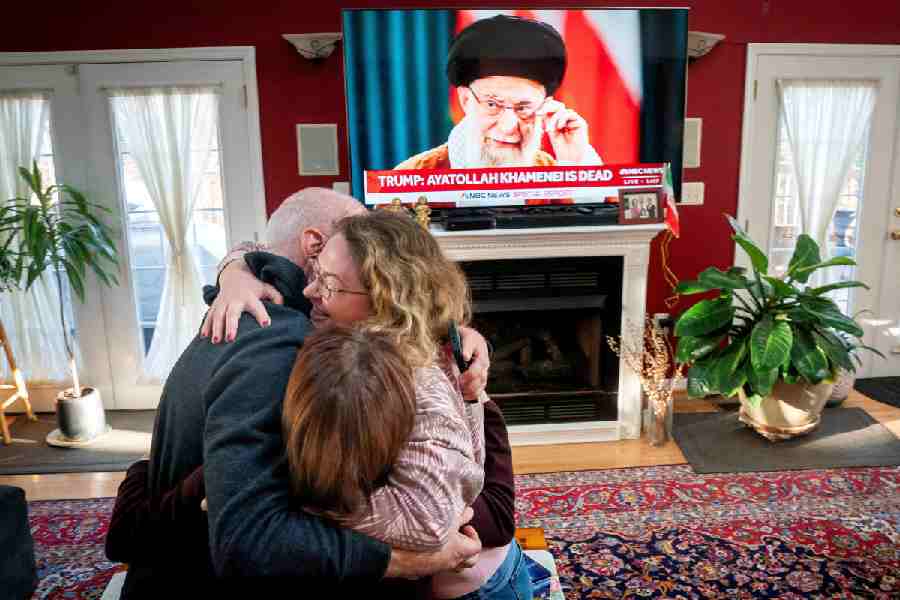
Iranians living abroad joined their families back home through video calls. Many sobbed from relief and happiness. Homayoun, an Iranian living in Paris, popped a bottle of Champagne. Shadi, in Los Angeles, did shots with friends. Shirin, in Maryland, danced wildly at home to loud music.
“I am so happy,” Shirin said. “I don’t know what to do with myself. Is this real? Thank God I am alive to see this day.”
It remained unclear what would come next after Khamenei’s nearly four decades in power, whether a new system of government would take over or power would be transferred to successors as he had instructed before his death.
The New York Times Services