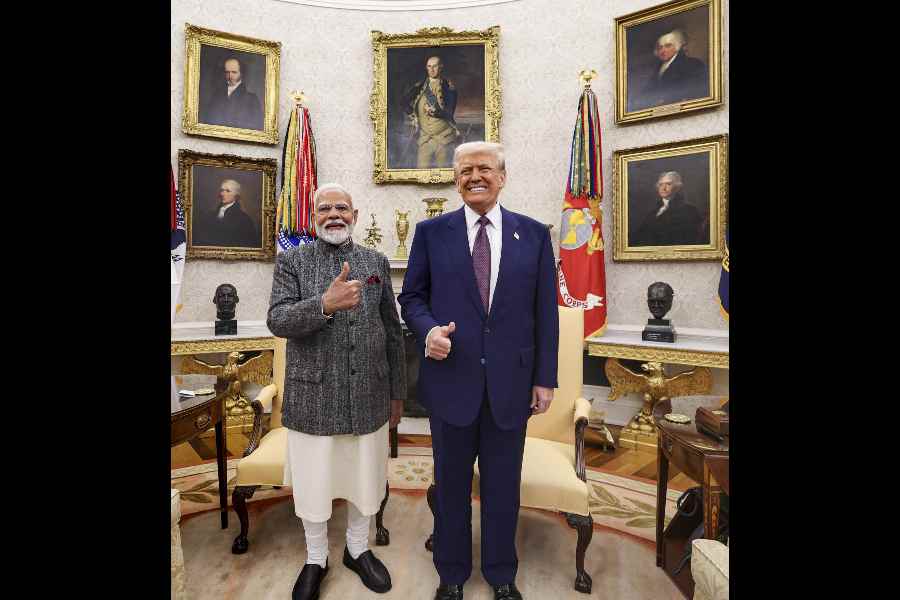
For a full eight months after Operation Sindoor, Prime Minister Narendra Modi kept his cool and did not respond to the claims and taunts of President Donald Trump.
Trump’s last statement, quoting Modi as having addressed him as “Sir”, must have been the last straw.
Addressing a public meeting on January 7, Modi said that when he was in Canada, he had been invited by Trump for lunch at the White House but he had very politely declined the invitation saying he had to be back home.
That was a gentle snub in response to Trump’s cavalier manner and his deliberate targeting of India and the barrage of insults heaped by him and some of his colleagues. The conclusion of the long-negotiated trade deal, after Trump loaded India with the highest rates of tariff worldwide, seems nowhere in sight despite commerce minister Piyush Goyal’s heroic claims that a deal is around the corner.
It should be clear to anyone well informed about India-US relations that this is a new nadir. In a book published a quarter century ago, at the threshold of a new era in India-US relations, American diplomat-author Deniz Kux had famously described the two countries as “Estranged Democracies”.
Over the two decades following that book’s publication, much has been written about how the two have moved from estrangement to engagement and more. It would appear that we are once again looking at a phase of estrangement.
The Modi government has been trying to maintain the relationship, buying defence equipment, participating in joint defence exercises, making concessions on the trade front, liberalising policy to aid foreign investment, and reducing India’s purchase of Russian oil. Trump clearly wants more. While Modi may have been willing to play along on a wide range of issues, it seems he has almost reached the end of his wits.
What does this mean in concrete terms? India has to undertake a fundamental re-examination of its foreign policy. The assumptions that defined the policy of engagement with the US — which, in fact,began tentatively during the tenure of Prime Minister Narasimha Rao, was briefly disrupted by India’s nuclear tests, resumed when Prime Minister Atal Bihari Vajpayee walked what were called the “first steps in strategic partnership”, which were followed by Prime Minister Manmohan Singh’s “next steps in strategic partnership” — no longer hold.
Even if there is a change in the attitude of the two heads of government in the coming weeks, the Indian establishment would be very wary of taking the relationship back to where it was a decade ago when the Indian armed forces were willing to salute President Barack Obama at the Republic Day parade.
Trump’s Donroe Doctrine, a manifesto of American neo-imperialism, has to be explicitly rejected by a post-colonial India that won freedom from imperialism and ignited anti-colonial movements across the world.
India may well purchase less oil from Russia and buy more defence and aerospace stuff from the US, but the relationship would be mainly transactional and muchless strategic. Given this likelihood, India has to re-examine her relationship with other major powers, including China.
It would not be wise on India’s part to press the case for a meeting of the Quad — the grouping of Australia, India, Japan and the US. Since it is India’s turn to host the Quad Summit, it is best that we choose to keep the invitations to ourselves.
This year India is chair of Brics. Most Brics member countries have criticised President Trump’s intervention in Venezuela and the abduction of President Maduro. India has issued a mild statement of concern rather than criticise the decision.
All manner of explanations have been offered by apologists for the Modi government as to why the Indian response is justified. The fact, however, remains that not only has India distanced itself from other Brics countries, it has not been the “Voice of the Global South” — a role that India voluntarily claimed for itself at the G20 Summit in Delhi.
India must also re-examine its participation in other US-led initiatives in Asia such as the Abraham Accords, India-Middle East Economic Corridor (IMEC) and the US-UAE-India-Israel (I2U2). This would be required at least to raise India’s stature within Asia, bruised by Trump’s actions and remarks over the past year.
It is also imperative that India improve its relationship with its neighbours, including China. The recent thaw in India-China relations is welcome but in both countries there would be individuals willing to sabotage the détente. A viable working relationshipwith China is important if Trump chooses to target it and countries friendly with China, like Iran and most of the members of the Association of Southeast Asian Nations (Asean).
India needs a stable neighbourhood all the way from West Asia and Iran to East Asia and the Indian Ocean region. Trump’s actions so far suggest that he is out to disrupt and destabilise various parts of the world under his version of American self-interest. This does not suit India’s interests.
However, given the importance of the US, its global economic weight and military power, India can no longer afford a piecemeal, case-by-case, episode-by-episode approach to dealing with Trump’s America. One hopes the government is undertaking a serious internal assessment of the costs and benefits of the various policy options available to it.
Twenty-five years ago, the National Security Advisory Board (NSAB), chaired by the late K. Subrahmanyam and aided by a high-poweredgroup of strategic policy thinkers and practitioners, undertook such a comprehensive review of India’s foreign and national security policy. That exercise provided the framework for a new era in India-US relations.
That framework is today in tatters. It is time again for a fresh look at how India should deal with new global challenges and relate to the emerging world order.