Indirect talks between American and Iranian officials in Switzerland ended on Tuesday with an agreement on a “set of guiding principles”, according to Iran’s foreign minister, who said both sides had agreed to exchange drafts on a potential deal.
The foreign minister, Abbas Araghchi, was as positive as he was vague, providing little clarity on what had discussed or when the next round of discussions might be held. American officials did not immediately comment publicly on the talks.
Araghchi told Iranian state television that the talks, which were held in Geneva and lasted about three hours, were “more constructive” and had made “good progress” than a previous round of negotiations in Oman earlier this month.
“We now have a clear path ahead, which in my view is positive,” he said.
But Araghchi did not elaborate on the substance of the talks and said a deal was not imminent, as West
Asia remains on edge over the possibility of an American attack should negotiations collapse.
Iran has insisted that talks were strictly limited to its nuclear programme, even as US officials have said they would push to curb the range of Iran’s ballistic missiles and its support of militias across
the region.
Araghchi did not address those points in his comments to Iranian state television, saying only that the two sides had reached a “general understanding on a set of guiding principles” to continue discussions and to “move toward drafting the text of a possible agreement”.
“This does not mean that we can reach an agreement quickly, but at least the path has begun,” he said.
The negotiations were hosted at the Omani ambassador’s residence by Oman’s foreign minister, Badr
Albusaidi, who mediated the previous round of talks. A spokesperson for Iran’s foreign ministry had said ahead of the talks that Omani officials would shuttle between the two sides.
Albusaidi said on social media after the talks that they had concluded “with good progress towards identifying common goals and relevant technical issues”.
“Together we made serious efforts to define a number of guiding principles for a final deal,” he said. “Much work is yet to be done.”
Steve Witkoff, the West Asia envoy, and Jared Kushner, President Trump’s son-in-law, had been expected to attend the negotiations, according to two US officials, who spoke on condition of anonymity to discuss sensitive diplomacy.
Trump, speaking on Monday on Air Force One, said he would be involved in the talks “indirectly” and that they’d be “very important”. He said Iran wanted to make a deal.
Trump has ordered a buildup of US forces in the region — including two aircraft carriers — after vowing last month to aid antigovernment demonstrators in Iran. The Iranian government quelled those protests in a bloody crackdown that killed thousands, according to rights groups.
Now, Trump is calling on Iran to reach a deal to limit its nuclear and military capabilities, or face the threat of a possible attack. Last week, he wrote on social media that he preferred a deal with Iran, but that if one could not be brokered, “we will just have to see what the outcome will be”.
Countries in the region worry that a potential American strike, and Iranian retaliation that could draw in Israel, could destabilise West Asia and endanger US allies in the Arab world that host American soldiers.
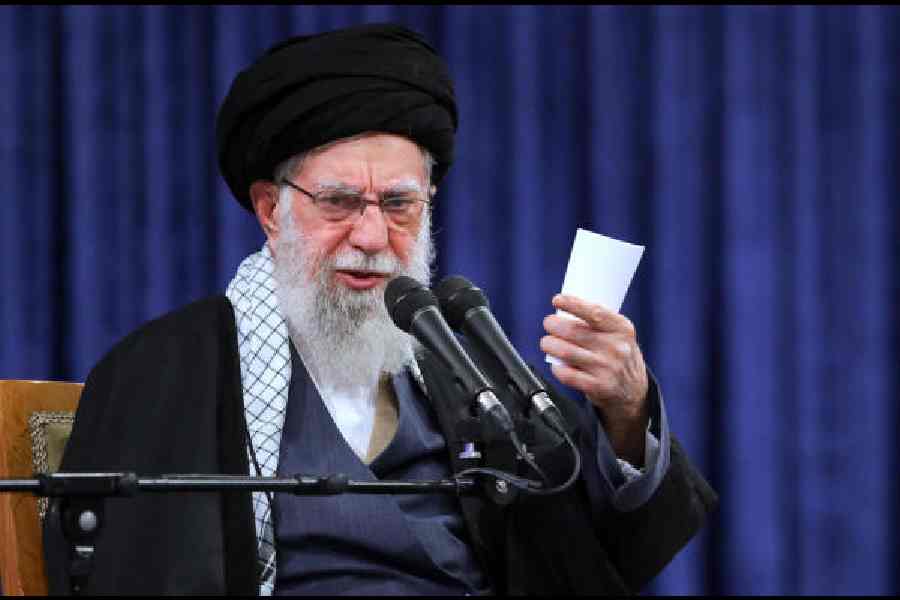
In a speech on Tuesday shortly after the talks began, Iran’s supreme leader, Ayatollah Ali Khamenei responded defiantly to Trump’s orders to send a second aircraft carrier to the region.
“An aircraft carrier is certainly a dangerous piece of equipment,” Ayatollah Khamenei said. “But more dangerous than the carrier is the weapon that can send it to the bottom of the sea.”
He also called demands to limit the range of Iran’s ballistic missiles “illogical”, arguing that such demands interfered with a nation’s right to possess weapons of self-defence.
“Any country without deterrent weapons will be crushed under the feet of its enemies,” he said.
New York Times News Service