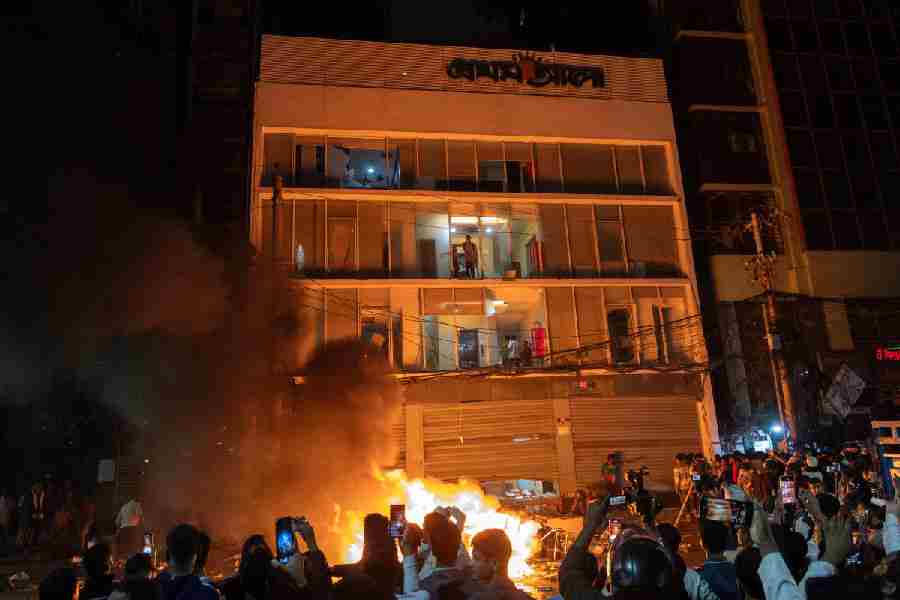
Mobs instigated and mobilised by Rightwing Islamist fanatics, online activists and pro-Pakistan forces took over Dhaka on Thursday night as the offices of two of the country’s leading media houses, Prothom Alo and The Daily Star, were vandalised, looted and torched.
The journalists stranded inside posted frantic and panicked messages on social media platforms, expressing shock and helplessness. But the security forces, which arrived late, were insufficient to tackle a mob that had no ears for words of reason.
The offices of these two media houses were attacked in Rajshahi town as well, while Nurul Kabir, editor of the English-language New Age,
was heckled.
The developments are a clear indication that Bangladesh would cease to have any media freedom if these forces continue to have their way, political observers said.
The apparent trigger for the onslaught was the news of the death of Sharif Osman Hadi, a youth political activist who came into prominence since the July 2024 protests. Hadi was to contest the elections, scheduled for February, but was shot in the head last week.
The suspected assassins are alleged to have links with former Prime Minister Sheikh Hasina’s party, the Awami League, and reportedly sneaked into India after shooting Hadi.
After Hadi’s death was announced on Thursday, fanatics called for revenge against the Awami League and India. They identified Prothom Alo and The Daily Star as among the principal agents of India and Hasina’s party operating in Bangladesh.
The Indian high commission offices in Khulna and Chattogram, Mujibur Rahman’s half-destroyed residence at 32 Dhanmandi, the iconic cultural institution Chhayanaut, the Indian government’s Indira Gandhi Cultural Centre, shops and the houses of Awami League leaders in different areas too faced vandalism and arson.
There was absolute silence from the chief adviser to the interim government, Muhammad Yunus, through the entire period of the vandalism. Everyone else who mattered in the administration too maintained silence, and the mob had a field day.
As widespread condemnation came from civil society, Yunus responded on Friday morning. He described the attacks as “barbaric”, “unwanted” and “disgusting”.
The government said the chief adviser had spoken to the editors of the two dailies over the phone, expressed his “deep sympathies” and assured them that the government was standing by them.
“These attacks on the two top media houses in the country amounted to an attack on press freedom itself. This incident has created a huge obstacle in the way of the country’s democratic progress and press freedom,” Yunus said.
His words, however, did not seem to have brought relief or assurance to anyone. When it comes to tackling organised mob violence instigated by Rightwing Islamist forces, the government has made it its habit to shower empty promises.
The Bangladesh Nationalist Party (BNP), the largest party in Bangladesh since the fall of the Awami League government last year, criticised the government’s failure to control the mob violence.
BNP spokesperson Salahuddin Ahmed said it needed to be investigated whether the violence had been manufactured to derail the scheduled February elections.
According to Dhaka-based researcher and political commentator Altaf Parvez, the media institutions were targeted because the Rightwing forces see the liberal and centrist media as one of the biggest obstacles in their path.
Parvez said the Rightwing forces had been working at the grassroots for several years, secretly during Hasina’s rule and openly after her exit. They were part of the July 2024 mass uprising against Hasina’s rule.
After Hasina’s fall, the first thing they did was to install their men in important security-related government positions. Thereafter, they launched their culture war under the garb of opposing India and the Awami League.
“The latest attacks in the heart of Dhaka, one of the most secure places in the country, have left people deeply scared. Critics of Rightwing politics fear more such attacks as the administration was absent when these mob attacks happened,” Parvez said.
Dhaka-based researcher and activist Sohul Ahmed said the “terrifying incident sounded like a death knell for all the dreams of the July 2024 mass uprising”.
The way the two most influential media houses of the country came under attack in the heart of the national capital had shaken people’s trust in the government and the administration, he said.
Ahmed said that after Hadi’s assassination, the government had failed to take effective measures to arrest the killers or the planners. Instead, it had arrested the parents and spouses of the accused.
Fanatical groups and several YouTube influencers had systematically called for attacks on Prothom Alo and The Daily Star, accusing them of being “pro-India” despite their role during the July Uprising.
While Ahmed believes that the public anger towards India and the ousted Awami League is often justified, in this case, he said, “The government attempted to conceal its own incapacity by manufacturing mass hysteria against India and the Awami League.”
Ahmed said the government’s strategic silence in the face of these attacks was nothing new, since it had over the past year remained “actively passive” during the repeated incidents of vandalism and organised mob violence.
“The tragic death of July revolutionary Hadi marks a critical moment in this transitional period. Forces of fanaticism are attempting to exploit the ongoing turmoil, and attacks on media houses are a central part of this strategy,” Ahmed said.