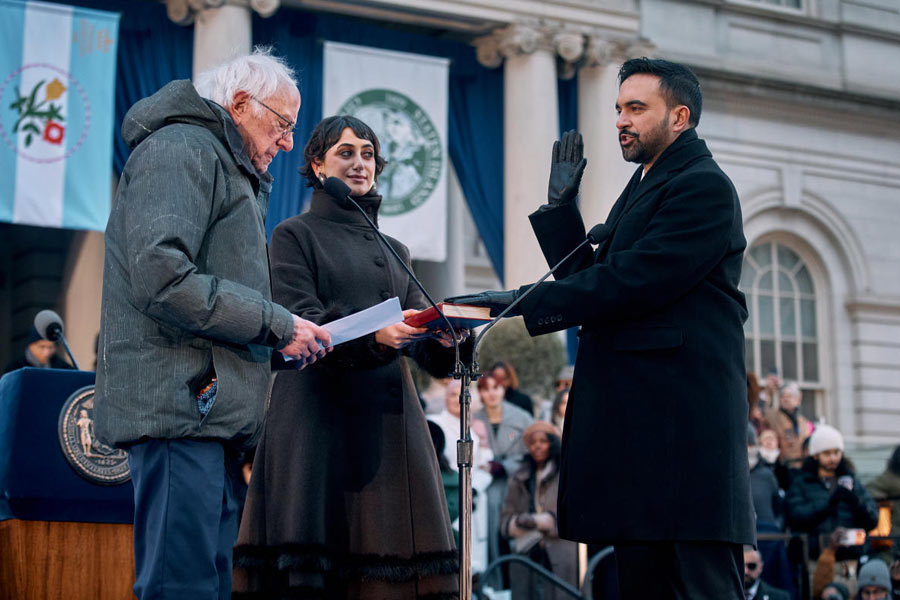
Indian-origin politician Zohran Mamdani on Thursday pledged to govern “expansively and audaciously” and deliver an agenda focused on affordability for New Yorkers, as he thanked his family from “Kampala to Delhi” after being sworn in as the 112th Mayor of New York City.
Mamdani was administered the oath of office by US Senator Bernie Sanders of Vermont at a ceremonial inauguration held outside City Hall on New Year’s Day. He had been formally sworn in earlier at a private ceremony on December 31 at a historic, decommissioned subway station, where New York Attorney General Letitia James officiated the oath at the turn of the new year.
With his inauguration, Mamdani became the first South Asian and Muslim to be elected mayor of the largest city in the United States.
In a nearly 25-minute address to New Yorkers following the public ceremony, Mamdani set the tone for his administration.
“Beginning today, we will govern expansively and audaciously. We may not always succeed. But never will we be accused of lacking the courage to try,” he said.
He added that under his leadership, City Hall would “deliver an agenda of safety, affordability, and abundance, where government looks and lives like the people it represents, never flinches in the fight against corporate greed, and refuses to cower before challenges that others have deemed too complicated.”
Mamdani, who is of Indian descent, is the son of acclaimed filmmaker Mira Nair and Columbia University professor Mahmood Mamdani. Born and raised in Kampala, Uganda, he moved to New York City with his family at the age of seven and became a naturalised US citizen in 2018.
During his speech, Mamdani expressed gratitude to his parents, who were present at the ceremony, and to his wife, Rama Duwaji. He also acknowledged the support of his extended family across continents.
“Thank you to my parents, Mama and Baba, for raising me, for teaching me how to be in this world, and for having brought me to this city. Thank you to my family, from Kampala to Delhi. And thank you to my wife, Rama, for being my best friend, and for always showing me the beauty in everyday things,” he said.
Thousands of supporters, ranging from young people to senior citizens, gathered outside and around City Hall despite freezing temperatures on January 1. Many stood for hours at a block party organised to mark Mamdani’s inauguration, cheering him on and celebrating what they described as the beginning of a hopeful new chapter for the city. Supporters wore pins, hats and T-shirts bearing Mamdani’s name and images.
Striking a note of unity, Mamdani addressed the city’s eight and a half million residents, saying they would together shape a new narrative for New York.
“This will not be a tale of one city, governed only by the one percent. Nor will it be a tale of two cities, the rich versus the poor. It will be a tale of eight and a half million cities, each of them a New Yorker with hopes and fears, each a universe, each of them woven together.”
He continued, “The authors of this story will speak Pashto and Mandarin, Yiddish and Creole. They will pray in mosques, at shul, at church, at Gurdwaras and Mandirs and temples. And many will not pray at all.”
Referring to the city’s political diversity, Mamdani said, “Few of these eight and a half million will fit into neat and easy boxes. Some will be voters from Hillside Avenue or Fordham Road who supported President Trump a year before they voted for me, tired of being failed by their party’s establishment.”
He added, “The majority will not use the language that we often expect from those who wield influence. I welcome the change. For too long, those fluent in the good grammar of civility have deployed decorum to mask agendas of cruelty.”
This was the only reference to Trump in Mamdani’s entire speech.
Mamdani secured a decisive and historic victory in the November election, defeating Republican nominee Curtis Sliwa and former New York State Governor Andrew Cuomo, who ran as an independent candidate and received US President Donald Trump’s endorsement on the eve of the polls.
In his earlier victory speech, Mamdani had taken on Trump over immigration, declared the end of a “political dynasty,” and said his election symbolised “hope” over tyranny and “big money.”
He had cited former Indian Prime Minister Jawaharlal Nehru to underscore what he described as a turning point in New York City politics.
“Standing before you, I think of the words of Jawaharlal Nehru: ‘A moment comes, but rarely in history, when we step out from the old to the new, when an age ends, and when the soul of a nation, long suppressed, finds utterance’.”
He went on to say, “Tonight we have stepped out from the old into the new. So let us speak now, with clarity and conviction that cannot be misunderstood, about what this new age will deliver, and for whom.”