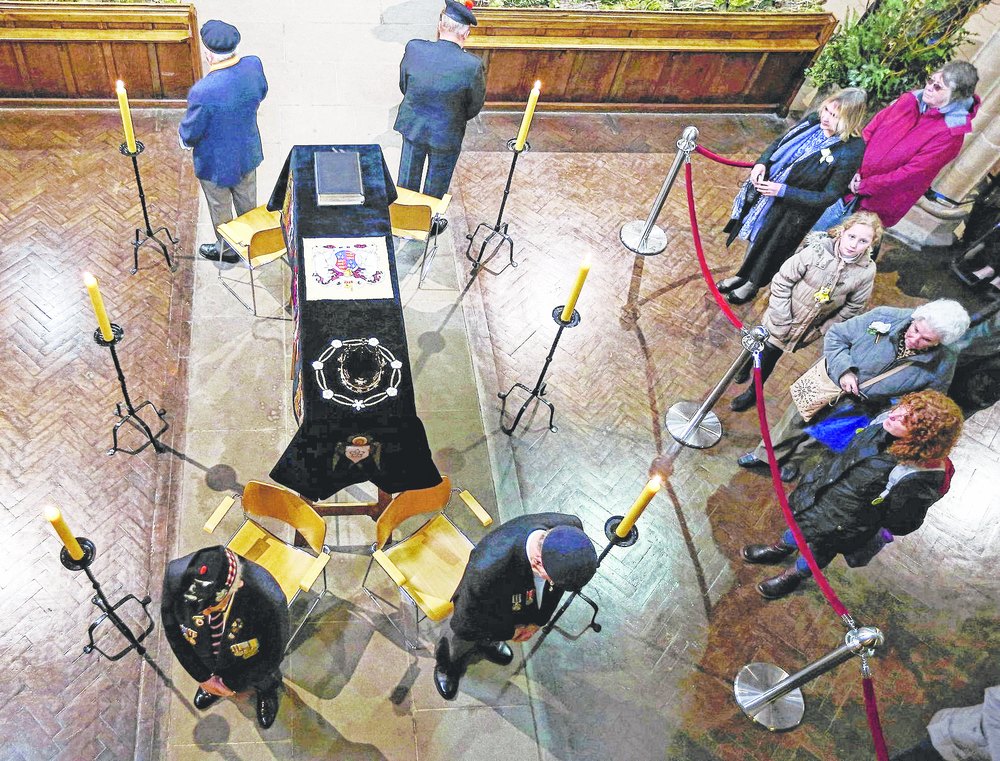

London, March 23: The remains of King Richard III, who said, "A horse! a horse! my kingdom for a horse!" (according to Shakespeare, anyway), were lying in state in Leicester Cathedral today, ready for reinterment on Thursday.
Not since Princess Diana was laid to rest in 1997 has Britain had as high profile a funeral.
If Richard were to come back to life, he would find there have been a few changes in Leicester since he was killed 530 years ago on August 22, 1485, in the nearby Battle of Bosworth Field by Henry Tudor, commander Lancastrian forces.
The victor succeeded the vanquished monarch as King Henry VII. The battle also brought a decisive end to the "Wars of the Roses".
For a start, Leicester is the first city in the UK where the ethnic minorities account for more than 50 per cent of the population. The city is where most of the 30,000 Ugandan Asian refugees settled after being expelled by Idi Amin in 1972.
"Bloody hell, I didn't realise there were so many Indians here," are likely to be the first words to escape the king's lips. "But, hark, what do I see before me but a Chicken Tikka Masala!"
Or possibly not.
In fact, there was a service commemorating the 40th anniversary of arrival of the Ugandan Asian refugees held in Leicester Cathedral on June 17, 2012. Verses from Tagore's Gitanjali rang out during the service of thanksgiving.Thursday's funeral service will be taken by the Archbishop of Canterbury, the Most Revd Justin Welby, with all the pomp and ceremony due to a king of England.
Richard's remains, discovered under a council car park in Leicester in the summer of 2012, arrived yesterday in a lead lined wooden coffin in which he will be buried inside the Cathedral.
A welcome has been extended to the king by an Indian and arguably the most important politician in the city - Keith Vaz, Labour MP for Leicester East and chairman of the powerful home affairs select committee.
"It may seem odd to the rest of the world but Leicester has taken King Richard to its heart," Vaz told The Telegraph. "We now have a strong claim to become a Royal City. What he would have made of our multiculturalism is a matter of speculation but he would have appreciated his new resting place in the Cathedral rather than a council car park."
The English love their history and Richard's funeral has caught the public imagination.
As his coffin was taken through the towns and villages of Leicestershire after a 21-gun salute, thousands of people lined the streets. White roses were tossed on the coffin for Richard was a "Yorkist" - some went to court demanding he be buried in York but a judge decided in favour of Leicester.
He was also the last English king to be killed in battle - the curvature of his spine plus eight deep wounds to the skull, along with carbon dating and DNA testing of his descendants, enabled archaeologists and historians at Leicester University to confirm the remains were those of King Richard III to an accuracy of "99.999 per cent".
The coffin placed on a gun carriage entered Leicester yesterday, briefly stopping at the old medieval city boundary at Bow Bridge - not far from Belgrave Road with its Gujarati restaurants, jewellery shops and statue of Mahatma Gandhi.
There it was met by the mayor Peter Soulsby who told a crowd of thousands: "King Richard, may you rest in peace in Leicester. We welcome King Richard back to Leicester, this most historic and modern of cities.
"No longer slung across a horse but now greeted by us with dignity and honour due a king of England."
After Richard's death, his body was stripped and, legend had it, thrown into the river at that very spot.
Actually, it was hastily buried in the grounds of an old monastery, where mechanical diggers missed shattering his skull by 1cm.
It was known he was buried in the vicinity but the discovery of the surviving part of his skeleton was entirely fortuitous. It could easily have been missed.
Richard has been painted by history as a villainous, Machiavellian character who murdered several people, including two of his nieces - the so-called "princes in the Tower" - in the pursuit of power.
But there are suggestions he got a bad press and wasn't nearly as evil as he was made out to be by Shakespeare in his play, The Tragedy of King Richard the Third.
In a service rich in symbolism yesterday the last Plantagenet king was heralded as a man born of his own time and in the words of Cardinal Vincent Nichols, Archbishop of Westminster, "a child of war" and sometime refugee - rather like the Shahs and the Patels from Uganda.
Delivering the sermon at Leicester Cathedral, the cardinal said Richard had shown his "steely ability" to pursue his ambitions in a time when power could be won "only by ruthless determination, strong alliances and a willingness to employ the use of force, at times with astonishing brutality".