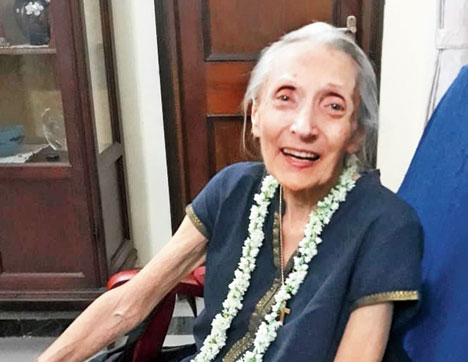

Gariahat: Orthopaedic surgeon Rajib Basu's hectic schedule leaves him with little time to know his patients beyond their medical problems. So when Christine Chowdhury, 86, came to him with a hip fracture, the last thing he expected was to be taken on a fascinating journey through the life of a World War II survivor from Belgium who married a Bengali while holidaying in London and, decades letter, settled in Calcutta.
"It's not every day that you treat someone who has lived through the horrors of the Second World War under German occupation in Europe. I saw her first as this elderly, frail lady in severe pain. By the time she left, I knew a story that is hard to forget," said Basu, who operated on Christine at AMRI Hospitals in Dhakuria about a week ago.

Christine, who is back in her Hindusthan Road residence but still unable to meet visitors, was eight years old when Hitler's forces occupied her hometown Mechelen in 1940. Her family's first instinct had been to flee the town, only to realise that it was a futile exercise.
"My mother, her parents and siblings returned to Mechelen soon after and lived under German occupation for almost five years," Rob, the elder of Christine and Dilip Chowdhury's two sons, told Metro.
Days before the Nazi invasion, there had been announcements over the radio about Belgium conceding ground to the advancing forces and Mechelen was among the towns emptying out fast. "We have heard stories from our mother about air-raid sirens and how people in the town were in the grip of fear," said Rob, who lives in Sydney.

Sneaking out of town at night, Christine and the rest of the De Meutter family had sought shelter inside a barn in the countryside. "Since the barn was already packed with people fleeing the Nazis, they had to proceed to another one. In the morning, they found out that the first barn had been bombed and most of the people inside were killed," Rob said.
The De Meutters decided to go back to Mechelen when they realised that it was pointless trying the run away from forces that had already overrun the area. The Germans had by then built checkpoints around Mechelen, rationed food and set up a transit detention camp for Jews.
This detention camp was for Jews who were to be moved from Antwerp mostly to Auschwitz-Birkenau in Poland, the most notorious of concentration camps run by the Nazis.

"Because of rationing, there was scarcity of food. Our grandmother, Maria, would stitch large pockets into her long coats. My mother was assigned to ride a bicycle to the countryside, meet farmers and get cheese, butter, milk and other supplies. The German soldiers guarding the checkpoints wouldn't frisk a child," Rob said.
For little Christine, missing out on her favourite bacon was the most painful part of rationing. Before the German occupation, she would not eat the rind of bacon. But during the war, if there was bacon on the plate once in a while, even the rind was precious, Rob said.

American soldiers liberated Mechelen in 1944, but fear was still in the air. Christine and the other children were forbade from going anywhere near the soldiers. "One day, my mother was walking with her friend when an American soldier shouted at them to stop. They started running and he followed them," Rob said. "The soldier jumped and pinned them on the ground and it was then that they realised he was trying to save them from a bomb."
The soldier gave the two girls a chocolate each. It was the first one Christine had received from anyone.

Christine would go on to become a nurse and fall in love with her future husband Dilip in London while on vacation. The Chowdhurys, who made London their home, came to Calcutta to live in Dilip's ancestral home a little more than 10 years ago. Dilip died last year at the age of 85.
Although she can't speak Bengali, Christine would rather live in Calcutta than anywhere else, Rob said.