|
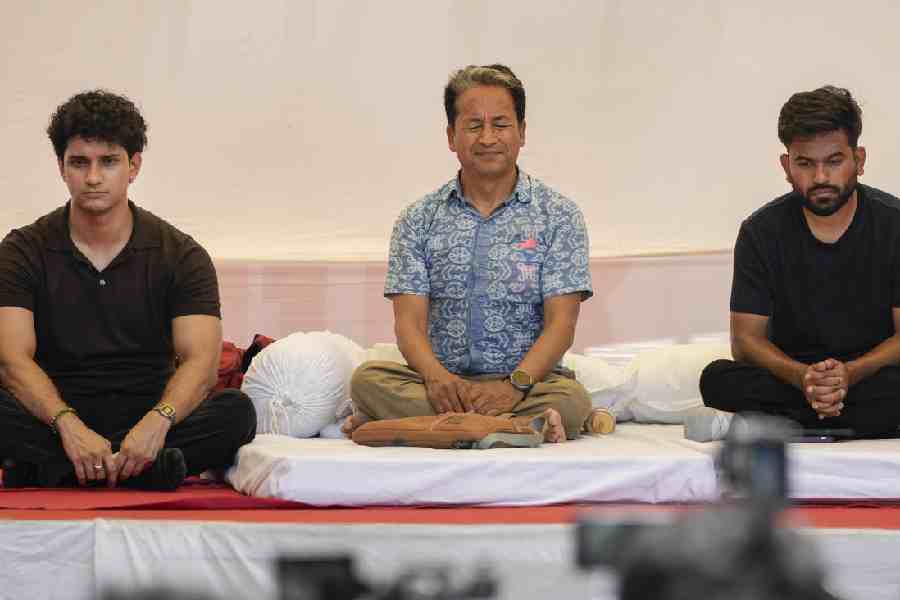
| Girls rehearse a skit on promoting vocational training on Saturday. Pictures by Sudeshna Banerjee |
A boy walks by a heap of garbage in his neighbourhood under a sign that says “Do not throw garbage”. He reads the sign, laughs at the blatant violation of the order, and tosses the empty jhalmuri packet in his own hand to add to the heap.
Soon mosquitoes and flies appear, delighted at the find. The leader of the swarm, Mogambo the “malaria expert”, starts getting requests from other swarms to be allowed to share the garbage dump. Thus the littered area is soon abuzz with mosquitoes spreading malaria, dengue and other vector-borne diseases, and flies causing cholera, dysentery and other hygiene-related ailments. The same boy appears again, clutching his aching stomach and his forehead burning with high fever. He is a victim of his own and his neighbours’ bad habits.
This is a segment of a skit enacted with puppets in Nazrul Palli, an under-developed area adjacent to the bridge near Technopolis. But it could well be a piece of day-to-day reality there, what with numerous ponds surrounding the shanties and pools of stagnant water accumulated in the shaded area under the bridge. “Last year, they had come to do some spraying. They haven’t been back since then,” said 16-year-old Nupur Sikdar, referring to civic workers spraying larvaecide. The skit would be part of the performance to be put up that afternoon in her backyard. It may not bring the civic workers but she hoped it would generate some awareness about the evils of garbage dumping.
Biren Dolui, a Class XI student who is handling two puppet flies Kini and Mini, recalled the outbreak of malaria in his Mahisbathan locality last year. “This year two are down already,” he says.
| winged army |
 |
| The skit on mosquito-borne diseases could well be a piece of day-to-day reality in Nazrul Palli, diagonally opposite Technopolis, what with numerous ponds surrounding the shanties and pools of stagnant water accumulated in the shaded area under the bridge. “Last year, they had come to do some spraying. They haven’t been back since then,” said 16-year-old Nupur Sikdar, referring to civic workers spraying larvaecide. The skit would be part of the performance to be put up that afternoon in her backyard. It may not bring the civic workers but she hoped it would generate some awareness about the evils of garbage-dumping. |
Nupur is one of the four youths from Nazrul Palli who attended a six-day workshop on “Puppetry in community intervention”, organised by the CG Block-based NGO Prayasam. The workshop addressed various social ills. “Puppetry is a very effective medium to spread social messages. The actors are all members of the target community who have been attending our alternate education centres in each area,” said Piyali Mazumdar, director of Prayasam.
Anurupa Roy of Katkatha Puppet Arts Trust, had come down from Delhi to teach the children how to make and act with puppets. The workshop started with a lesson in how to breathe life into a puppet.
The first puppets the teenagers made were of crushed newspaper. “Such puppets can be made in 40 minutes. They are about a foot high but have the anatomical details of a human figure. A novice needs to be aware where the hand, the neck or the backbone is and how much manipulation moves a puppet to what extent,” Roy said.
Then a brainstorming session was held to decide which issues the skits would address. Gender discrimination, preventive health, child domestic labour and need for vocation training are what they came up with.
Once the script was ready, they got busy making the rod puppets. “The face is an upturned jhuri (wicker basket). We covered it with cloth and pasted brown paper on it. In the eye sockets, we put ping pong balls. Then the nose and eyes were drawn. Even the hair is painted paper pasted separately. The throat is a PVC pipe. We made the mosquitoes out of plastic bottles,” Mekhla Mukherjee, a field co-ordinator for Prayasam, explained. “We use throwaway objects available locally,” Roy added.
“This is the first time I saw a puppet. We had great fun learning a new art,” smiled Puja Hazra, a Mahisbathan girl whose father sells vegetables. She plays a housewife who illtreats her child domestic help while pampering her own son of the same age. A Prayasam survey has revealed a large number of households in Salt Lake employing child labour. The skits would soon be performed in Puja’s locality too. The participants in the workshop have taken on another responsibility — of training others. Kakoli Mondal, a 20-year-old housewife, talks of the excitement the workshop has generated in her area. “Every day when we come back they ask us what we learnt that day. For today’s performance, many have bunked school to be in the audience. We have promised to teach them all that we learn.”
The first performance on a pondside drew a sizeable crowd. They would gradually travel to other under-developed areas.
“We want to stage these plays during the Puja as part of the block community programmes across Salt Lake. We request the block commitees to offer us a platform,” says Mazumdar.