 |
| DAN HOYLE |
It can be hard to break away from the sedated luxury of Hulu free-streaming movies and the mild climate of my home of San Francisco. On arriving in a new place such as Calcutta, there is always at first the haze, the lack of perception, the clogging of the antenna by the endless honking horns, the humidity that turns my smart-looking research shirt into a wet, dripping cloak within 10 minutes of walking, the familiar tout greetings of “Hey my friend, America! You need McDonald’s/cold beer?”
But since I am stationed in a neighbourhood in south Calcutta, and am lucky enough to stay with a generous and warm family of friends, the adjustment period was brief.
On the third day, I was at the Mohun Bagan football match, where the home side thrilled the crowd with a sloppy but satisfying 2-0 victory, and mourned the moving on of beloved Brazilian hire Jose Barreto, saddling him with a garland so big it would fell lesser men. Later, I confirmed Calcutta’s sporting spirit in the stampede towards the Eden Gardens to watch this city’s great champion cricket team [Kolkata Knight Riders] take on the Mumbai Indians.
At the Jadavpur Coffee House, three committed intellectuals allowed me to join them in their nightly adda to discuss art, politics, and humanism. Deepankar, wild-haired, wide-eyed, face griped by the urgency of centuries of ideas, gives a riveting discourse on the decision to embrace nostalgia over consumerism, the preservation of oppressed Indian cultural practices by a small band of European intellectuals in the 1800s, and his dual devotion to being a Brahmin intellectual priest and a Western rationalist who rejects the inhumanity of the caste system.
The Bengali gift of gab, the suspicion of capitalism, the unpretentious lust for ideas manifests itself most directly here. “Read all night, talk all day,” says a self-identified failed film-maker (and aren’t we all failed film-makers? Here, it’s accepted, even valued).
The reverence for art and ideas is moving — on Tagore’s birthday, the shrines, devotions, and playing of Rabindrasangeet throughout the city made me wonder: would America ever celebrate Whitman thus? I’m afraid not.
 |
The intellectual intensity can be comically bewildering too. After a long adda at Presidency Coffee House, I rushed outside, desperate for mineral water, and could only see books stretching out for miles. In what other place is it easier to find an old first edition novel than a bottle of water?
D for Diversity
I was honoured to contribute to the stew of art and ideas in Calcutta later that week when the American Center sponsored a performance of excerpts of my solo show The Real Americans. It was hard to know if the American reference-heavy script would resonate in India, but the performance received an energetic response from the crowd, with lots of extended laughter and clapping at various points.
What emerged in the post-show discussion were the similar challenges India and the US face in maintaining an inclusive and meaningful democracy in societies with so much diversity and plurality.
And what diversity. In north Calcutta, I bought chai from a 72-year-old man who had three sons who had died of diseases, a fourth son who had been missing for 23 years, two daughters who had married, and a middle daughter who had also died. He said he was not well, he had problems with his knees, and he was partially blind. He tended his wood-stump fire, inhaling smoke all the while, selling small cups of that addictive, sweet, milky tea. His life seemed a tragedy, but when I thanked him for the interview, he turned and gave a smile of deepest grace and tenderness, hands raised and twisting.
At risk of dragging another soggy Western yoga mat sensibility into an infinitely complex country, I can only describe that it felt like his soul leaped out from his body and thumped my chest. I reeled back two steps in shock, and thanked him again. His body curled up further and his smile widened and sweetened even more.
A few nights later, I attended Abhishek’s [Dutta] fashion show at the Stadel hotel, where Calcutta’s glitterati twinkled poolside. Or a few nights back, I found myself hurtling through Calcutta’s streets in a hatchback as ear-splitting dubstep music propelled us to a rooftop party.
Around midnight, as we bought biscuits and biryanis at a roadside stop on our way home, a fresh looking young man in stonewash jeans and basketball shoes rolled up on his gleaming new motorbike.
I took photos as he and his friends posed, but what was outside the frame told a second story, as two elderly women beggars waited with sad eyes, pleading for change. I didn’t feel it right to include them in the photo, didn’t feel I could do so without offering them money, and then paying to photograph people is always bad form, especially as a researcher, so I left them out of the frame. But I won’t forget the moment, for it seemed to contain, in miniature, the immense rise and huge challenges that lie ahead for India.
You cannot live alone with your problems in Calcutta. And you cannot forget how big the world is — it is in front of you everyday, and its intricacies are infinite. Suffice it to say that every evening, sitting cramped in a tea stall, slowly drenching my shirt in the muggy heat yet again, with horns blaring constantly, I feel completely at home, in awe of a world that is always streaming for free.
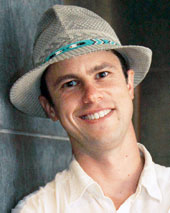
Dan Hoyle is an American stage writer and actor, known for his brand of journalistic theatre. He was in Calcutta to research the adda culture in the city for his next project and also stage excerpts of his solo show The Real Americans