 |
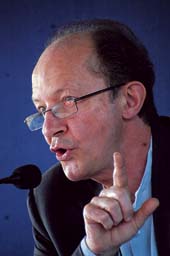
| Philosopher Giorgio Agamben at the lecture. Picture by Bishwarup Datta |
Giorgio Agamben, a leading contemporary philosopher, has an interesting highlight in his CV. He acted in Pasolini’s The Gospel According to St Matthew.
Agamben was in town to deliver a lecture titled The Kingdom and the Glory at the Centre for Studies in Social Sciences. Christian theology plays a very important part in his philosophy.
The Italian, who is carrying forward the work of Michel Foucault, is well-known for his critique of modern states, particularly the US response to 9/11. In his book State of Exception (2005), he warns against a generalisation of the state of exception in the modern states with a piece of law like the USA Patriot Act, which means a permanent state of imposition of the state of martial law and emergency and a legitimisation of this state as a ‘dominant paradigm’ for governance.
Three years ago, he refused a lecture visit to the US as he would then be required to give up his biometric details, which would reduce him to a state of bare life (zoe).
It was similar to what Nazis did to their prisoners. The other figure that runs through this state of emergency is of the ‘homo sacer’, the ironic name for the sacred man under Roman law, who has committed a crime and, therefore, can be killed, but not sacrificed. The law excludes him, yet he remains within its power. It’s the status accorded to prisoners, from the country and abroad, in the US and other modern states. Guantanamo Bay, for Agamben, operates within the “state of exception”.
But at the lecture on Friday, Agamben spoke of his more recent work on economic theology. He said he was using the model of Christian economic theology to better understand the present — the functions of power in the governance of modern states.
This research, said Agamben, had a lot to do with the amazing discovery of the role played by the Greek term “oikonomia”. Two political paradigms derive from Christian theology: political theology, which located in one God the transcendence of sovereign power.
From political theology, modern theories of sovereignty are derived. But economic theology, based on the idea of oikonomia (administration of house), goes on to explain more of what is happening now.
Economic theology goes on to explain the de-politicisation of the world and the dominance of economy over other aspects of life. The concept was necessary just when the Trinitarian doctrine began and theologians faced trouble. Economic theology reconciled the ideas of one God and Trinity. The early Church fathers explained that God in his essence is one. But he can, for the economy of his household, divide himself into three. It is one of the first managerial devices that have stuck on.
Agamben feels theologians made oikonomia the essential theological paradigm, leading to the understanding of divine life and the divine governance of earth as an economy, not politics. Contemporary economy is not exactly a secularised version of economic theology. Nor it is explanation of capitalism.
But its close association of the governance and economy alludes to many living, earthly global powers: their kingdom and glory. You know who.