
When one meets the gentle artist Sushen Ghosh, who only speaks in such subdued whispers that one has to keep one's ears pricked up during an entire conversation, it would be impossible to figure out that he could be so, shall we say "calculating".
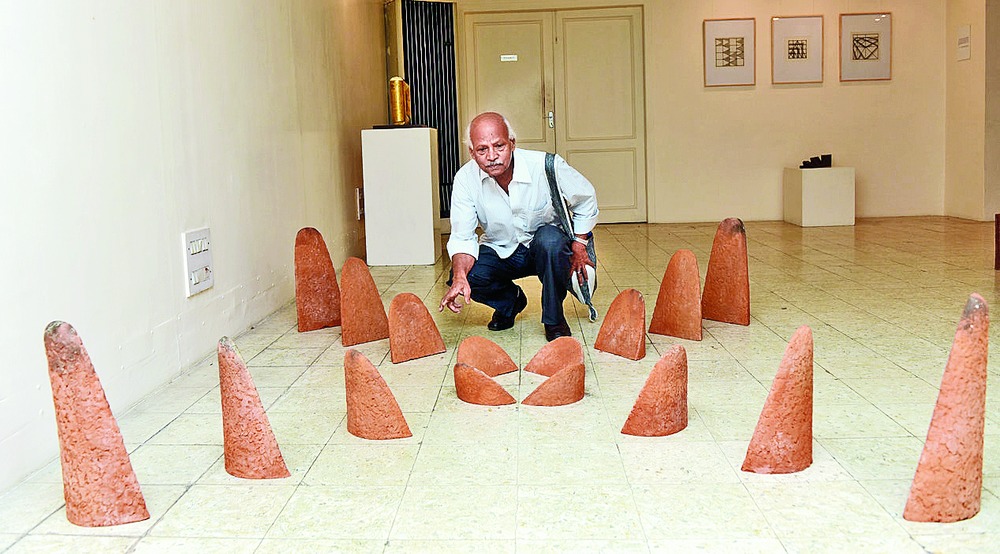
Then the relevance of figures and mathematics to his works sinks in as one sets eye on the spare terracotta and metal forms that, irrespective of size, have the aloofness and dignity of monoliths. When the artist, surprisingly lithe for a 76-year-old, arranges them in a sequence that emphasises their swelling or receding order, one realises that this rhythm has much to do with the complex form of musical compositions. This is what he called "evolution and reverse evolution."
Ghosh, whose exhibition of sculptures, drawings, paintings and serigraphs, Frozen Music, opens at CIMA Gallery on Friday, explains that he still plays the flute and used to practise gymnastics in his youth. Ghosh goes back to Santiniketan of yore when he was trained by the likes of Benode Behari Mukherjee and Ramkinkar but learnt to appreciate modernists like Matisse, Paul Klee and Cezanne and Bauhaus at the same time. He has great admiration for Brancusi and the manner in which he turned a face into an ovoid shape, and Modigliani, and indeed they left their mark on Ghosh.
"Benode Behari's compositions were perfect. All these artists have something in common although the Modernists were analytical," says Ghosh. In Santiniketan, the stress was on form, tactile quality and appearance, rather than tonality. The integrated course for students included painting, sculpture, graphic art and design, and this explains the strong designal element in Ghosh's work.
The exhibition is all about Ghosh's evolution as an artist. His bronzes dating back to the 1960s belong to a period when Ramkinkar obviously held sway. The massive heavily dented head of the legendary sculptor and the woman with an overly elongated neck already show that Ghosh was trying to strike out on his own. He is trying to lay bare the essentials.
Here too, as in his later works, each piece bears the imprint of the sculptor's fingers as he constructed these forms. So, even the most austere of these are never lacking in human warmth.
Ghosh's lightning sketch of Dame Petelote in flight is typical of those times but it is his kinetic drawings of dancing forms from a temple that have a bearing on the rhythm innate in his later work. One of his most significant bronzes from 1964 is the powerful and dynamic figure of a man with his hands and head upheld. It is of medium height (99cmx38.1cmx20.3cm), but one can literally feel an upsurge of emotion as his disproportionately large chest swells out. What Ghosh said about Nandalal Bose - the master's drawings deviated from academic realism and this anomaly was justified by their rhythm - applies to his own sculptures too.
In 1970, the same barrel-chested man has been reduced to his essentials - an upper half that reminds one of folk toys and legs like stilts. In yet another variation, the figure has been deprived of all other signs of humanness, save the heavily pitted torso and legs. This was the year when Ghosh was in London doing advance diploma at Goldsmiths, long before the famous art college had started producing the likes of Damien Hirst.
Here Ghosh came face-to-face with an extensive range of original work in London's museums, and it was here that the abstract principles of mathematics and geometry first began to mould his sculptures. As he speaks of Pythagoras and the mathematical expression of musical notations it becomes clear that through his work he is trying to revert to a rudimentary stage, and he experiments with permutations of geometric forms and grids in his sculptures, serigraphs and drawings to achieve this.
Ghosh said that if one observed Benode Behari's murals, one could discern a sense of movement that draws the eye from one end to the other. In Ghosh's sculpture too one sees the same unfolding of forms that has the lyricism of a dance and the grace of a hand-held fan being unfurled. "It is as if a pebble has been cast in a still pool and ripples have started to form," signs off Ghosh.