
Pic: Manasi Shah
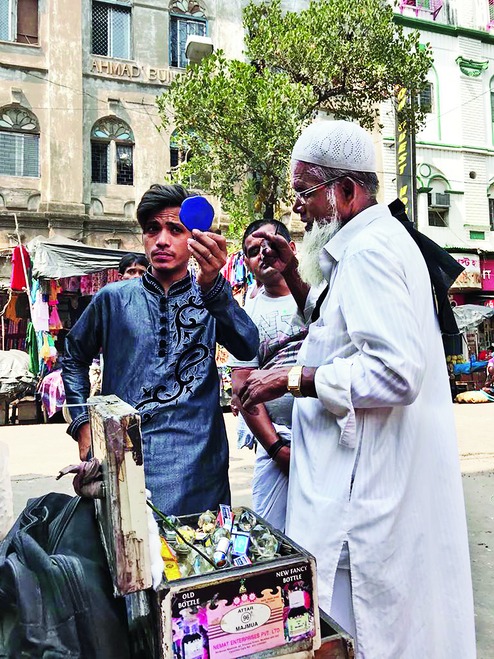
Athar Ali's eyes are brimming with tears. And after a while they spill forth, roll down his cheeks and fall onto his collared, embroidered coral kurta. Immediately, the bearded, bespectacled man standing before him, takes a piece of cloth flung across his shoulder and starts to rub his eyelids. The second man is Mohammed Nayeem, a 58-year-old surmawala, referred to as chacha by Ali. After a couple of minutes, Ali opens his eyes, and there it is - a run of jet black surma on the lower lids of deep brown eyes.
Mohammad Lal is awaiting his turn after Ali, at Nayeem's corner. " Bohot din ke baad lagaye ho, isliye jal raha hai. Jo log ko roz lagane ka aadat hota hai, unhe itni takleef nahi hoti... You are doing this after a long time, which is why your eyes are burning. Those who do it regularly do not suffer so much discomfort," he tells Ali, whose eyes are by now bloodshot from the ministrations.
We are in one of the many bylanes adjoining central Calcutta's Nakhoda Masjid on Jumma - the Islamic name for Friday. The afternoon namaz has just got over and flocks of men are heading out of the masjid. Some of them are going back to work and some are queuing up in front of the two surmawalas stationed close to the masjid entrance.
Surmawala Mohammad Izhar's small frame is eclipsed by the long queue of customers. The 45-year-old has been in this business for more than a decade now. He does this only on Fridays; the rest of the week he is either pushing a cart, helping someone change tyres or doing other odd jobs for survival. He doesn't have much time to spare. Nayeem is no less busy but more garrulous.
Nayeem, like the other surmawalas, carries a stool and a wooden box. The box contains some black sticks, cotton buds, mirrors and itr bottles. Preserved in special glass vials and metal bottles is the surma, a fine powder that comes from the surma stone. It is not the same as kajal, though.
With a thin black stick, Nayeem prods some powder out of a bottle. This is followed by some swift strokes on Lal's lower eyelids. Lal is calm and relaxed, unlike Ali.
This time too, Nayeem takes the black cloth and covers Lal's eyes with it, then rubs them gently. This way, we are told, the surma settles in and the eye massage soothes the burning sensation. When Lal opens his eyes, they are red, though he insists there is no discomfort.
Now Nayeem takes another stick, wraps some cottonwool around it, dips it into one of the bottles filled with water and then cleans the inside of Lal's eyes. "See, this is how we clean the eyes. All the dirt and dust particles that might have settled in the eye come out this way," he tells us as he discards the used wad of cotton and hands over a mirror to Lal. The entire exercise costs Rs 5.
Muslims apply the surma at specific times of the day, says Ali. Some apply it before namaz, some apply after, some before retiring for the day, some every day and some only on Jumma. He says, "Surma lagana sunnat hai... It is all about respecting the Prophet and following his teachings."
The surma comes in many colours. "Madhu, laal, kaala, gulaabi, safed... Yellow, red, black, pink, white," Nayeem briefs us. We understand that it is as much about faith as about style. The younger customers preen before the mirror after application, very Shah Rukh Raees Khan.
And just when we start to wonder why we don't see women applying the surma, there comes Marzina Khatun with her eight-year-old son Raju Sheikh in tow. Khatun is a regular customer, Nayeem tells us. On Jumma days, she comes to Nayeem for the surma and the rest of the time, she does it herself. She is wearing a niqab, and only her bright eyes are visible. Her little boy is insistent, he wants some too, but his mother is afraid he will not be able to bear it. She promises to let him have some itr instead, once she is done.
Nayeem brings out a cut-glass bottle filled with a canary yellow liquid that smells of beli or jasmine. Nayeem puts a drop of itr on some cottonwool and rubs it on Raju's tiny wrists and clothes, and tucks it in the outer fold of his ear.
Itr is made by crushing flowers and extracting the oils. Says Nayeem, "The most expensive ones are Oud [derived from the tropical agar tree] and Mushk [derived from the glandular secretions of animals]. Beli, Chameli, Gulab, Rajnigandha are cheaper, they sell more."
Does he have enough to do, we ask. Of course, he replies. Everyone comes to him as he roams the streets of the city daily. He says with pride, "Gujaratis, Marwaris. Muslims come to me mostly on Jumma, but Hindus come to me on all days at all times. Thelewaale, dukaanwaale, sab lagwate hain."