 |
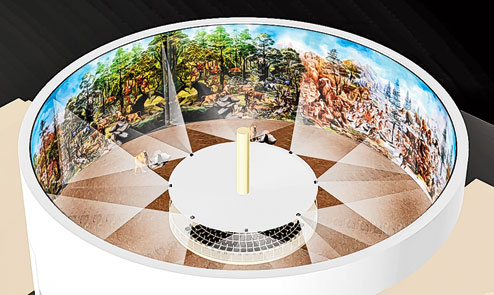
| The surround vision plan of the Science Exploration Hall at Science City |
You have heard of surround sound. This one promises to be surround vision! A Science Exploration Hall is coming up at Science City which will have a four-storey-high cylindrical projection screen providing an immersive experience. “Imagine being seated in a theatre with a screen all around you. The chairs, on a platform in the centre, will be partially revolving. Eight to 12 projectors will be used to project the image on a screen 120m in periphery and 11m in height,” said G.S. Rautela, director-general, National Council for Science Museums.
The cylindrical building for the hall stands ready, next to the Space Theatre. “We are working on the interiors now. It is supposed to open by next March,” he said. The bill has come to Rs 34 crore.
The authorities want the inaugural film to be on the evolution of mankind. “Our experts have written the script. We have floated a global tender for the production,” Rautela. The film will be for 12-15 minutes and will be shown multiple times a day.
There will be two other rides on the first two floors. On the ground floor one can undertake a journey seated in moving trolleys to experience the evolution of life, from the Big Bang to the emergence of modern man. The first floor will house two exhibitions, one on the heritage of science and technology in India and the other on the wonders of cutting-edge technology.
The Space Theatre with an overhead dome screen that currently beams 70mm films in the analogue format will be upgraded to digital. The theatre is India’s first and largest, with a 120mx11m screen.
“Once we convert to digital, just a single computer would be enough to project a film. It’ll be easier to change films and screen multiple films one after another. We can acquire new titles too,” said Science City director Arijit Dutta Choudhury.
A new large-format film is being screened at Space Theatre, titled Grand Canyon Adventure: River at Risk with breathtaking 3D shots of one of the world’s seven natural wonders. The 45-minute film in English is screened from 11.30am to 6pm, with the last show on weekends at 7.30pm. Tickets are for Rs 50.
As good as it gets here!
 |
| Jack Nicholson in As Good As It Gets, the inspiration for Lokkrishti’s play |
Jack Nicholson is coming to the Calcutta stage. Well, his Oscar-winning screen avatar Melvin Udall is. Theatre group Lokkrishti started off its silver jubilee celebrations recently with a public play-reading of its next production, Rom Com, inspired by Nicholson’s As Good as It Gets.
“Usually such script-reading sessions happen behind closed doors. Last year, when we staged Biley on Swami Vivekananda’s 150th birth anniversary, we had called our friends. This time we decided to open doors to the public and seek their opinion as well,” said group director Phalguni Chatterjee at the reading at Bangla Akademi.
Seated in the front row was Debshankar Haldar, who will essay the lead role of Udall’s Bengali persona, Ananta Dasgupta. After the introductory speeches, playwright Ujjwal Chattopadhyay started reading the play about an author with an obsessive compulsive disorder (OCD) and the waitress he must be served by.
After the reading, many audience members spoke up. “In the first scene, why does the servant express surprise at Dasgupta’s fixations? If he has been in his employ for long, he should have got used to such demands,” said one. The feedback would be acted upon, promised the director.
“Nicholson’s Udall was on my mind when I penned Ananta Dasgupta, though I have taken liberties with the story to suit our milieu,” said Chattopadhyay.
Lokkrishti will hold a three-day theatre festival from September 13 as part of its jubilee celebrations. “When we started on September 5, 1989, we hardly thought we’d survive so long, just like a batsman coming out to bat focuses on getting off the mark rather than hitting a century,” smiled Chatterjee.
Language count
The first all-India linguistic survey in nearly a century is ready to be released. Facts and figures collated from seven years of research and four years of fieldwork, conducted by The People’s Linguistic Survey of India (PLSI) under the aegis of Baroda-based NGO Bhasa Research and Publication Centre, will be part of a series of 50 volumes to be published by Orient BlackSwan. The first five books will be launched in Delhi on September 5 at the Mahatma Gandhi Memorial to mark the 125th birth anniversary of Sarvepalli Radhakrishnan.
PLSI chairperson and Sahitya Akademi Award-winning writer Ganesh N. Devy said at an event in Calcutta recently that there are at present 780 languages in India.
“India is 10 times richer in terms of languages than the rest of the world. Bengal accounts for five per cent of the country’s languages,” said Devy, who is also the founder of the Tribal Academy at Tejgadh, Gujarat.
Bengal has been found to have 38 spoken languages and 28 of them, including Urdu, Lepcha, Nepali, Bangla, Santhali, Bedia and Mundari, have made it to the books as separate chapters with focus on their history, words and available literature (both oral and written). Ten endangered languages with limited information have been clubbed into one chapter. The volume on Bengal — Languages of Paschimbanga — will be released both in Bengali and English.
Devy put the total cost of the project at Rs 80 lakh. The PLSI’s partner in the project was the English department of Vidyasagar University, West Midnapore. Jadavpur University’s Centre of Advanced Study in Comparative Literature and Centre for Translation of Indian Literatures also pitched in.
“We started work in 2010 with a workshop at Visva-Bharati. The chapters on tribal languages have inputs from members of the communities,” said Indranil Acharya of the English department at Vidyasagar University.
Writer-activist Mahasweta Devi, with whom Devy set up the Denotified and Nomadic Tribes Rights Action Group in 1998, lent her support to the project. “It is a very important work. But I have seen tribals communicate through various ways other than words. You don’t have to communicate everything through language,” she said.
Alphabet art
 |
| Angry birds and more on a city wall as part of the Alphabet Project. Picture by Arnab Mondal |
Dirty walls of the city have turned into a canvas for the expression of art. Recently, city-based young artists Jus, Snik, Shock and Elek2 have been spotted spray-painting letters on walls near the Lake Gardens flyover, as part of the Alphabet Project. Their aim is to recreate the 26 letters of the English alphabet in different styles and promote their art “in a city that is uninitiated”.
“We wanted to show people what we do and our various styles,” said Snik.
What sets each letter apart is the artist’s individual style, use of colours and fonts. One makes “O” look like a bomb while another paints “Q” resemble the red Angry Bird. Their place of work are usually grubby walls that people don’t even give a second glance.
Delhi-based graffiti artist Zine was also in town recently. Known for his works at the Sunburn Festival in Goa, the Hornbill Festival in Nagaland and the Buddh International Circuit, Zine chose a wall near Armenian College.
“When it comes to graffiti, India is never on the map. This might be an expensive hobby, but I have earned a lifetime of experience in this art form,” said Zine.
(Contributed by Sudeshna Banerjee, Chandreyee Ghose and Sneha Dutta)