Without delivering a single overtly political line, Union home minister Amit Shah on Wednesday crafted a carefully calibrated message for traditional Hindu voters before the Assembly elections, presenting himself not as a statesman but a pilgrim on bhakti marg (path of devotion).
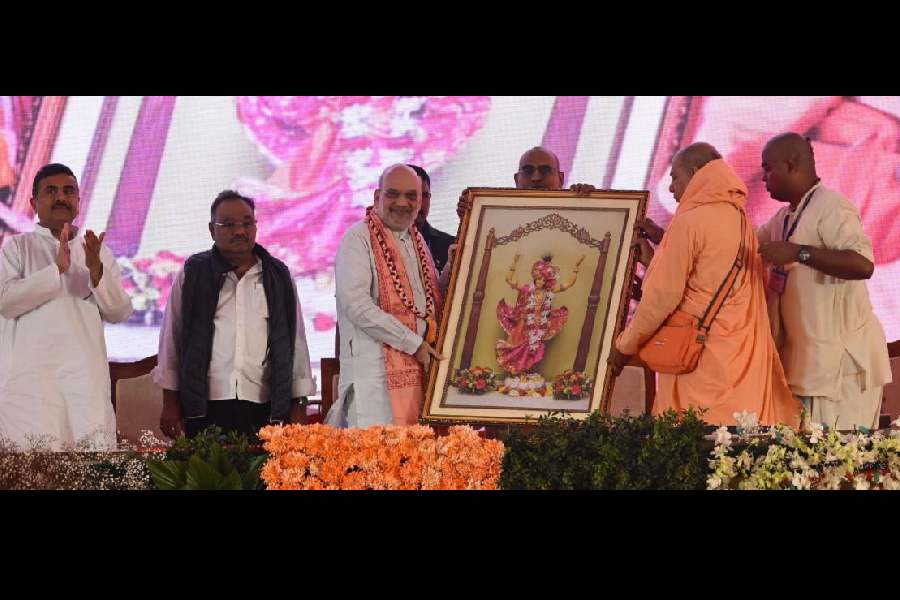
Addressing thousands of devotees at the ISKCON parking ground in Mayapur to mark the 152nd appearance day of Bhaktisiddhanta Sarasvati, Shah began his speech with chants of “Hare Krishna,” invoking the spiritual legacy of Vaishnavism, and paid homage to icons such as Bhaktisiddhanta Sarasvati, Hari Chand Thakur and Guru Chand Thakur, linking devotional practice with social reform in a move widely seen as both symbolic and strategic.
Stressing that he had come not as the country’s home minister but as a devotee carrying greetings from Prime Minister Narendra Modi, Shah said, “Today before leaving for Mayapur I met Prime Minister Narendra Modi and told him that I am going to Mayapur and he conveyed his sincere greetings saying Hare Krishna. Today I came here not as the home minister, rather as a devoted follower of Chaitanya Mahaprabhu.”
Shah tried to position himself firmly within the Vaishnav spiritual continuum associated with Chaitanya Mahaprabhu.
The tone and setting underscored a larger political subtext.
By blending devotion with outreach to traditional Hindu communities — particularly Vaishnav monks and the Matua sect, which holds electoral significance in several Bengal constituencies — Shah appeared to be reinforcing the BJP’s attempt to consolidate religious identity into political capital.
Alongside devotees, Shah chanted “Hare Krishna”, which was read by political observers as a deliberate attempt to align faith with electoral mobilisation without explicit campaigning.
Shah was accompanied by Union minister Bhupendra Yadav, leader of the Opposition in the Bengal Assembly Suvendu Adhikari and Bengal BJP president Samik Bhattacharya, signalling the political weight behind what was framed as a spiritual visit.
“Today I found the opportunity to enlighten myself through my visit here which in earlier occasions could not be made possible despite efforts,” Shah said, drawing applause from the gathering.
Praising Bhaktisiddhanta Sarasvati’s reformist vision, Shah said the spiritual leader dispelled the notion that modernity and religion were incompatible.
“He made it clear that being a modern person does not mean becoming an enemy to religion. Religion can progress through modern concepts and goes in parallel,” Shah said, adding that Sri Chaitanya’s Bhakti movement had rescued people from suffering and ignorance.
He also lauded the efforts of ISKCON and the Gaudiya Saraswata tradition for carrying forward the devotional legacy across generations.
Paying tribute to both Bhaktisiddhanta Sarasvati and A.C. Bhaktivedanta Swami Prabhupada, Shah said: “These two great personalities not only carried forward the Bhakti movement initiated by Sri Chaitanya Mahaprabhu, but also connected it with modernity and paved the way for the spiritual upliftment of youth and people across the world.”
On a philosophical note, he said: “The real Guru enlightens his disciples. Persons with Krishna in mind come up with the sense of service and help others for their progress is the real Guru. Veda said that knowledge without bhakti creates pride. Knowledge with bhakti brings transformation.”
Referring to ISKCON’s outreach, Shah praised the organisation’s translation across languages and distribution of the Bhagvad Gita.
“I used to travel a lot across the country and I found the Gita translated in all languages published by ISKCON. Everyone, from homemakers to laptop-savvy youth, is being inspired by Gita and ISKCON is spearheading the holy job of the Gita movement. Modi ji, whenever any state head comes to visit, gives a copy of the Gita as a message of welfare to the world,” he said, reinforcing the spiritual-national narrative that has become central to the BJP’s cultural messaging.
Referencing the electorally influential Matua community in south Bengal, Shah said: “Shri Hari Chand Thakur and Guru Chand Thakur tried to connect the community to this bhakti marg through social welfare.”
Shah also expressed hope that by 2047, India would emerge as a developed nation while carrying the message of Sanatan Dharma to the world.
Trinamool Congress questioned the intent behind Shah's spiritual visit. Party MP Mahua Moitra remarked that voters would ultimately judge the motive behind Shah’s carefully calibrated outreach.