 |
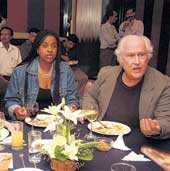
| Fernando E. Solanas with his partner at a festival dinner. Picture by Aranya Sen |
The 13th Calcutta International Film Festival has come to an end. Despite the trouble in the state that flowed into the premises of the festival venues, the films of Fernando E. Solanas, the Argentine director who has been a favourite of the city especially since his last visit here in 1994, were one bright spot. At 71, Solanas came this year with his five-film package, including Tangos — The Exile of Gardel, The Voyage, The Cloud, Social Genocide and The Dignity of the Nobodies. The organisers arranged for a surprise screening of his recent work, the final part of the documentary series Argentina Latente (though without subtitles!).
It was significant that Solanas, whose Toward a Third Cinema, co-written with filmmaker Octavio Getino was the manifesto for the Latin American Third Cinema movement of the 1970s that came down on neocolonialism, capitalism and Hollywood films as mere money-making entertainment, was visiting the city last week. The filmmaker believes that there’s nothing more dangerous than censorship, lack of information and misinformation, because through these mediums demons are invented. He was agitated by the intense police security at the festival that he felt prevented him from meeting the media and people.
His films say the same things. In Tangos he captures the anguish of a group of exiles who emigrated to Paris in the wake of the repressive era of dictatorship. In that other land, they try to recreate the tango, a part of their lives. The feature Sur (South) rejects linear narrative to incorporate dreams, memories, fantasies and tango performances which bring out their inner lives of the characters. In The Voyage a young Argentine boy’s search for his father becomes an allegorical journey across the Latin American continent. The theme of identity also runs through the film The Cloud that takes up the issue of modernisation during the turn of the century as it documents the struggles of a small group of actors to save their independent theatre from commercial forces. And those who had not been lucky enough to see The Hour of the Furnaces got a chance to grasp the genius of Solanas as a documentary maker through the films Social Genocide and The Dignity of the Nobodies, the first two of a four-part documentary that looks at the political history of Argentina, from the fall of the dictatorship in 1983 through the economic crash and social collapse in 2001 to the present day. And the dignity and courage with which the Argentinean people bore their misfortunes.
At a crowded workshop at Jibanananda Sabhaghar, Solanas also spoke of strategies of filming. He spoke of low-budget film-making that would also make allowances for adverse political situation. He advocated shooting with Mini-Cams and MiniDVs to cut down costs. Also, in an atmosphere of censorship and political control, to keep a second screenplay ready, for you don’t know — circumstances may not allow you to shoot the way you want to at all!
Are filmmakers here listening?