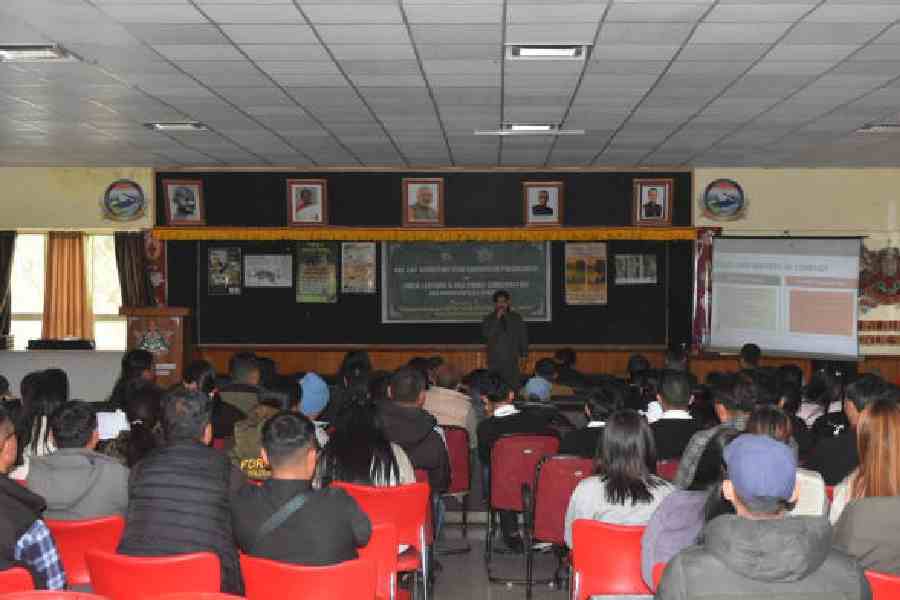
The Sikkim forest and environment department organised a daylong workshop on the conservation of the snow leopard and red panda at Mangan in north Sikkim on Saturday following an increase in the sighting of the animals in the Himalayan state.
The workshop, hosted by the forester of Khangchendzonga National Park (KNP) and the Mangan wildlife division, also discussed the mitigation of human-animal conflict.
According to department sources, Sikkim recorded a population of 21 snow leopards across the higher reaches of the Himalayan state in the recent past.
The snow leopard is listed as ‘vulnerable’ in the International Union for Conservation of Nature (IUCN) red list, with its global population estimated at only around 10,000. Experts fear the number could decline further by 2040.
“Poaching and habitat destruction due to development activities are among the major threats to the species,” a source said.
In India, the snow leopard’s habitat extends across high-altitude regions of Jammu and Kashmir, Ladakh, Uttarakhand, Himachal Pradesh and Arunachal Pradesh, which are generally at elevations above 14,000 feet.
Sikkim is also home to around 300 red pandas, the second-highest population in the country, officials said.
“Keeping in view the vulnerability of these threatened species, the workshop was primarily organised to strengthen conservation efforts,” a source said.
The workshop brought together officials, stakeholders and members of the local community.
Resource persons delivered detailed presentations on Sikkim’s rich wildlife heritage, including its diverse flora and fauna, protected sanctuaries and national parks. The sessions aimed at enhancing public understanding of the fragile mountain ecosystem and the importance of sustained conservation measures.
Among those present were Pema Wangchen Namkarpa, additional district magistrate of Mangan; Suraj Thatal, conservator of forest-cum-field director; Karma Wangyal Lepcha, divisional forest officer of KNP; Karma Gelay Lachungpa, DFO (Wildlife); and other experts from the forest and environment department.
Speakers underscored the shared constitutional responsibility of the state and its citizens in protecting and improving the natural environment. They observed that increasing human activity and use of natural resources have intensified pressure on wildlife habitats, necessitating informed coexistence rooted in awareness, responsible coexistence and respect for nature.
Experts also highlighted Sikkim’s ecological significance, noting that although the state accounts for only about 0.2 per cent of the country’s geographical area, it supports nearly 25 per cent of India’s biodiversity.
The presence of 36 species of rhododendron reinforces its status as a biological hotspot and underscores the need for sustained conservation initiatives.
The workshop outlined several recommended interventions, including the formation of rapid response teams in coordination with the animal husbandry department, empowerment of eco-development committees, strengthening of disease investigation laboratories, and regulation of dog movement along tourism trails.
Vaccination, sterilisation and registration of dogs accompanying grazing herds, scrutiny of live animal supply chains, and intensified awareness and enforcement drives were also discussed, officials said.