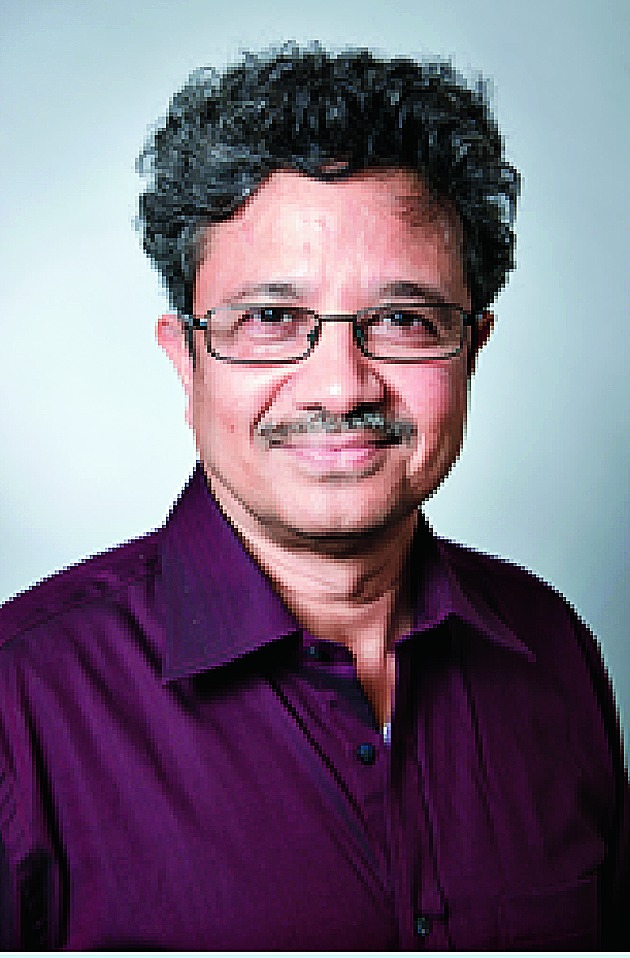

Jan 8: Biologist and Presidency alumnus Animesh Ray, who is studying worms in his California laboratory to decipher brain mechanisms that influence rational choice, wishes he was a student at the College Street institution now rather than over four decades ago.
Ray says he is struck by the contrast between what Presidency (then a college) could not give to its students in the early-1970s but is now (as a university) providing in abundance - exposure to external experts and opportunities to explore things beyond their curriculum.
"Good science needs hard work and two other ingredients - courage and imagination," said Ray, a professor and chair of faculty at the Keck Graduate Institute, Claremont, California, who's among alumni attending Presidency's bicentennial celebrations.
"Courage is imprinted by your parents, grandparents, or experiences in upbringing. Imagination comes from exposure to new things. It is important for students not to be constrained by their curriculum," said Ray, who will chair a session at Presidency tomorrow.
Ray is currently engaged in, among other research projects, studies to observe nematode roundworms, Caenorhabditis elegans, creatures only 1mm in length. He places the worms in a Petri dish, gives them a choice of two foods - bacteria A or bacteria B - and maps brain activity as the worms choose what to eat.
"Rational choice is so intrinsic to behaviour, it determines virtually everything that humans do consciously," Ray said. "But the basic brain mechanisms underlying rational choice remain largely unknown."
The worm's brain, with only 300 neurons - in contrast to the human brain's 80 billion - is the start of a long process.
Ray's studies on worms is an exercise that he views as a bridge between brain science and economics - but his own interests in economics dawned only after his son became an economist and his daughter picked an economist to be her husband.
As a science student at Presidency, Ray learnt almost nothing about economics. Students then were expected to stick to the curriculum, class notes and lectures, even though classes were frequently disrupted in the early 1970s because of Naxalite campaigns.
Ray recalls walking - he didn't have the money to take the bus - from Presidency College to the British Council Library, where he would read books that would take him beyond the classroom. "That experience allowed me to learn on my own."
After college, he joined Jawaharlal Nehru University, its first batch of life sciences programme, before pursuing a PhD in Australia and then moving to the US.
Through the years, he has focused on how genomes rearrange to evolve new functions, his research touching the genetics of skin cancer, lung cancer, and the Huntington's disease, a neurodegenerative disorder. He's now collaborating with neurobiologist Paul Sternberg to study worms.
When a worm chooses between two bacteria, it executes a task similar to one a human would when asked to choose between an apple and an orange. Economists have known for years that choices made by people do not always appear rational.
"When you pick an orange over an apple, then a mango over an orange, we would assume you would pick a mango over an apple when given that choice," Ray said. "But this logic breaks down, economists call it the breakdown of transitivity of rational choice. We're trying to find out the brain's activity influencing this."
Since he graduated in 1974, this is Ray's second "serious visit" to Presidency. He conducted a 10-day course last February, giving lectures on biology to undergraduate students, contributing to what university officials say are efforts to expose students to non-curriculum topics.
"We want our students to feel excited about things, even if they're from outside their curriculum," said Presidency vice-chancellor Anuradha Lohia.