 |
| Picture by Aranya Sen |
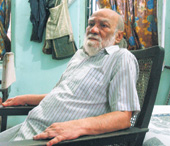
It is Saptami evening but Peary Row, a stone’s throw from Maniktala bazaar, is silent, deserted, unchanged with its narrow bylanes, worn houses without nameplates, the stench of drains. “You must have thought I was really sick, since you have brought fruits,” laughs the octogenarian on the second floor of 1 Peary Row, his wheezing giving him away. An injury from a fall a few months ago has confined him to the room with metal implants in the hip and arm. The lung ailment also troubles him. But then this is Badal Sircar, dramatist and director who enjoys challenges. This was the man who in the 1970s sought to take theatre beyond all hurdles with his Third Theatre and opened new avenues for theatre as experience.
“Medicine is expensive and I am entirely dependent on attendants, but there is a good side to this. My night attendant is a bookworm and handing out the books from my shelf, I have myself rediscovered the joys of reading,” says Sircar. “I don’t trust modern writers, the plays and short stories one gets to sample these days. Old masterpieces are safer,” he adds, waving the copy of Pather Panchali that he is reading.
At 82, the past is coming back in many ways. Between guiding his old troupe Satabdi and its newer offshoots Pathasena and Aina, Sircar has concentrated on bringing out his writings, like the travelogue Bishhoykar Shyamdesh and the play Nadite. But more importantly he is in the midst of writing his autobiography Purono Kashundi (Old Mustard Sauce), of which the first two volumes are out.
Reticent, and even intimidating to some, Sircar has invaluable experiences to share. He has lived through the famine and riots, studied on a foreign student’s scholarship in London, worked in governmental town planning and land survey departments in London, Enugu (Nigeria) and Calcutta. On shoestring budgets, he has often trekked cross-country. Purono Kashundi took readers on a lively jaunt through his childhood in north Calcutta, Darjeeling, Dehra Dun, his days at BE College and Damodar Valley Corporation. Part II of Purono Kashundi narrates Sircar’s experiences as a foreign student and professional in a world still nursing its wounds from colonial rule.
In Part II, the tone is more relaxed, the narrative proceeding with fewer flurries back and forth. It has none of the agony and ecstasy documented in Probasher Hijibiji, published soon after Part I appeared. Probasher Hijibiji is a valuable compilation from the pages of Sircar’s diary, his letters written to his sister Monu and poems written between office work. It encapsulates his creative ideas, his artistic frustration in London, France and Nigeria.
Purono Kashundi Part II traces the man in roughly the same period (1957 and 1967). We learn of his attempts to battle hunger and cold so as to save money to catch the plays of Joan Littlewood, John Gielgud, Michael Redgrave, Vivien Leigh or Charles Laughton. Unforgettable characters like hostel inmate Krishna who without knowing any Bengali enjoyed bursting in on addas with the exclamation “Ki khando, ki khelenkari!” Broadminded landlady Mrs Bilitar and her family, sisters Monu, Kanu, his wife Putul, children Kabul and Tabul, memories of a chance encounter with Somerset Maugham and listening to Paul Robeson.
Details and dates of several of his early plays can be found in Part II, as well as anecdotes about Solution X, Boro Pishima, Ebong Indrajit, Baki Itihash, Bagh, Tringsho Shatabdi or Ballabpurer Rupkatha. His only crime drama Samabrito is still to be published, we learn. And Ebong Indrajit had been written “with no definite plan”, as though it was “a passage from one poem to the next with a few dialogues to bridge the gaps”.
“The third volume should be more interesting because it will feature the birth of Satabdi,” said Sircar, smiling as if to say the this is where Purono Kashundi might also reveal its pungent side in Sircar’s recollections of the Bengali theatre scene. The first signs of it appear in Part II, Tapan Roy’s Theatre Centre, Sombhu Mitra, Bohurupee and Nandikar find mention as well as the “disaster” that was the Shouvanik Ebong Indrajit.
Would he never write another play? Doesn’t contemporary happenings excite him? “Yes, the Rizwanur case as reported in The Telegraph interests me. I realise this is the best time to hire the police for your dirty work. Mercenaries, if caught, would have to go to jail and run the risk of getting hung, but the worst that can happen to a policeman is a transfer,” laughs Sircar, calling for tea.
As the extra-sweet tea and cream biscuits disappear, the kashundi dealer confesses a love for “singara, kachuri and fries…yes with kashundi”, but those are obviously things he can do without, unlike cigarette, adda and theatre.