 |
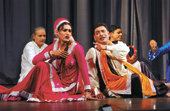
| Naqqals from Punjab performing female impersonation at the National Folk Theatre Festival in Salt Lake. Picture by Sanjoy Chattopadhyaya |
Pretty boys playing prettier women ... singers pitching their voices high at near-breaking point and percussionists pounding the hides off their assorted drums... Duhsasana reeling, exhausted by the endless yards of Draupadi?s sari that he pulls off, only to see them reel back around her as soon as he pauses to take a moment?s breath. Typical scenes from the traditional forms that constituted the Eastern Zonal Cultural Centre?s week-long National Folk Theatre Festival at Salt Lake in the last week of February.
The city slicker does not get enough exposure to the living theatres of the Indian countryside. We know more of Western performance than we do about our own rural practitioners. One may ask why on earth we should want to know about them ? backward forms steeped in religion and superstition? Because knowledge is power; and art rendered invisible by lack of exposure becomes powerless for no fault of its own, not having access to the information technology and publicity machinery that affluent populations can command. Because it gives us glimpses into alternate and pluralistic aesthetic experiences, so that we can resist brainwashing by monocultural First World (or even Hindi-medium) concepts taught to and beamed at us every day. Because postmodern foreign scholars come to India to research these very same ?premodern? forms for what they can gain about artistic techniques that the West has lost over the centuries.
Accepting imported realistic and naturalistic acting as the USP, the 21st century Indian is alienated from both the exaggerations and subtleties of indigenous skills. For instance, the Naqqals of Punjab, who specialise in female impersonation and slapstick buffoonery. It is essential for gender experts to study how these men present the illusion of being women: some spectators near me actually couldn?t tell they were men. However, also what distinguishes the ?feminine? according to them (the demure look, the pouting of lips, the swaying of hips), as well as how we obviously recognise them as male, yet willingly suspend our disbelief to view them as female. Then again, the crude duet gags that employ a slapstick, literally ? a large leather bat whacked by the superior partner over the inferior, who plays the dolt but whose observations invariably hit home and receive the slap as their just dessert.
To illustrate diversity from another troupe at the festival, this one from the south, Terukkuttu in Tamil Nadu has many similarities in its elaborate, glittering headgear and costumes with Yakshagana and Kathakali, but is much more informal and casual. Actors miss cues, enter at the wrong time and are chided or beckoned from stage to come on, but we don?t mind, since we accept it as wholesome family entertainment. Nobody expects the human impossibility of perfection. Indeed, the child?s-eye view epitomises the response to folk forms. When the larger-than-life demons rush at the village front row with their tongues stuck out, kids scatter in gleeful shock ? an effect that our Western proscenium stages can never create. Fun is what it?s all about. In Draupadi Vastraharanam, the sad Pandavas looked quite spineless, making vague but limited motions of protest, while like a proverbial Indian mother-in-law, Gandhari threatened to beat up Draupadi with her fists if she didn?t comply.
Eastern Zonal Cultural Centre did us a good turn by hosting these troupes, but abdicated its responsibility to provide them maximum mileage. Having brought them all the way from different parts of the country, it should have featured them in mainstream halls within the city for the benefit of most Calcuttans, instead of cutting costs with just one show for each at its own Bharatiyam complex in Salt Lake. The problem of the disempowered again: would EZCC have dared to give this treatment to a famous urban director?
Golden voyage
Calcutta?s pioneering and longest-surviving Hindi-language group, Anamika, began its 50th anniversary celebrations on February 26 at Natya Shodh Sansthan, also in Salt Lake. Anamika is to the city?s Hindi theatre what Bohurupee is to Bengali theatre. Established in 1955 by like-minded young people who had previously dabbled in amateur dramatics, Anamika trailblazed Hindi group-theatre here, even inspiring the movement in the north Indian heartland later. Some of the founder members, like Pratibha Agrawal and Shyamanand Jalan, are still with us; others joined afterwards, including such directors as the late Shivkumar Joshi (himself a reputed dramatist in Gujarati), Sheo Jhunjhunwala, Swaran Chaudhry and Bimal Lath. Can we hope that, during this golden jubilee year, Anamika will initiate a documentation of its journey through in-depth interviews, so that posterity will have first-person records of its accomplishments?
These achievements are not to be treated lightly. I wonder if there is any Bengali group that can match Anamika?s tally of 72 full-fledged productions in 50 years, not counting one-act plays, children?s theatre, dance dramas, musical presentations, play and story readings, poetry recitals, and the organisation of several important festivals, seminars and workshops. Anamika staged 45 of those 72 full-length plays in its peak period, 1966-82, averaging almost three per year. In 1973-74, it put up as many as eight new shows! Most big groups consider themselves very lucky if they can manage one new production annually.
A prolific assembly line alone did not characterise Anamika?s activities. It dealt in quality theatre. Shyamanand Jalan discovered Hindi drama?s modernist genius, Mohan Rakesh, by directing the then-unknown author?s Ashadh Ka Ek Din in 1960, and moulding the final shape of Lahron Ka Rajhans in rehearsal with Rakesh in 1967, a dramatist-director collaboration that opened unexplored possibilities in Indian theatre. He boosted Badal Sircar's reputation nationally by staging Evam Indrajit and Pagla Ghora in Hindi. Pratibha Agrawal remained a pillar throughout, especially as a translator and adapter of new Hindi scripts, some dramatised from fiction. Both Jalan and she acted brilliantly, too, among many Anamika members.
With such an illustrious history behind it, Anamika?s new offering premiered that evening came as a mild letdown. P.L. Deshpande?s Bechara Bhagwan, translated from Marathi by Sudhir Kulkarni, is a short satirical farce about an idol of Krishna who starts speaking to devotees in his temple. At first they do not know whose voice they are hearing, and blame one another for Krishna?s acerbic barbs. Only a blind man identifies the voice. When Krishna finally proves his divinity, they immediately pester him for favours. One could sympathise with the director, Bimal Lath, who admitted that he had difficulties putting a cast together because actors do not have the same commitment they used to in the past. The lacklustre performances proved his point. Wanted: young blood to restore Anamika to its glory. Qualifications: imaginative vision and tough discipline.