Two out of 18 tribunals are currently hearing in-person appeals by deleted Bengal voters seeking restoration of their rights, sources at the Joka centre from where all the tribunals were supposed to work said on Tuesday.
The 18 SIR tribunals have to decide more than 34 lakh appeals. Around 27 lakh are against exclusions, and around 7 lakh are against fresh inclusions. Legal experts said the pace at which cases were being heard, it would take at least five years to dispose of the appeals. This would mean the next Assembly elections would be upon many of those not allowed to vote this time. The Calcutta Municipal Corporation polls are slated later this year.
The new BJP government on Monday said people deleted from the voter list, including those whose appeals are pending before the tribunals, would “for the time being” not receive the benefits of its Annapurna Bhandar scheme, which replaces the Lakshmir Bhandar.
Nineteen tribunals, each led by a retired judge, had been set up following instructions from the Supreme Court. Last week, former Calcutta High Court Chief Justice T.S. Sivagnanam stepped down from the tribunal he was heading, citing personal reasons.
Sources in the administration said more tribunals were at work, but “virtually”.
It was not clear how they were hearing individual applicants. Lawyers and activists assisting deleted voters said many of them lacked the wherewithal to attend virtual hearings.
“Only two of the 18 tribunals — for South 24-Parganas and Murshidabad — are conducting physical hearings at Joka. There is little clarity on how the other tribunals are functioning. At least some of them are conducting virtual hearings,” said a government source.
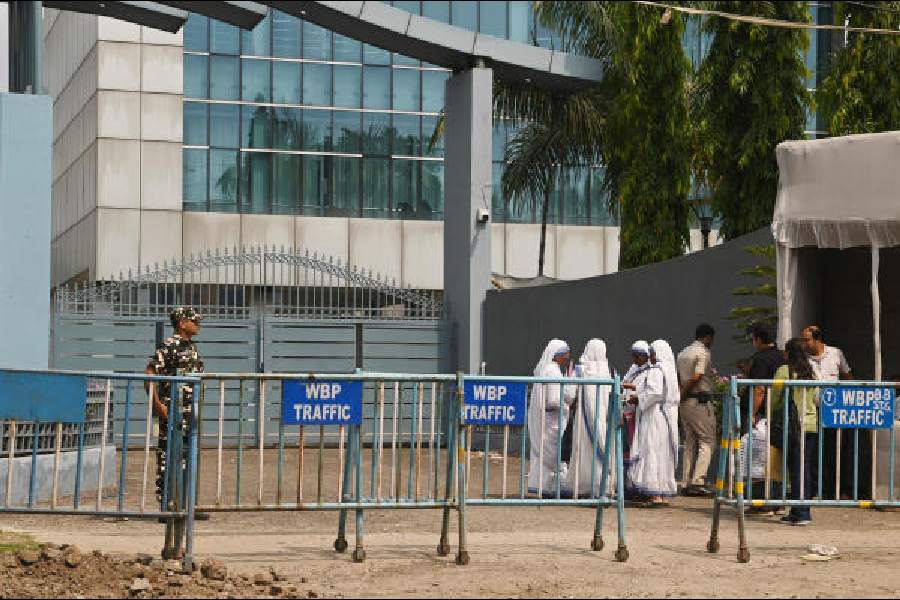
When The Telegraph visited SPM-Niwas, the central government institute in Joka, on Tuesday, a posse of central force jawans was at the gates. A camp was set up outside the institute to guide appellants. Bengal police and government personnel were present at the camp.
“Notices are being sent to deleted voters who filed appeals. The notice mentions the date and time of the hearing. Only the appellants and their lawyer, if any, are being allowed inside,” said an official.
Four nuns from a missionary organisation arrived at the centre around 1.50pm on Tuesday. Two of them were deleted from the revised rolls in Baruipur West, South 24-Parganas. They received the hearing notices on May 8.
The nuns were accompanied by their local booth-level officer and a social worker. Only the two deleted voters were allowed to enter the campus.
One of them, in her late 60s, traces her roots to Jharkhand. The other, who hails from Basanti in South 24-Parganas, is 74. Both have been part of the missionary organisation for many years and are voters in Baruipur.
On Tuesday, the nuns came out after more than an hour, dejected.
They showed their Aadhaar cards, voter cards, ration cards and baptismal and residence certificates. At the hearing, the nuns were told that the papers were not enough. The residence and baptismal certificates do not have any government stamp.
“I was told that having a passport would have strengthened my case,” said one of the nuns. The other nun used to have a passport, but it expired 12 years ago. She was reportedly told to apply for a renewal.
Three men from Farakka in Murshidabad were also there to attend the hearing, accompanied by a lawyer. They refused to share any details of what happened inside.
“Only about a dozen cases from each of the two districts were scheduled for hearings on Tuesday,” said a source.
Another source said one tribunal judge was hearing more than 100 cases virtually every day.
Legal experts and activists are apprehensive that the disposal of all appeals could take years at this rate.
“Even if each of the 18 tribunals hears 100 appeals every day, disposing of 34 lakh appeals would take more than five years. On top of this, there is no clarity on how the tribunals are functioning. The Supreme Court has more than once stressed the need for transparency in the process. The SoP on how the tribunals are functioning has not been made public,” said Arindam Das, a senior advocate who has filed more than 100 appeals on behalf of deleted voters. None of them has received hearing notices yet.
The legal aid cell at the West Bengal National University of Juridical Sciences (NUJS) has also filed appeals on behalf of around 150 deleted voters. None of them has received hearing notices.
“The weakest and the most marginalised will be the worst sufferers. They cannot afford legal consultation. Their fate hangs in the balance,” said Sarfaraz Ahmed Khan, a professor of law at the law school.