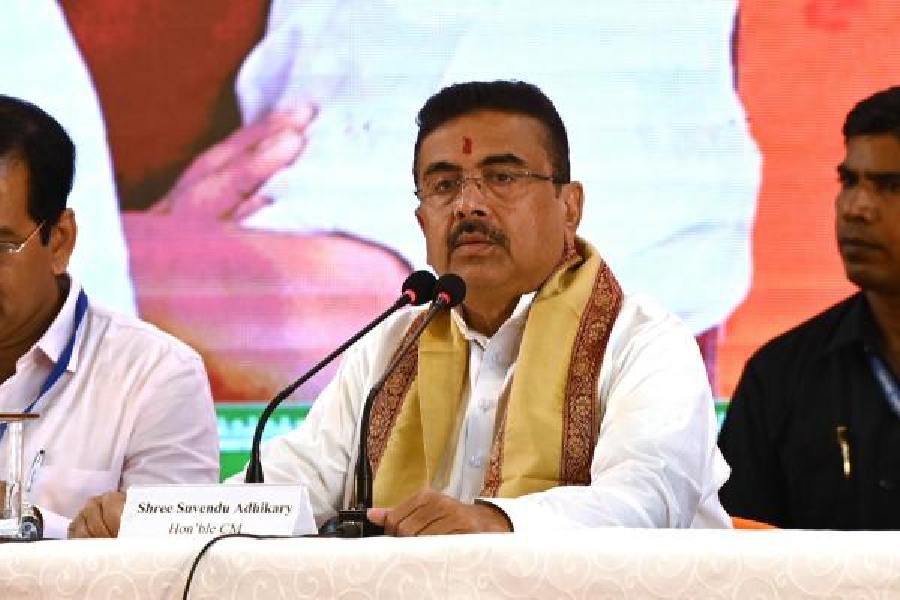
The BJP-led Bengal government is set to take up a major challenge — introduce a new policy, discarding the hands-off land stance of the previous Mamata Banerjee government — in a bid to attract big-ticket investments to the state.
“We have to bring in large industries to Bengal to ensure a better future for the state. The previous government had no comprehensive land policy. As the land parcels in Bengal are fragmented, the intervention of the government is required if industries have to be attracted,” state BJP president Samik Bhattacharya said at a meeting of the National Chamber of Commerce on Tuesday.
The comments show that the BJP will depend on industrialisation to generate employment opportunities in the state. The lack of jobs was the Achilles heel of the previous government, and the BJP used the issue against the Trinamool Congress during the election campaign.
Bhattacharya also promised a fear-free environment for investments and announced that the government would scrap the Urban Land Ceiling Act, which the BJP believes is a major impediment to attracting investments.
“I can tell you that you would not require to pay anybody for setting up industries.... The urban land ceiling also created hurdles to investments. We will revoke this Act, too,” said Bhattacharya.
A direct land purchase policy is in place in Bengal at present, instead of the new Land Acquisition Act. According to the policy, farmers are offered only 1.5 times the current market price if the government acquires their plots. This is why the policy did not yield much result.
A section of officials said the new government would face a series of challenges if it wanted to introduce an environmentally friendly land policy in Bengal.
First, over the past 15 years, the state has not acquired land for government projects or industries. This is why the state government did not frame any rules to implement the Land Acquisition Act that came into effect across the country in 2013.
“As rules were framed for the Land Acquisition, Rehabilitation and Resettlement Act, 2013, no land could be acquired for state government projects or for industries over the past one-and-a-half decades. Now, it would take time to frame the rules as all have to start from scratch,” said an official.
Second, the state government would have to make the deal for the land losers attractive to ensure that the ruling party doesn’t incur the wrath of common people like the erstwhile Left Front government. The anti-land acquisition movement was believed to be the major reason behind the downfall of the 34-year-old Left Front regime in Bengal.
“The major reason behind the people’s resistance against land acquisition was the lack of incentives. The new Land Acquisition Act addresses the issue as it offers up to four times the current market price of the land. But to ensure a smooth land acquisition, particularly for industries, something more has to be offered to ensure that the policy does not trigger people’s ire as it happened with the Left Front government at Nandigram and Singur,” said a senior official.
Bhattacharya said the government would ensure that farmers whose land would be acquired for industries got a share in the industrial projects.
“This could be a good proposal as it would not leave the farmers in a spot, as a steady source of income would be there apart from the lump sum compensation they would get for their land,” said an official.
Another issue that the state government would have to look into is the land ceiling in the rural areas —24.22 acres.
“It is almost impossible to set up industries within the land ceiling. It was often found in the past that industrialists were harassed in the name of the regularisation of surplus land. This particular issue has to be addressed if the state wants to invite major investments,” said an official.
Also, the records of land parcels have to be updated so that the acquisition process gets smooth after the acquisition Act is put in place.
“The land parcels are small and fragmented in the state. The records were digitised. But several complaints were pending in the blocks that the Trinamool-backed goons changed the records in the districts to sell off the land parcels illegally. Such complaints have to be addressed immediately, and names of original owners have to be brought back in the records,” said a source.