 |
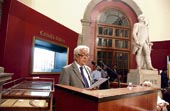
| Historian Tapan Raychaudhuri delivering the lecture at Victoria Memorial. Picture by Aranya Sen |
It’s not often that a memorial lecture by a historian draws enough crowds for an auditorium to spill over. But that happened at Prince Hall of Victoria Memorial, when renowned historian Tapan Raychaudhuri delivered the Sudhir Kumar Mitra pre-centennial memorial lecture.
Perhaps it was Raychaudhuri the historian, as much as Raychaudhuri the writer of Bangalnama, the memoirs of a Bangal from Barishal, now settled in Oxford after a long and illustrious career, who got the crowds in.
Bangalnama is being serialised in a Bengali magazine now. The lecture was titled Bangalnama: Pariprekshit (The context of Bangalnama).
Disappointing some among the audience, Raychaudhuri did not focus on the Bangal, the Bengali from the other side of the Padma, but took the opportunity to dissect the character of the Bengali. Never accused of being mealy-mouthed, he drew up a list of the traits that make up the contemporary Bengali character.
“Aamader jibone bish achhe (Our lives are poisoned),” he said, speaking on the communalism that vitiates the Bengali mind. Many blame colonial rule for the Hindu-Muslim antagonism, “but all of it is not true,” said Raychaudhuri.
“Colonial rule was over 60 years ago.” How does that explain a 15-year-old Bengali of today harbouring strong communal feelings?
But one “Bengali trait” could be traced to the British. “Parasrikatarata”, (envy of others’ good luck), he said, had something to do with British patronage of the Bengali.
“A lot depended on whom the sahib praised, and there were many fighting for the privilege. However, recognition from abroad is not so rare now.”
With parasrikatarata, he listed “atmaprachar” (self-advertisement) and “chhoto ghotonaye hujug kora” (to go ga-ga over minor achievements) as other “Bengali characteristics” that could have roots in the way expressing one’s superiority in terms of caste and status was important in Bengali society.
“Aamra sobai Kongsho rajar bongshodhor (We all claim to be blue-blooded),” said Raychaudhuri.
He spoke about the ugliness of the hedonism of globalisation in our country. “Globalisation is happening everywhere. But in a poor country, we should have a little more shame. It’s not the same walking into a five-star restaurant in a country where your neighbour may have gone without food,” he added.
But should we lose all hope? No.
“The future is not entirely dark,” said the affable historian, who thanked his wife exuberantly for her contribution to his life, even claiming it was all right if he was labelled “uxorious” at 80.
He said Bengalis have a lot of potential, they have intelligence, a cultural-mindedness. There are signs. Women’s writing in Bengali is strong, without “nyakami”.
“But now, we are behaving the way a poor man does when he accidentally comes into wealth. We have to get out of our self-seeking ways,” he said.