
Best of both worlds
Blame me for being greedy but I want the best of both worlds in monsoon. I want to jump in the muddy puddles and splash water at passers-by, float my paper boats in waterlogged streets, negotiate life-threatening pothole-riddled Calcutta roads sitting hunched-up on hand-pulled rickshaws (Oh! those iconic things of yore!) and sip cardamom-flavoured creamy milk tea accompanied by samosas, pneyaji and alur chop at rain-battered decrepit roadside shacks.
On the other hand, I also want a city with excellently tarred roads which do not have any craters and from whose surface water magically vanishes without accumulating, like the back of a duck, even after the heaviest downpour so that if and when I step out of home, I need not worry about the usual monsoon mishaps in a metropolis.
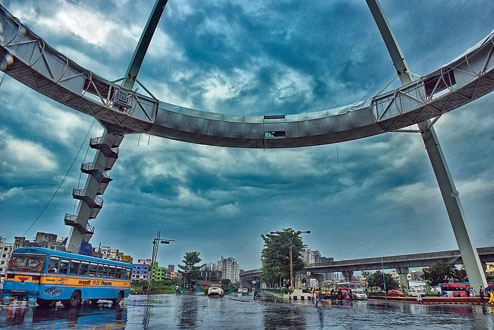
New Town, where I currently live, has the best roads in Calcutta with hardly any water-logging whereas south Calcutta’s Mudiali from where I hail, offers me ample opportunities to dip my toe in the accumulated pool. In both places, nature offers itself in its most beautiful and bountiful avatars during the monsoon.
Mudiali looks scrubbed and washed and cleaned of all the dust and grime during monsoon. As you walk along Southern Avenue and the Rabindra Sarobar lakes you cannot help but marvel at the lush beauty of a resplendent rain-drenched city.
My present abode in New Town is also a true nature lover’s paradise. From my terrace I can watch miles and miles of the wetlands blurred into a smoky haze during heavy showers.
It is an ethereal experience to witness the intensity and fury of thunder and lightning as they play out magnificently against the vast and endless canvas of the waterbodies. It makes me feel blessed.
Rajoshi Gupta, Sanjeeva Town
Telebhaja conundrum
Earlier, we lived in Behala, where if the roads got flooded it would take two to three days for the water to recede. That way New Town’s infrastructure is a blessing. Even if water accumulates here it drains out in half an hour.
True, our children are missing out on floating paper boats in waterlogged streets, a favourite timepass back then, that’s hardly anything to complain about. Besides, my son is having great fun these days swimming in the rains at New Town Business Club.
But the vast expanse of New Town creates a lot of muck in the rain. The other day my son slipped and fell in the mud while getting off his school bus and you can imagine the condition of his uniform. We mothers are having a tough time keep our wards’ school uniforms white this season.
What makes it worse is the cattle roaming about. The cow dung, the sand and soil and the rains make a deadly concoction and walking to the market becomes difficult.
New Town markets offer delicious hilsa. But if the rains give us telebhaja pangs, we have to walk quite a bit to reach a seller. We live in a residential area whereas the hawkers are concentrated in the office area. But maybe that’s a blessing in disguise as we are forced to have home-made telebhaja, hygienic and healthy.
Moumita Khan, Sankalpa 4
Too empty for memories
When I was a school-going boy, I remember I used to come home from South Point to Golpark splashing my way through knee-deep water. Even in the rain, there would be other people out on the road, some known, some unknown. One day, an auto-rickshaw fell in a crater. With passengers inside, it stayed stuck bent sideways. I remember how other passersby and I rushed and pushed the auto out. Monsoon created memories in south Calcutta.
Here in New Town, it’s just nature and me. There’s no one on the streets to share the experience or even create memories with. A view from my 17th floor apartment would be of a green wilderness dotted with buildings, one-third of which are under construction. How much romanticism can you create in your mind amid such emptiness? The rains are so monotonous that if I leave this place tomorrow, there won’t be any visuals for me to remember this place by. Even for a taste of telebhaja, I have to drive four to five kilometres in the rain through what then appears like a ghost town.
Yes, there is life on the fringes of New Town but you have to reach out to experience that. Once, during the monsoon, on my way back from office, from a distance I saw boys play a game of football in a far-away field. It brought back so many memories from childhood that I decided to venture that way and watch a bit from the car. Soon, my car got stuck in the mud and it was those very boys who came to my rescue for a Rs 100 tip.
I would rather say that the monsoon in Salt Lake, where my parents stay and where we return in the weekends, is a lot more eventful. The township becomes green after every shower. Because of people’s passion for gardening, there is greenery in front of every house. The fish markets are lively. They may not be Gariahat, but they are better than air-conditioned malls. And yes, we have a telebhajawala just across the corner in CJ Block. Even if there is water-logging after a shower, it recedes quickly.
So now that the attraction of wading through dirty water has ebbed with age, in monsoon I would vote for Salt Lake over the two other places I have lived in.
Chiradeep Majumdar,
Uniworld City
Recreating the para feel
I used to live in Belur earlier and it would take it me 45 minutes to commute from there to my Dalhousie office. Now that we’ve moved to New Town it takes me over an hour. But we’re better off here, especially in monsoon, as there’s no water logging.
I live on the sixth floor now and the township looks all the more beautiful from up here. The trees and fields get washed in the rains and look lush and clean.
While the para culture of the old neighbourhood isn’t something readily available in gated communities, we are consciously making an effort to foster ties here. So every time heavy rains mar our plans to go out, four or five families pool in and have in-house picnics. The menu is simple but perfect for the monsoon —khichuri, beguni and ilish machh bhaja.
Monika Roy, Eastern Grove