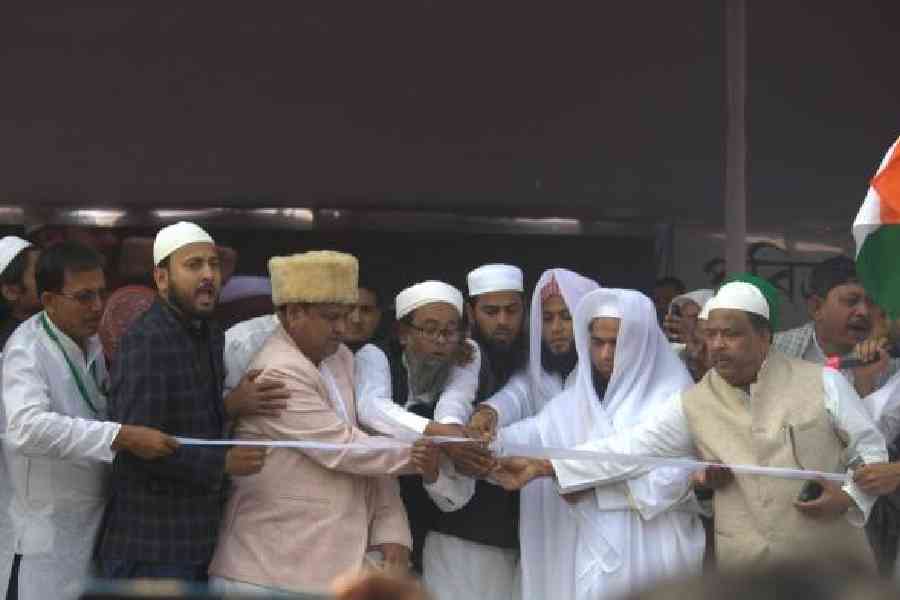
A proposed Babri Masjid, 900km away from the original one at Ayodhya that was demolished by the Hindutva brigade 33 years ago, exploded on Bengal's political arena on Saturday at Beldanga in Murshidabad.
On December 6, 1992, Babri Masjid, a shrine Mughal emperor Babar's commander Mir Baqi had built in 1528-29 at Ayodhya, Uttar Pradesh, was razed down. If the saffron brigade had then sought to erase a part of history linked to Babar, suspended Trinamool Congress MLA from Bharatpur, Humayun Kabir, through the foundation-stone laying ceremony of a proposed "Babri Masjid" on Saturday, sought to resurrect the memory of the 16th-century shrine to rewrite his political future with an eye on the 2026 polls.
“What we witnessed during the foundation-laying ceremony was not merely the construction of a mosque; it marked a renewed attempt to transplant cow-belt style politics into Bengal. This time, the mobilisation is centred around Muslims rather than Hindu politics,” said political scientist Biswanath Chakraborty.
He believes the impact of this development could potentially lead to a new form of minority-based politics not only in Bengal but also nationally.
Chakraborty was referring to thousands of members of the Muslim community who brought bricks from different parts of Bengal and converged at Beldanga, where Kabir vowed to complete the construction of the mosque as soon as possible.
Chakraborty drew obvious parallels to the brick-carrying campaign and the movement launched by the saffron camp in the 1990s for the construction of the Ram Temple in Ayodhya.
Political observers recalled that, following a massive mobilisation drive, thousands of Hindus travelled to Ayodhya carrying bricks as symbolic contributions to the temple, which was ultimately inaugurated last year under the leadership of Prime Minister Narendra Modi.
Muslim participants this time not only carried bricks but also cement bags, iron rods, and donated money for the construction of the proposed Babri Masjid in Beldanga.
Several political sources say Kabir — who is viewed by many Trinamool Congress leaders as a marginal figure in Bengal politics — has attempted to engineer a new political narrative among Muslims, who constitute over 30 per cent of the state’s voters and are a key support base for chief minister Mamata Banerjee, against the BJP’s aggressive Hindutva campaign.
Traditionally, minorities in Bengal have aligned themselves with mainstream parties, unlike states such as Telangana and Assam, where minority-based parties like Asaduddin Owaisi’s All India Majlis-e-Ittehadul Muslimeen (AIMIM) and Badruddin Ajmal’s All India United Democratic Front (AIUDF) have emerged. Though such attempts were made by Mamata Banerjee's current cabinet colleague Siddiqullah Chowdhury, through his outfit Jamait Ulama E-Hind, these weren't not successful. Very recently, Nawsad Siddique's ISF tried to craft its space among minorities, but had to join hands with the Congress and the CPM for the lone seat it won in 2021.
Suspended from Trinamool on Thursday, Kabir had immediately said he would launch a new party on December 22 and contest 135 seats against Trinamool and the BJP in the 2026 polls. He urged minorities to ensure its victory in 90 Assembly segments where Muslims play a decisive role, accusing the chief minister of suspending him for his Babri Mosque project — an apparent attempt to stir resentment among Muslims against Trinamool.
Since his suspension, Kabir has been highlighting Mamata's "initiatives using government funds" for the Jagannath Temple in Digha, the proposed Durga Angan in Calcutta and Mahakal Temple in Siliguri, as well as donations to clubs for Durga Puja and the Red Road Puja carnival. He claims these are evidences of her outreach to Hindu voters at the cost of minorities.
“Kabir has cleverly used these examples to provoke Muslim sentiment against Mamata Banerjee. However, it remains to be seen whether he can sustain this Babri Mosque narrative and his political stance,” Chakraborty added.
Senior Trinamool leaders argued that generating sympathy for the Babri Mosque issue did not automatically translate into electoral support from minority voters. They claimed that Muslims understood it was essentially designed to fragment minority unity and indirectly benefit the BJP.
“Some Mir Jaffers and traitors are playing religious politics according to the BJP’s script. Some misuse temples, others misuse mosques to provoke communal tensions. Such tactics will not work in Bengal, where Mamata Banerjee has set an example of inclusive politics embracing all communities,” said state minister Firhad Hakim at a unity rally in Calcutta.
Mamata, in a post on X, wrote that Bengal was the land of Rabindranath Tagore, Kazi Nazrul Islam, Ramakrishna, and Vivekananda — a soil that has never bowed to division and never will.
“Hindu, Muslim, Sikh, Christian, Jain, Buddhist — we walk shoulder to shoulder in Bengal. We share each other’s joys, because we believe religion belongs to individuals, but festivals belong to everyone. Those who are trying to spark communalism to destroy the country, our fight against those will continue,” Mamata wrote.
The BJP countered these claims, saying that Mamata suspended her MLA but indirectly facilitated the foundation stone-laying of the Babri Mosque by providing extensive police security to appease Muslims. Senior BJP leaders like Gaurav Bhatia in Delhi accused Mamata of helping promote the mosque project.
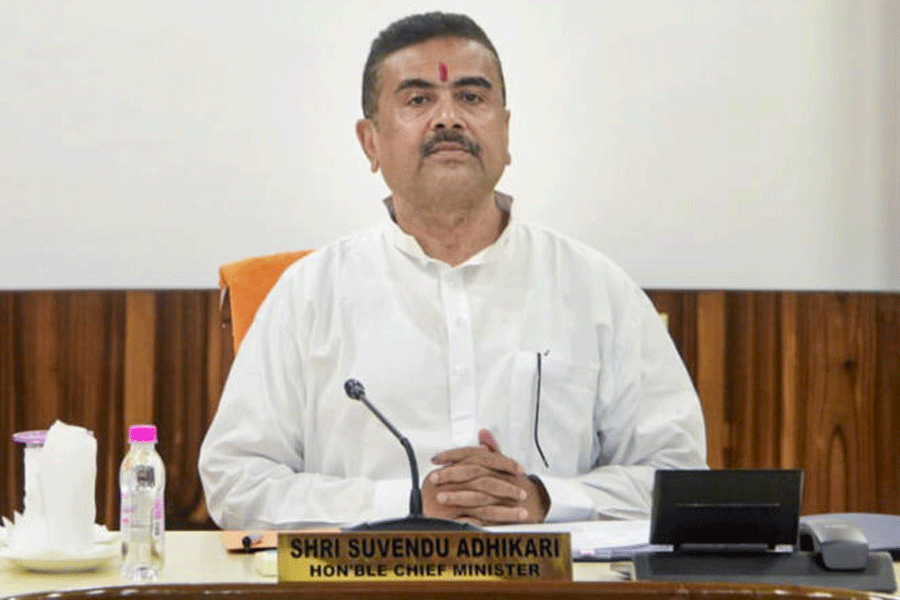
Leader of the Opposition Suvendu Adhikari linked Kabir’s actions directly to Mamata.
“The Babri Mosque project is an attempt to revive Mughal-Pathan symbolism once again. We do not oppose the construction of mosques, but object to the naming. Mamata Banerjee alone engages in minority appeasement, and therefore, we urge Hindus to unite,” Adhikari said.
The CPM called Kabir’s move a strategy engineered by either the BJP or the Trinamool Congress to deepen communal rifts in Bengal.
“The Babri Mosque politics we are witnessing now has been jointly fostered by the BJP and the Trinamool. Kabir’s actions reflect a design promoted by one or both parties (the BJP and Trinamool), whose political strategy is similar. The truth will take time to come out,” said CPM central committee member Sujan Chakraborty.