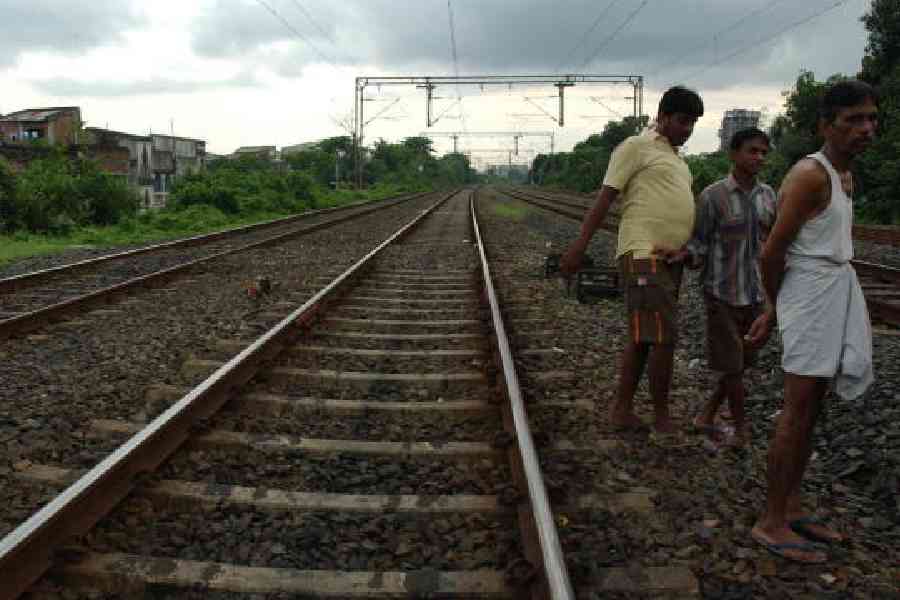
After decades of surveys, political assurances and public agitations, the proposed Krishnanagar–Karimpur railway line in Nadia has finally been shelved, with the Railway Board citing poor financial viability.
In response to a Right to Information application filed in January 2026 by Karimpur resident Avradeep Biswas, the railways confirmed that the project had been dropped as it was “unprofitable”.
The railways claimed that the proposed project’s financial internal rate of return (FIRR) stood at -0.53 per cent, making it an unprofitable venture.
In his reply on February 5, J.C. Das, the deputy chief engineer and public information officer of Eastern Railway’s construction department, said: “The project has been shelved by the Railway Board.”
He noted that the detailed project report was submitted to the Railway Board on September 18, 2024, after the final location survey, but the proposal was put on hold owing to low passenger potential and weak financial return.
“In view of the low traffic potential and low rate of return, the Railway Board has decided to shelve the proposal for the time being,” the official response said, referring to a Railway Board letter dated February 25, 2025.
Railway authorities dismissed speculation regarding land acquisition hurdles.
A railway official explained: “Freight potential in this stretch is extremely limited, and the project would depend largely on passenger services. Even after investing around ₹2,500 crore, the chances of recovery are minimal.” Another official added, “Karimpur is well connected by road. Rail services are available from Palashi near Behrampore, roughly 70km away. That weakens the case for a new rail link.”
The decision has sparked disappointment across Nadia and parts of Murshidabad and Birbhum.
Local campaigners strongly contested the “unprofitable” tag, invoking historical precedents. In 1905, Captain C.L. Magniac conducted a technical survey, while E.A. Radice examined the economic feasibility of a proposed Krishnanagar–Jalangi route, then 56 miles long, when rural population density stood at 434 per square mile. A revised survey in 1910 highlighted the region’s agricultural potential.
“In 2011, the population density crossed 3,400 per square mile and has increased further since. Calling the line unviable today ignores demographic reality,” an activist said.
Residents also pointed out that if railway expansion was being pursued in other border belts, the northeastern international frontier of Nadia should not be overlooked. For years, residents have demanded an alternative corridor linking Krishnanagar to Behrampore via Tehatta, Karimpur, Jalangi, Domkal and Islampur, which they believe could have opened a new connectivity axis for northeastern Nadia and adjoining regions. With the project shelved, that prospect appears remote.
The latest feasibility study in 2024 with an allocation of ₹2 crore had briefly revived hopes. BJP MP Jagannath Sarkar and Trinamool MP Mahua Moitra had both claimed credit, stating the study followed their representations to Union railway minister Ashwini Vaishnaw. In 2004, a 13km survey from Dhubulia to Charatala in Chapra proposed two stations and a bridge over the Jalangi river, but they stayed on paper.
The Eastern Bengal Railway opened the Calcutta–Kushtia line in 1860, and in 1899 a narrow-gauge line linked Ranaghat and Krishnanagar via Shantipur. A 1905 East Bengal State Railway survey envisaged 26 stations along a new corridor at an estimated cost of over ₹17 lakh, followed by a revised survey in 1910. Both the World Wars stalled progress, and further surveys in the 1940s met a similar fate. More than a century after the idea first emerged, the Krishnanagar-Karimpur rail link remains unrealised.