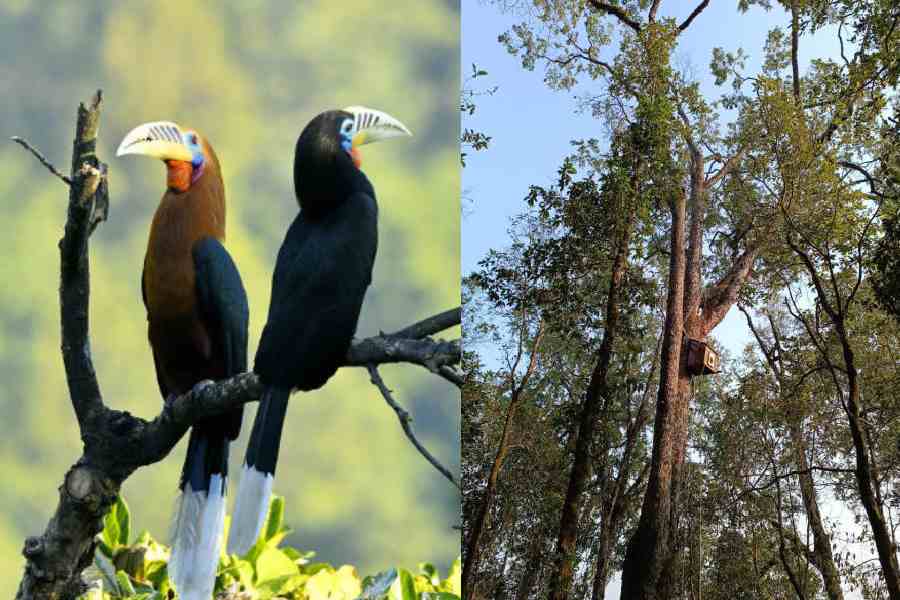
The Kurseong forest division in Darjeeling district has launched an initiative to protect and expand hornbill habitats in forested areas under its jurisdiction in an important step toward wildlife conservation.
The forest department is working in collaboration with Nature Mates-Nature Club, a Calcutta-based NGO, to install artificial nests in Latpanchar, located on the outskirts of the Mahananda Wildlife Sanctuary, to provide safe and secure breeding spaces for the birds.
Devesh Pandey, the divisional forest officer of Kurseong division, said that a few years ago, a similar initiative was undertaken at the Buxa Tiger Reserve (BTR) in Alipurduar district.
This marks the second such effort in the wild areas of the Kurseong forest division in north Bengal, a region well known for its rich hornbill population in the foothills.
“We have jointly initiated a project with Nature Mates–Nature Club to develop artificial hornbill nests in the Latpanchar forest. After the BTR, this is the second such initiative in the region. We hope proper nesting facilities will help increase and sustain the hornbill population,” Pandey said.
Forest officials explained that hornbills were highly selective when choosing nesting sites, typically preferring natural cavities in trees, which often remain vulnerable and unprotected.
To address this, artificial nests have been carefully designed using wooden planks without paint to maintain a natural appearance. In addition, CCTV cameras have been installed in three of the nests to monitor hornbill movement and breeding activity.
“The project is currently being implemented on an experimental basis. We will jointly monitor hornbill activity through CCTV surveillance. If successful, this initiative will not only help protect their habitat but also contribute to increasing their population in the wild,” the forester said.
The Mahananda Wildlife Sanctuary, which is on the outskirts of Siliguri, is regarded as a major hotspot for birdwatchers and ornithologists. India is home to over 1,300 bird species, and around 350 species are found within Mahananda alone, which spans elevations ranging from 400 to 3,000 feet.
Sanjok Dewan, a guide instructor of the Mahananda Eco-Tourism and Conservation Society (METACOS), noted that all four hornbill species found in the region — Great Indian Hornbill, Oriental Pied Hornbill, Rufous-necked Hornbill, and Indian Grey Hornbill — are major attractions for bird enthusiasts visiting the forest.
“Currently, more than 40 hornbills can be spotted in the forests of the Latpanchar area. We urge the forest department to undertake proper population assessments to ensure their continued conservation,” Dewan said.