
Calcutta: Iconic stone images from Java and Angkor Wat displayed in the archaeological section of the Indian Museum are drawing foreign visitors, including those from Southeast Asian countries, in large numbers.
The number of foreign tourists to the museum has increased from 10,735 in 2016-17 to 11,727 in 2017-18, officials said. A large section of these foreign visitors was from Southeast Asia.
"The objects in the museum connect people within and beyond India. The museum exhibits become more relevant when they connect emotionally with people. Someone from Southeast Asia sees an object of his land and identifies his progeny with this country and talks more about it. This is how museums connect people and land," Indian Museum director Rajesh Purohit said.
While Buddha's relics attract people from Japan, Korea and China, the Hindu icons are a top draw among visitors from Southeast Asia.
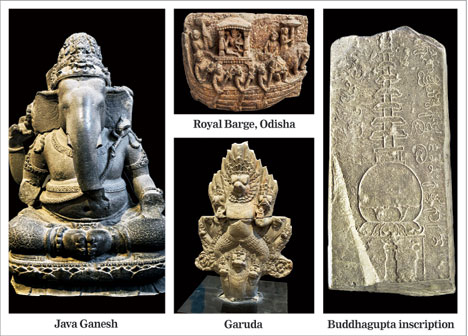
The figure of Java Ganesh, wearing a dhoti with Indian motifs, is a proof of a once-thriving textile trade between Java or Indonesia and India.
The Buddhagupta inscription from the Malayan island, now Singapore, connects the land with Bengal. "Earlier, Bengal had geographical provinces named Rarh, Goud, Karna Suvarna, Banga.... The historical-geographical region of Karna Suvarna is now Murshidabad, which was then called rakta mrittika, the land of red soil. From there a sailor, Buddhagupta, had travelled to Southeast Asia," the director said.
Another image in the gallery steeped in historical significance is that of Garuda, the eagle-like bird which is the mount of Vishnu.
The sandstone artefact is from Ankor Wat in Cambodia, which boasts the largest Vishnu temple of the world and is a UN heritage site. "This image makes visitors from Cambodia recall the stone frieze of Angkor Wat," said Purohit.
The monsoonal trade wind played a significant role in migration, trade and transport.
An image of temple sculpture from Bhubaneswar, in the museum storage now, shows a boat or a barge stacked with trade materials.
"People with parasols in it are preparing to make their jatra (journey) to Suvarna dweepa (island)," Purohit said. "Such images promote study, research and engagement of the audience."