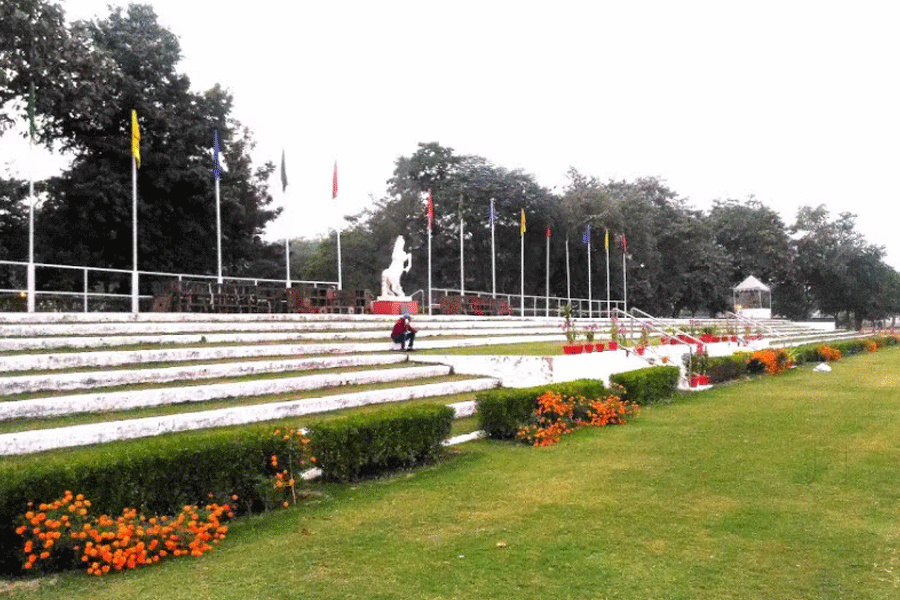

An archaeological excavation at Sialkali, in Murshidabad's Raghunathganj, has unearthed enough finds to indicate a Gupta-era settlement in the region.
A team from the directorate of archaeology and museums, led by co-director (excavations) Binoy Moni, has been digging a mound in Sialkali, spread across 1,600sq m and is 15ft above the ground, since August 11.
"The trial dig, just wrapped up, was intended to ascertain whether Sialkali is indeed the source of the gold coins accidentally discovered on May 31, 2013, from mud dumped near Ahiran in Murshidabad as part of a project to expand National Highway 34," said Pravakar Pal, additional director of the directorate of archaeology and museums.
Sialkali is around 10km from the spot near Ahiran where the coins were found.
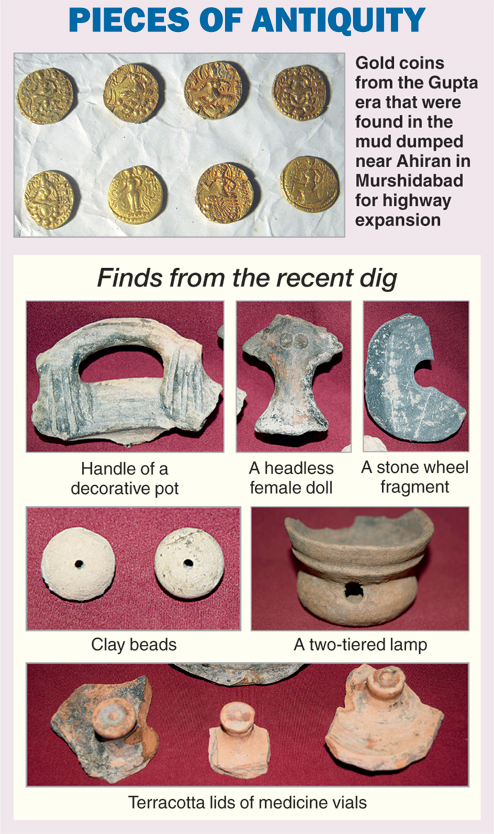
The gold coins (around 100 were found but police could only recover 11) weighed 8-9g each and were later identified as belonging to Gupta rulers - Samudragupta, Chandragupta and Chandragupta II or Kumaragupta.
The Gupta rule continued from the third to sixth centuries.
Archaeologists felt the find could lead to more discoveries about the lesser known kings towards the end of the Gupta rule. The then director of state archaeology, Gautam Sengupta, had said: "With the finding of this hoard of coins we may have to think afresh the extent or origin of the Gupta power."
So far Moni and his team have reasons to be optimistic. Soil samples from the Sialkali mound have matched with those from where the gold coins had been recovered.
"The pottery shards and other pieces of antiquity unearthed in Sialkali point to a Gupta-era settlement in the region. Sialkali is close to the other previously identified major Gupta period sites of Deka Bichkandi, Rakhsashidanga and Haatpara-Chandpara," Moni said.
Among the pottery shards found are fragments from cylindrical containers, miniature medicine jars with lids, large round-bottomed pots, small bowls and vases.
The colours of the pottery shards include grey, black, buff, deep red, brown and bright red (which was typical of the Gupta period).
Also found were pestles to grind medicinal herbs, a stone wheel about 10cm in diameter, terracotta beads, balls, fragments of toy animals and a two-tiered lamp with a hollow base. "When the base is filled with water, the heat from the wick would not make the lamp too hot to hold," Moni said.
He is also excited about a headless doll found in the mound. "Shaped out of clay with fingers, the doll belongs to the ageless variety. We have never found such a doll from this region before," Moni said.
"Though no structures have been found yet, a few decorated bricks have been unearthed. At some distance from the dig, farmers have reported once seeing a stone dais and a flight of stairs."