 |
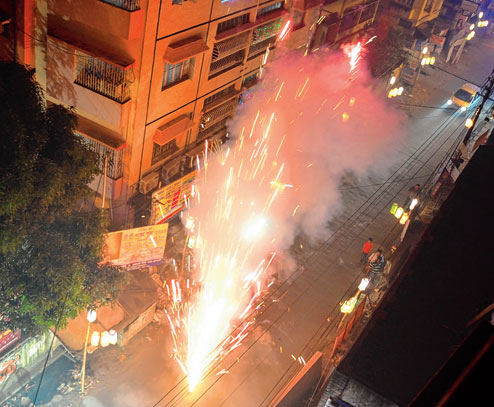
| A smoke-spewing sparkler in Baguiati on Diwali night. Picture by Amit Datta |
Calcutta’s Diwali revellers released so much smoke and toxic particles in the air that the pollution level recorded on that night was 15 times the national standard.
Experts said Monday night was probably the “most polluted” ever, though it’s hard to confirm the ignominious record in the absence of comparable long-term data.
But then, data from the state pollution control board’s (PCB) automatic station at Rabindra Bharati is scary enough to induce palpitation.
On November 4, the average PM10 level was 1335.8 microgram per cubic metre of air from midnight to 4am — the highest being 1,660mcg at 2am.
For the record, the national standard is 100mcg.
The average PM10 level was around 321mcg and 566mcg for the corresponding hours on November 2 and 3 respectively.
PM10 is particulate matter in the air smaller than 10 micrometre. Exposure to high concentration of PM10 even for a short duration can cause serious respiratory and heart problems and World Health Organization says the particulates are carcinogenic too.
The air pollution data reflects the volume of fireworks, including crackers, lit on Diwali night.
“The figures are alarming and I cannot remember similar air pollution data from previous years,” a PCB official said.
The impact of fireworks on Kali Puja night was obvious when data from the previous night was compared. “The November 2 figure (321mcg) can be taken as the standard for a winter night in Calcutta,” an expert said.
Siddhartha Datta, the pro vice-chancellor of Jadavpur University, told Metro the Diwali night air was extremely toxic. “Other than particulates in the exhaust fume of diesel vehicles, toxic heavy metals from fireworks get mixed with the smoke. It’s a lethal cocktail,” the professor of chemical engineering added.
Pulmonologist A.G. Ghosal of the National Allergy Asthma and Bronchitis Institute agreed.
“Respiratory problems increase during winter because of the spike in air pollution. But extraordinary rise in air pollution triggered by fireworks on Diwali must have affected thousands of people, especially the elderly and children. We are getting a lot of patients with respiratory problems,” the doctor said.
The common complaints were “eyes smarting, heavy breathing, chest pain and runny nose”.
“White smoke filled our house on the 10th floor. We passed several hours in extreme discomfort and it took a long time for the smoke to clear out so that we could breathe easy,” said Sovona Chatterjee, who lives in a highrise on Ballygunge Circular Road.
Chatterjee said banned crackers were burst on Diwali. “We made repeated calls to the pollution board helpline but to no avail. People continued to burst chocolate bombs and other loud crackers till 4am. The rule violations were witnessed mostly in the highrises,” she alleged.
According to Sanjit Datta of Cossipore, the smog blanket reduced visibility to such a level that major road accidents could have happened.
“I was driving home from a relative’s house and couldn’t see the road beyond a point despite keeping the headlights and fog lights on. It’s as if a huge smog cover had engulfed me. The night was perhaps the smoggiest in years,” he added.
Foul air
● 1,335.8 microgram of PM10 per cubic metre of air is the average from midnight to 4am on November 4
● 1,660mcg at 2am, the highest on Diwali 2013
● 100mcg, the national standard
● 566mcg on Kali Puja night
● 321mcg on November 2
SOUND SHOCK
● 63.4 decibel, the average noise level on Diwali
● 75 decibel at Golpark, the noisiest