A south Calcutta school's antidote to maths phobia could make those scarred for life by theorems and trigonometry wish someone had spared a thought for them too.
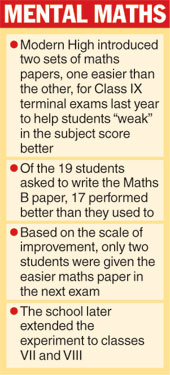
Modern High School for Girls last year introduced two sets of mathematics papers, one easier than the other, for its Class IX terminal exams as part of a strategy to help students "weak" in the subject score better and gain the confidence to catch up with their peers.
The results were encouraging. Of the 19 students asked to write the Maths B paper, 17 performed better than they used to. Based on the scale of improvement, only two students were given the easier maths paper in the next exam in February.
The school also extended the experiment to classes VII and VIII, from where 20 girls were chosen to write the Maths B paper. At least one of these students showed significant improvement, according to a school official.
"If students keep scoring low marks, it becomes depressing for them. Success encourages them to improve. Our first job is to make them unafraid of maths," Devi Kar, director of Modern High, told Metro. "We have seen improvement in Class IX. We intend to continue the system in classes VII, VIII and IX," she said.
Modern High's twin-paper experiment is based on what education researchers have long been saying: that the only way to remove the fear of a subject is by making it appear easy and fun.
In 2010, a mathematician from Chile had published a paper advocating special strategies to fight the psychological hurdles or social prejudices that keep students away from maths. "No one can learn with fear," said Monica del Pilar Canales-Chacon from the Institute of Mathematics at the Universidad Austral de Chile.
Education experts say that what needs to be addressed first is the mental block that is created by the inability of teachers to generate interest in a subject like maths.

"Being good in maths might be a prerequisite for those who are or want to be mathematicians but that is different from learning basic maths, which any average student can. Psychological blocks are created because students who perform badly develop an aversion to the subject. If they keep performing poorly, the aversion increases," said Anindya Sen, dean (academics) at IIM Calcutta.
On many occasions, parents add to the problem by taking the easy way out: hire a private tutor or send the child for coaching.
A study by scientists at Johns Hopkins University in the US in 2011 showed that mathematical ability in pre-school children is strongly linked to an inborn and primitive capacity for numerical estimation called Approximate Number System (ANS) or number sense.
Melissa Libertus, a post-doctoral researcher at Johns Hopkins and lead author of the study published in the journal Developmental Science, said the study was the first to examine the role of number sense in children too young to have already had formal instruction in maths.
Previous studies had apparently left open the possibility that some children were better at maths only because they had received high-quality lessons.
But Anindya Majumdar, who has been teaching maths at St. Xavier's Collegiate School for the past 30 years, said the importance of how the subject is taught should never be underestimated. "Teachers need to be able to create an ambience where the student can admit to not understanding something clearly. There is no middle path in maths. The approach is binary: either you understand or you don't."
A professor at IIT Kharagpur said the fear of maths must be addressed at the primary level rather than wait till a child reaches Class VII. "There will always be students weak in maths and they have to be given remedial classes in smaller groups where they are not embarrassed to ask a question, thinking that it might be considered silly."
Boards like the London-based IGCSE allow flexibility even in major exams. Students can either opt out or opt for one of the three levels of maths, depending on interest and aptitude. At Garden High International School, which follows the IGCSE curriculum in Class IX, 30 per cent of the students have opted for the lower tier of maths. "Being in the lower tier doesn't mean a child can't move up to the next level," said Anuradha Das, director of Garden High.
The ICSE curriculum has one maths question paper but students have the option of not taking the subject in Class IX. Most schools in Calcutta, however, discourage students from dropping maths.
Some schools in the city try to make maths interesting in ways other than setting easier questions. Apeejay School has three kinds of worksheets called the tortoise, rabbit and eagle that students have to tackle, based on their level of proficiency.
Ratuli Mukherjee, who teaches maths at La Martiniere for Girls, had done a study last year to find out the "attitude" of a group of Class IX students towards the subject. The students were taken to the Birla Industrial and Technological Museum (BITM) and assessed on the basis of a mathematical attitude test inventory containing a set of multiple-choice questions.
"We got a psychology teacher and the school counsellor on board to help us arrive at a conclusion. We found out that a student's attitude towards maths differs in different environments," Mukherjee said.
This year, students of classes VI to X at La Martiniere will be taken to the maths gallery at the BITM as part of a 20-mark project.
Junior school students at South City International School were taken to Spencer's to shop with a budget of Rs 100 for a similar project. "The students, assisted by their teachers, made purchases so that they could put to practice applications taught in class such as addition and subtraction," said John Bagul, principal of South City.
At Sri Sri Academy, students from classes I to V pick up maths basics in the laboratory rather than the classroom. "They are taught with shapes, cut-outs and puzzles. They learn fractions by dividing a pizza," principal Suvina Shunglu said.
Now that's what someone who missed out on the fun might describe as having your pizza and eating it too.
Do you think you could have done better in maths if you were in school now? Tell ttmetro@abpmail.com