 |
Debashish Nayak, a conservation architect who has moved to Ahmedabad for years now, was the first one to tell me about Nundlal Guin (1874-1963).
Guin was an artist qualified at the Government School of Art, now known as the Government College of Art & Craft, and he was responsible for designing and constructing not just the Birla Industrial and Technological Museum in Ballygunge but also innumerable buildings along Chittaranjan Avenue and other neighbourhoods of the city as well.
There is another reason for remembering Nundlal Guin at this time of the year when exactly a century ago, George V visited Calcutta after the Durbar in Delhi. Guin had landed the job of putting up the temporary amphitheatre for the royal reception on the Maidan.
The office of his firm, N. Guin & Company at 117B CR Avenue (earlier 12/A Chittaranjan Avenue) closed recently. His grandson, Mihir Baran, is a collector of his grandfather’s memorabilia and has a good collection of the impeccable line drawings of buildings Nundlal had planned and constructed, photographs of some of them, newspaper clippings, his bank passbook (he used to be paid in thousands in those days) and other odds and ends that together create a composite picture of the forgotten man.
Mihir Baran has a handout printed on the occasion of Nundlal’s shradh that carries the bare facts of his life. Nundlal was originally from Serampore and he came to Calcutta with his father, Nabakrishna Guin, whose eponymous sweet shop adjacent to the pre-eminent establishment of Bhim Chandra Nag, is still a Calcutta landmark.
After stints in leading architectural and engineering firms, Guin joined the E.B.S. Railway drawing department where he prepared the elevation of the proposed Central Railway station and also drew the plan and elevation of the Delhi Durbar station. In 1915, he became head of the department.
Following the king’s visit in 1912, Guin started private practice as an engineer and architect, and the building that housed his office was one of his first assignments. Besides being responsible for putting up many CR Avenue buildings that belong to the Marwari seths, Kolay Market, Mehta Building, Arya Kanya Maha Vidyalaya, the house of KC Das, Mohta Building on Strand Road, and Marina Garden Court at 191 Park Street, Guin had the honour of becoming a member of the Engineering Association of India.
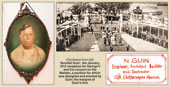
Mihir Baran’s cousin, Asit Baran, who lives at 13/2 Hidaram Banerjee Lane in Bowbazar, which used to be Nundlal’s home, has a photograph of his gifted ancestor in the bedroom. It is a rather small house unlike the large and airy buildings that Nundlal himself conceived and constructed. His is a tinted photograph in an oval metal frame, paired with a portrait of his bejewelled wife. He wore a dhoti at home but tailored suits were a must for office.
The certificate from the Government School of Art says he was a scholarship student trained in elementary freehand drawing, practical geometry, orthographic projection, isometric projection, projection of shadows, mechanical drawing, pen and ink drawing and model drawing. Nundlal’s drawings in Mihir Baran’s possession bear the stamp of his skill and expertise. His grandson says Nundlal used to give drawing lessons to the second son of the Bhawal zamindar who was involved in the sensational court case.
Nundlal was neither a visionary nor was he a modernist but within his limited scope he designed and built some elegant houses freely borrowing neo-classical elements, and adapting them suitably to local conditions. Common features were ornamented balconies, pilasters and pediments, and the regular alignment of the fenestration gave them a look of uniformity and order.
I have discovered of late that the apartment block (of 1933 vintage) in which I have lived in Bentinck Street for 40 years now was also designed by him and the original plan bears his bright red insignia. In 1961, my father had added two floors to the structure, but the original building with a courtyard on the first floor and the coloured glass screens alongside the double staircases remain. A photograph of the original three-storeyed building exists.
King George V arrived in Calcutta with his consort on December 30, 1911, and he was received at Prinsep’s Ghat. He bade adieu from the same landmark on January 8, 1912. According to a report in The Statesman, the pandal erected for the pageant on the Maidan between Chowringhee and Jail Road was a “handsome structure in Oriental design”. Edward Thornton, of Martin and Co, designed the pandal, Stephen Wilkinson was the superintending architect, and Motilal Radha Kissen the contractors.
Although there is no mention of Nundlal Guin here, in a certificate dated January 10, 1911, Stephen Wilkinson (his office was at Standard Buildings in Dalhousie Square) wrote: “I have very much pleasure in certifying as to the abilities of Mr Nudo Lall Guin who for the past three months has been working as assistant engineer on the construction and erection of the Royal Amphitheatre on the Calcutta Maidan…. Mr Guin is also a first class draughtsman and his abilities should be the means of ultimately securing him a first-class appointment.”
Mihir Baran says in his childhood he used to hear how his grandfather disappeared for a week and more when the work was on full swing.
Guin won similar plaudits from Basant Kumar Birla, who in his memoirs titled A Rare Legacy fondly remembers how Nundlal Guin had built Birla Park, which was completed in 1923, on 19 bighas purchased from Surendrananth Tagore in 1919. It is the Birla Industrial and Technological Museum today.